Structural Drying That Prevents Mold & Saves Your Property
Water damage extends far beyond what you can see. Our IICRC-certified technicians use industrial dehumidification, scientific moisture monitoring, and advanced drying techniques to extract moisture from deep within walls, subfloors, and structural components throughout St. Charles and St. Louis.
Why Professional Structural Drying Matters
Water damage is deceptive. The puddle you can see represents only a fraction of the moisture that has penetrated your home's structure. Water wicks through drywall, saturates insulation, penetrates subfloors, and absorbs into concrete and wood framing, often traveling several feet beyond visible damage.
Without professional structural drying, this hidden moisture creates the perfect environment for mold growth, wood rot, and structural deterioration. The science of psychrometrics governs how we remove this moisture: controlling temperature, humidity, and airflow to maximize evaporation while dehumidifiers continuously extract moisture from the air. This creates a controlled drying cycle that brings your structure back to safe moisture levels.
The Drying Timeline
Water Extraction & Setup
Remove standing water, set up dehumidifiers and air movers, take baseline moisture readings throughout structure.
Active Drying Phase
Moisture migrates from materials into the air. Daily monitoring confirms progress. Equipment repositioned as needed.
Verification & Completion
Moisture levels compared to dry standards. Final documentation for insurance. Equipment removal when targets reached.
Structure Returned to Normal
Materials at equilibrium moisture content. No mold risk. Ready for reconstruction or normal use.
Complex water damage or dense materials may extend drying time. We never rush the process.
Advanced Industrial Water Extraction & Drying
Professional structural drying requires commercial-grade equipment that operates on principles far beyond what consumer products can achieve. Our trucks carry thousands of dollars in specialized drying technology to handle any water damage situation.
LGR (Low Grain Refrigerant) Dehumidifiers
LGR dehumidifiers represent the current industry standard for structural drying. Unlike conventional refrigerant dehumidifiers that lose efficiency as humidity drops, LGR units use a pre-cooling coil that allows them to extract moisture even when relative humidity falls below 40%. This is critical during the final stages of drying when moisture is being pulled from deep within materials.
Our commercial LGR units remove 20 to 30 gallons of moisture per day, compared to 3 to 5 gallons for consumer dehumidifiers. They maintain this efficiency across the wide temperature ranges common in Missouri basements and crawl spaces. Multiple units work in concert to create drying zones throughout your home.
Desiccant Dehumidifiers
For the most challenging drying situations, desiccant dehumidifiers offer capabilities that refrigerant units cannot match. These machines pass air through a rotating wheel coated with silica gel, which chemically absorbs moisture regardless of temperature or existing humidity levels. The wheel then rotates through a regeneration zone where heated air drives off the captured moisture.
Desiccant units excel in cold environments like unheated crawl spaces and basements during Missouri winters, where refrigerant units struggle. They can achieve extremely low humidity levels (below 20% RH) needed for specialty drying applications like hardwood floor restoration. We deploy desiccant dehumidifiers for commercial projects, multi-story water damage, and situations requiring aggressive drying timelines.
High-Velocity Air Movers
Evaporation requires airflow across wet surfaces. Our commercial axial air movers produce concentrated streams of high-velocity air that dramatically accelerate moisture evaporation from carpets, walls, concrete, and other materials. Unlike box fans that simply circulate air, these units are designed specifically for water damage restoration.
Strategic placement is critical to effective drying. We position air movers based on psychrometric calculations and the specific layout of your water damage, creating airflow patterns that move moisture toward dehumidifiers. For wall cavity drying, we angle units to push air up wall surfaces, facilitating evaporation from inside wall assemblies. Typical residential water damage requires 8 to 15 air movers operating continuously.
Daily Moisture Monitoring & Documentation
Professional structural drying is a scientific process, and you cannot manage what you cannot measure. Our technicians take comprehensive moisture readings daily using professional pin-type and pinless moisture meters. These instruments measure moisture content as a percentage within wood, drywall, concrete, and other materials, not just surface wetness.
We establish baseline readings from unaffected areas of the same materials in your home, then track affected areas against these dry standards. All readings are documented in scientific drying logs that show the progression from wet to dry at each monitoring point. This documentation proves proper drying protocols were followed and is essential for insurance claim approval. Thermal imaging supplements meter readings by revealing hidden moisture that visual inspection cannot detect.
Drying Wet Subfloors and Wall Cavities
The most challenging aspect of structural drying is reaching moisture trapped inside wall assemblies, beneath flooring, and within ceiling systems. Traditional drying methods require demolition to access these areas. Our advanced techniques save thousands of dollars in reconstruction costs by drying materials in place.
Non-Invasive Hardwood Floor Drying
When water saturates hardwood floors, conventional thinking says tear them out. Our floor drying mat systems create negative pressure beneath the flooring, pulling moisture out through the wood grain without removal. This technique saves homeowners the cost of replacing expensive hardwood while achieving complete drying. Success rates exceed 80% when drying begins within 48 hours of water exposure.
Injectidry Wall Cavity Drying
Wall cavities trap moisture that cannot escape through painted drywall surfaces. Our Injectidry systems use small ports drilled at strategic locations to inject dry air directly into wall cavities, ceiling spaces, and other enclosed areas. This targeted approach dries insulation, framing, and the back side of drywall without removing entire wall sections. The small access holes are easily patched, saving thousands in demolition and reconstruction costs.
Thermal Imaging Technology
Moisture hidden behind walls and beneath flooring is invisible to the naked eye, but our FLIR thermal cameras see what you cannot. Water evaporating from wet surfaces creates temperature differentials that show clearly on infrared imaging. We use thermal cameras to map the full extent of water intrusion, identify hidden moisture pockets, and verify that all affected areas have been properly dried. This technology ensures no moisture is left behind to cause mold problems later.
Scientific Drying Documentation
Every structural drying project includes comprehensive documentation of our process. Daily moisture readings at multiple points throughout the affected area demonstrate the progression from wet to dry. Equipment logs show dehumidifiers and air movers deployed. Thermal images document hidden moisture discovery and verification. This scientific documentation satisfies insurance adjuster requirements and provides you with proof that professional drying standards were met.
Subfloor Drying Challenges
Subfloors present unique drying challenges because moisture becomes trapped between the flooring surface above and the floor joists or concrete below. In Missouri homes, we commonly encounter:
- OSB and plywood subfloors that swell when wet and may need replacement if drying is delayed
- Concrete slabs that hold moisture deep within their porous structure for weeks
- Multi-layer floor systems with moisture trapped between vinyl, underlayment, and subfloor
- Crawl space situations where moisture migrates upward through floor systems
Wall Cavity Moisture Dynamics
Water follows gravity, but it also wicks upward through porous materials. A flood reaching 6 inches on the floor may saturate drywall 3 feet above the waterline through capillary action. Inside the wall cavity:
- Fiberglass insulation absorbs water and loses R-value, often requiring removal
- Wood studs absorb moisture and can begin mold growth within 48 hours
- Electrical wiring and boxes can hold moisture and present safety hazards
- Vapor barriers can trap moisture inside the wall if not addressed properly
Understanding Psychrometrics: The Science of Structural Drying
Effective structural drying is not about running equipment; it is about controlling the relationship between temperature, humidity, and airflow. This science is called psychrometrics, and our IICRC-certified technicians apply these principles to every project.
Temperature Control
Warm air holds more moisture than cold air. By maintaining temperatures between 70 and 80 degrees Fahrenheit, we maximize the air's capacity to absorb moisture from wet materials. This is why winter water damage often takes longer to dry, the cold air cannot hold as much moisture. We use heating equipment when necessary to maintain optimal drying temperatures.
Optimal range: 70-80 degrees F
Humidity Management
Moisture migrates from areas of high concentration to low concentration. By using dehumidifiers to maintain low relative humidity (below 40%), we create a vapor pressure differential that pulls moisture out of wet materials and into the air. The dehumidifier then removes this moisture from the air, creating a continuous drying cycle.
Target: Below 40% relative humidity
Airflow Optimization
Still air creates a boundary layer of humid air at the surface of wet materials that slows evaporation. High-velocity airflow from our air movers disrupts this boundary layer, replacing humid air with dry air and dramatically accelerating evaporation. Strategic placement ensures airflow reaches all wet surfaces without creating dead zones.
Minimum: 1 CFM per square foot of affected area
Preventing Secondary Damage
Psychrometric control is not just about drying fast; it is about drying safely. Improper drying techniques can cause secondary damage that costs more than the original water damage:
Wood Checking and Cracking
Drying wood too fast causes surface cracks as outer layers dry faster than the core.
Hardwood Floor Crowning
Sanding cupped floors before they fully dry leads to crowning when they later flatten.
Moisture Migration
Without dehumidification, moisture spreads to unaffected areas causing additional damage.
Mold in Hidden Areas
Surface drying without addressing cavities leaves moisture where mold can establish.
Why Choose Professional Structural Drying
The difference between professional structural drying and DIY attempts often means the difference between complete restoration and ongoing problems. Here is why homeowners throughout Saint Charles and St. Louis trust Eversafe for their water damage drying needs.
IICRC Certified Technicians
Our technicians hold IICRC certifications in Water Damage Restoration (WRT) and Applied Structural Drying (ASD). This advanced training covers psychrometric science, equipment selection, drying calculations, and documentation standards required by insurance companies.
Commercial-Grade Equipment
Our trucks carry equipment worth tens of thousands of dollars: LGR and desiccant dehumidifiers, dozens of air movers, professional moisture meters, thermal cameras, and specialty systems like Injectidry and floor drying mats. This equipment performs at levels consumer products cannot match.
Insurance-Ready Documentation
We provide the scientific drying logs, moisture readings, thermal images, and equipment records that insurance adjusters require. Our documentation follows IICRC S500 standards, ensuring your claim is supported with professional evidence that demonstrates proper mitigation protocols.
24/7 Emergency Response
Water damage does not wait for business hours, and neither do we. Our Saint Charles-based crews respond around the clock to begin drying before moisture has time to spread or mold has time to establish. Quick response dramatically improves drying outcomes and reduces overall costs.
Prevent Secondary Damage
Improper drying leads to secondary damage: mold growth, wood rot, warping, and structural problems that cost far more than proper initial drying. Our controlled drying process prevents these complications, protecting your home and potentially saving thousands in future repairs.
Direct Insurance Billing
We work directly with your insurance company, handling documentation, adjuster communications, and billing. Our pricing follows Xactimate industry standards used by all major insurers. Most homeowners pay only their deductible, and we coordinate everything so you can focus on getting back to normal.
Professional Structural Drying Throughout St. Louis Metro
Our Saint Charles headquarters positions us for rapid response throughout the greater St. Louis metropolitan area. Whether you are in Saint Charles County, St. Louis County, or surrounding communities, we provide professional structural drying services with the same expertise and equipment.
The St. Louis metro area presents unique challenges for structural drying. Missouri's humid continental climate means high humidity levels during summer months, which slows natural drying and provides ideal conditions for mold growth. Our clay-heavy soils retain water around foundations, contributing to basement moisture problems and slow concrete drying. Older homes in historic neighborhoods of St. Louis and St. Charles often have balloon-frame construction that allows moisture to travel vertically through wall cavities.
Our technicians understand these regional factors and adjust drying strategies accordingly. We monitor ambient outdoor conditions and compensate for Missouri's variable weather. During humid summer months, we deploy additional dehumidification capacity. In winter, we add heat to maintain optimal drying temperatures. This local expertise, combined with our IICRC certification and commercial equipment, ensures proper drying regardless of when your water damage occurs.
Recent Structural Drying Projects
See our structural drying work throughout Saint Charles County and the St. Louis metro area. From residential water damage to commercial projects, we restore properties to dry, safe conditions using industry-leading equipment and techniques.
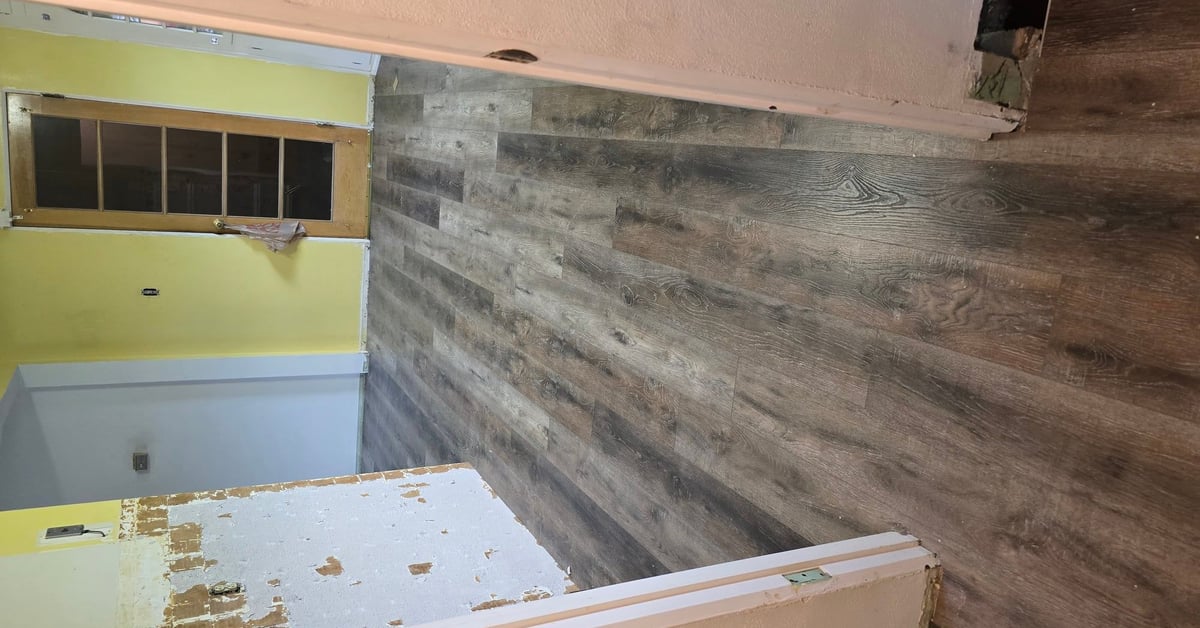
Basement Flooring Restoration Work in Progress
Overhead view into a basement area during renovation, featuring partially installed dark wood-grain laminate or vinyl plank flooring covering most of the floor space. Yellow painted drywall walls on both sides, an open wooden door with glass panels, a white bathtub or shower enclosure in the corner, exposed subfloor in patches, minor debris, and construction edges visible. Suggests water damage restoration with flooring replacement underway.
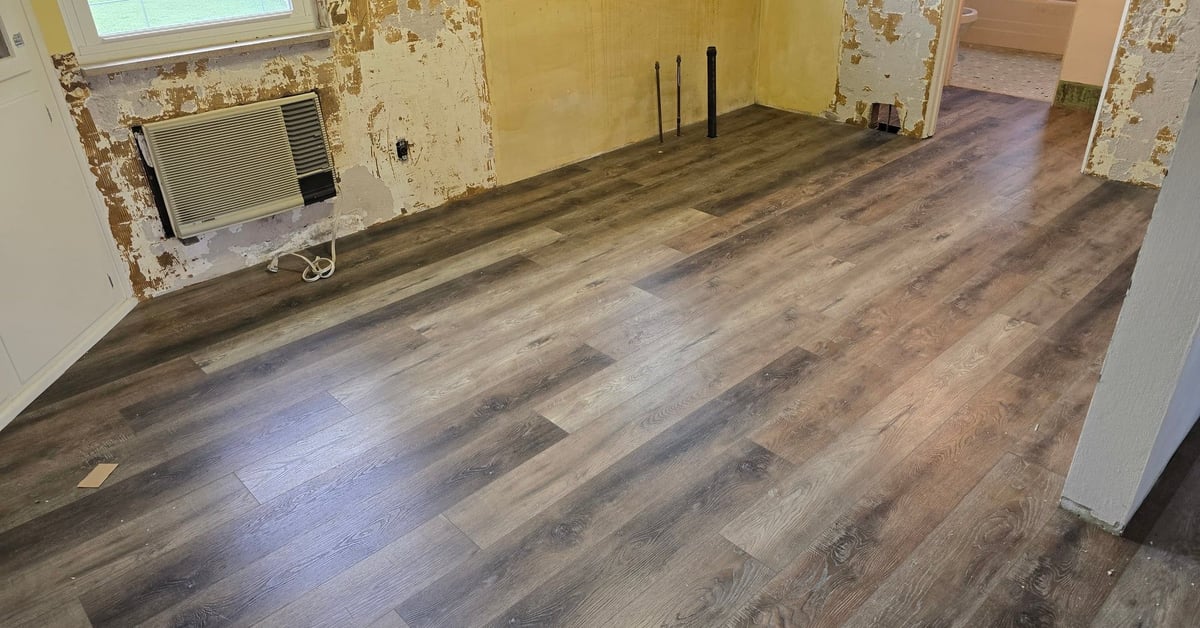
Water Damaged Bathroom Walls with New Flooring
A room undergoing restoration shows severely damaged walls with peeling yellowed plaster and exposed wooden studs, particularly around a window-mounted air conditioning unit. Freshly installed dark laminate flooring with a wood-grain pattern covers the entire floor. An open doorway reveals an adjacent bathroom featuring a white bathtub and tiled walls. Two metal poles stand in one corner, and minor debris is present, indicating active renovation work likely due to prior water damage.
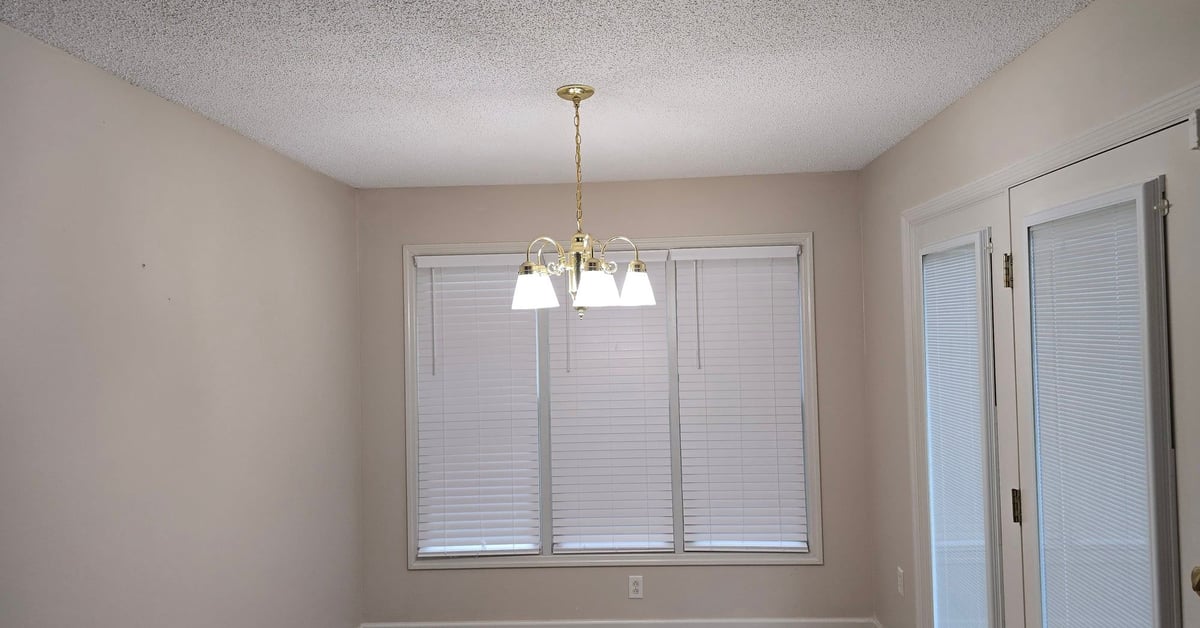
Empty Dining Room with Chandelier and Blinds
A spacious, empty dining room featuring light beige walls, a textured popcorn ceiling, a centered gold-toned four-arm chandelier with glass shades hanging from a chain, three large windows on the left covered with white horizontal blinds, a glass-paneled door on the right with blinds, and brown ceramic tile flooring. The room is clean, well-lit from natural light, and appears freshly restored with no visible damage or furnishings.
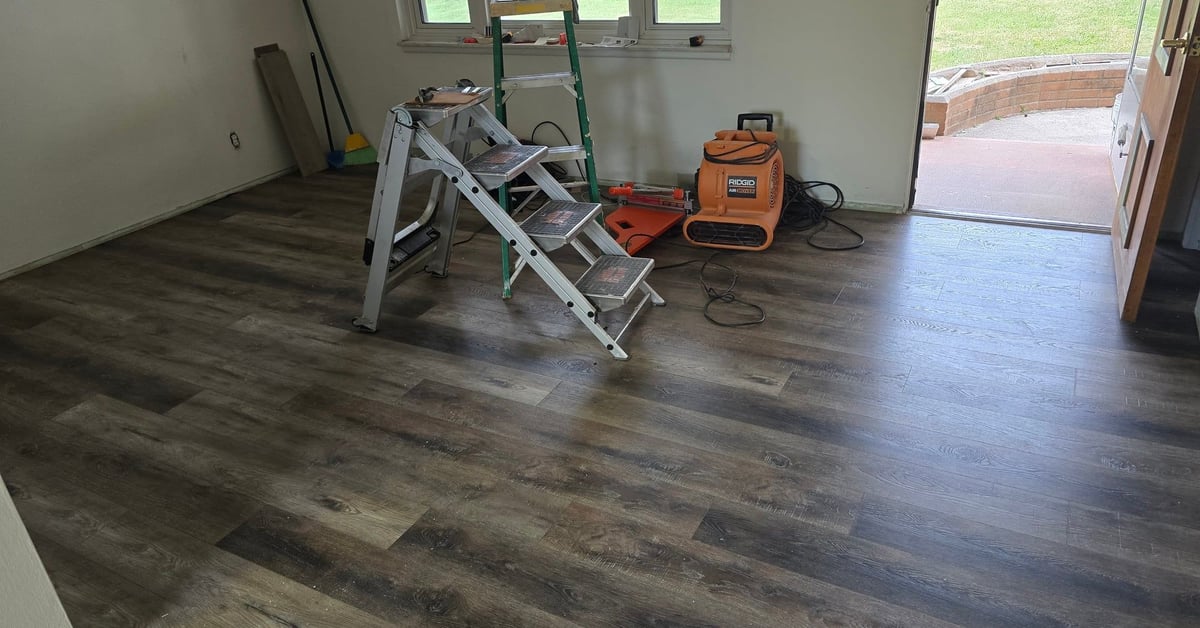
Room Restoration with New LVP Flooring and Equipment
Spacious empty room during restoration work, featuring freshly installed gray luxury vinyl plank (LVP) flooring throughout. An orange commercial air mover/dehumidifier is plugged in and operating in one corner, with orange extension cords nearby. Two aluminum ladders—one extended and one folded—are leaning against the wall, along with a broom, cardboard sheet, and minor wall patch. White walls, large window with view of grass outside, open door showing red truck parked on gravel driveway. Clean, well-lit space with visible electrical outlets and switch plate.
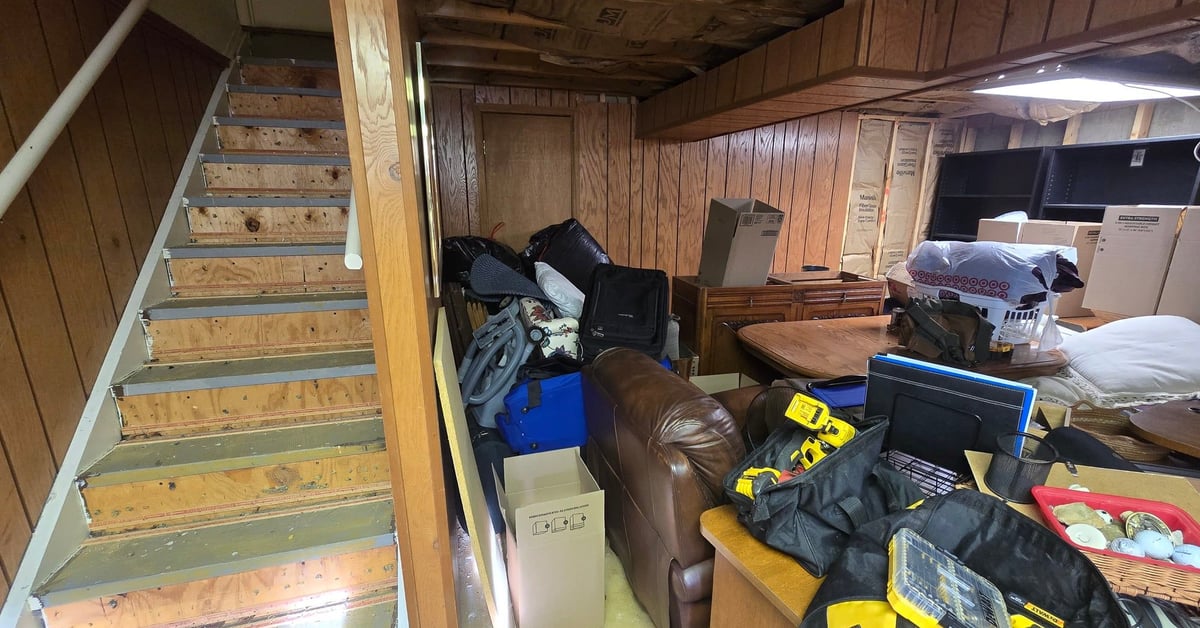
Cluttered Basement Before Restoration Work
A cluttered unfinished basement with wooden paneled walls, exposed wooden beams and pink insulation on the ceiling. A wooden staircase with railing descends from the left side. The floor space is filled with household items including a brown leather armchair, wooden desk cluttered with tools like a yellow drill and cases, multiple cardboard boxes, blue plastic bins, black garbage bags, pillows, baskets, and scattered debris. Fluorescent lighting illuminates the area, suggesting preparation for cleanup or restoration.
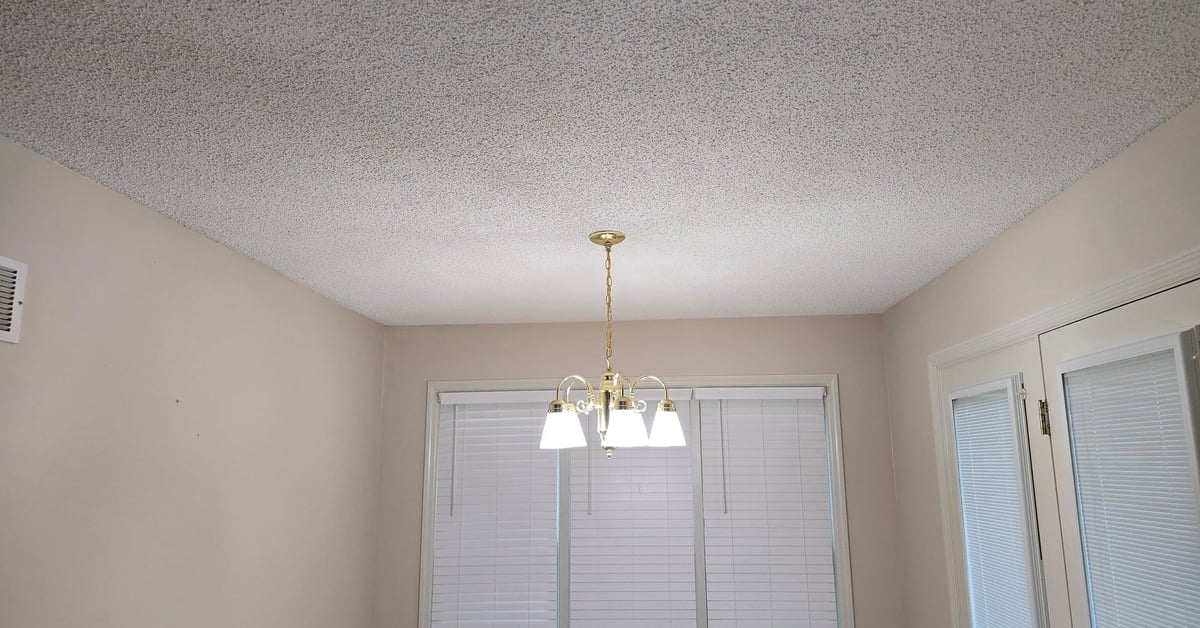
Clean dining room with chandelier and beige walls
A spacious, empty dining room featuring a textured popcorn ceiling, elegant gold chandelier with four bulb fixtures, light beige walls, large triple window covered with white horizontal blinds, and glass-paneled French doors. The room is well-lit, spotless, and appears freshly restored with no signs of damage or ongoing work.
What Our Structural Drying Clients Say
When water damage threatens your home, you need a team that delivers results. Here is what homeowners throughout Saint Charles and St. Louis say about their experience with Eversafe Restoration's structural drying services.
"Chad fixed my mold. He explained to me exactly how the mold happened and why it would not happen again. He was very kind to me. I explained I was suffering from a medical level of anxiety and he was very understanding. Every day, Chad made sure to communicate clearly and keep me informed throughout the entire process."
Bob Gaines
3 months ago
"Eversafe Restoration was incredible to work with. We had unexpected water damage and Chad responded quickly and professionally. He explained everything clearly and made sure we understood the repair process. The crew was efficient and thorough. Highly recommend!"
Andrea Herron
6 months ago
"They took care in giving me the best service. Very detailed oriented in repairing and finishing moisture damage in my home. They did such an excellent job, I won't think twice about calling Eversafe for anymore restoration needs I have in the future!"
Ryan McGovern
6 months ago
"11/10 would recommend! Great job, great price, and it took them no time at all."
Corey Holmes
3 months ago
"Did a great job."
Matt Guthrie
6 months ago
"Excellent service from start to finish. Professional and reliable."
Destiny Boschert
6 months ago
Structural Drying FAQs
Get answers to common questions about structural drying, professional dehumidification, drying timelines, and moisture monitoring services in Saint Charles County and the St. Louis metro area.
How long does structural drying take?
The standard structural drying cycle takes 3 to 5 days under optimal conditions, though some situations require longer. Several factors influence drying time: the porosity of affected materials (concrete and hardwood take longer than drywall), the total volume of water absorbed, ambient temperature and humidity levels, and the equipment deployed. Porous materials like carpet padding, drywall, and insulation dry relatively quickly, typically within 2 to 3 days. Denser materials like hardwood flooring, concrete slabs, and structural lumber can take 5 to 7 days or longer. Environmental controls play a critical role: we maintain optimal temperature (70 to 80 degrees Fahrenheit) and low humidity to maximize evaporation rates. Our IICRC-certified technicians monitor moisture content daily using professional meters, adjusting equipment placement and settings to accelerate drying while preventing secondary damage. We never rush the process because incomplete drying leads to mold growth and structural problems that cost far more to address later.
What equipment is used in structural drying?
Professional structural drying requires specialized commercial-grade equipment that far exceeds consumer-available tools. LGR (Low Grain Refrigerant) dehumidifiers are the workhorses of structural drying, capable of removing 20 to 30 gallons of moisture per day even in low-humidity conditions where conventional dehumidifiers struggle. For severe saturation or large commercial spaces, we deploy desiccant dehumidifiers that use silica gel to achieve extremely low humidity levels regardless of temperature. High-velocity axial air movers create targeted airflow across wet surfaces to accelerate evaporation, and we position them strategically based on psychrometric calculations. HEPA air scrubbers filter airborne mold spores and particulates during the drying process to protect indoor air quality. Infrared thermal imaging cameras allow us to see temperature differentials that reveal hidden moisture behind walls and under flooring. Professional moisture meters, including both pin-type and pinless scanners, measure moisture content in various materials to document progress and verify completion. We also use hygrometers to monitor ambient humidity levels throughout your home.
Why can't I just use house fans to dry my basement?
Household fans and box fans are fundamentally inadequate for structural drying and can actually make moisture problems worse. Standard fans lack the CFM (cubic feet per minute) output needed to create meaningful evaporation from saturated materials. More importantly, fans only move air; they do not remove moisture from that air. Without dehumidification, moisture evaporating from wet surfaces simply redistributes throughout your home, elevating humidity levels and creating conditions for mold growth in previously unaffected areas. This can spread contamination rather than solving it. Additionally, household fans cannot reach moisture trapped inside wall cavities, beneath subfloors, or within concrete slabs. Water wicks upward through porous materials, often saturating areas several feet above the visible waterline. Professional structural drying uses the psychrometric principle: warm, dry, moving air absorbs moisture from wet materials, then dehumidifiers remove that moisture from the air, creating a continuous drying cycle. Without all three elements (heat, airflow, and dehumidification), proper drying cannot occur.
How do you know when a structure is actually dry?
Determining when a structure is truly dry requires objective measurement, not visual inspection or guesswork. We use professional moisture meters that measure moisture content as a percentage within different materials. Wood framing should dry to 16% moisture content or lower, which is the industry threshold for safe, stable conditions. Drywall typically dries to 1% or less. Concrete can retain elevated moisture even when it appears dry, so we use specialized concrete moisture meters that measure to specific depths. The key to accurate assessment is comparison to dry standards: we measure unaffected materials in the same structure to establish baseline moisture levels, then compare affected areas to these baselines. Your home's normal equilibrium moisture content varies based on construction materials and local climate. We also use thermo-hygrometers to verify that ambient humidity has returned to normal levels (typically 30% to 50% relative humidity). Our technicians document all moisture readings daily in scientific drying logs, creating a clear record showing the progression from wet to dry. This documentation is essential for insurance claims and provides verification that proper drying protocols were followed.
Can structural drying save my hardwood floors?
In many cases, yes, professional structural drying can save hardwood floors that would otherwise require replacement. Success depends primarily on response time and water category. When we begin drying within 24 to 48 hours of water exposure, hardwood floors can often be successfully dried and refinished rather than replaced, saving homeowners thousands of dollars. We use specialized floor drying systems that create negative pressure beneath hardwood flooring, pulling moisture out through the natural grain of the wood. This technique is particularly effective for solid hardwood floors over plywood subfloors. The key challenge is addressing cupping, the concave warping that occurs when the bottom of boards absorbs more moisture than the top. With proper controlled drying, cupped floors often flatten as moisture equalizes. Crowning, the opposite condition where boards become convex, typically indicates the floor was sanded before fully dry. We monitor moisture content at multiple depths and locations throughout the drying process to ensure even moisture distribution before recommending refinishing. For engineered hardwood and laminate flooring, success rates are lower because these products are more susceptible to delamination when saturated.
Is professional dehumidification necessary for small leaks?
Yes, professional dehumidification is often necessary even for seemingly minor water intrusions, and the consequences of skipping it can be severe. Water damage follows a predictable escalation pattern: what starts as a small leak quickly becomes a larger problem when moisture migrates through porous building materials. Drywall can wick water several feet above the visible waterline. A slow toilet leak can saturate subfloors, floor joists, and the ceiling below without any visible signs until mold appears weeks later. This delayed damage, called secondary damage, is often excluded from insurance coverage because it results from failure to mitigate the initial water event. Professional dehumidification addresses the entire moisture load, not just visible water. It prevents mold growth, which can begin within 24 to 48 hours in the right conditions. It protects the structural integrity of drywall, which loses its strength when it remains damp. It prevents warping and swelling in wood trim, doors, and cabinetry. Even a small leak that saturates a few square feet of carpet has likely also wetted the padding beneath, the subfloor, and potentially the ceiling below. Professional assessment identifies all affected areas so they can be properly dried.
Does structural drying prevent mold?
Proper structural drying is the most effective way to prevent mold growth after water damage. Mold requires moisture to grow, and the critical window is 24 to 48 hours. If wet materials are dried to safe moisture levels within this timeframe, mold growth can typically be prevented entirely. Our structural drying process is designed around psychrometric science: the study of air-water vapor mixtures. By controlling temperature, humidity, and airflow, we create conditions that maximize evaporation while preventing condensation that could spread moisture to unaffected areas. The target moisture content for wood materials is 16% or lower, a level at which mold cannot establish. For drywall, we target 1% or less. Concrete, being porous and alkaline, generally resists mold growth but can support mold on organic materials like dust if it remains damp. Throughout the drying process, we maintain positive pressure in unaffected areas to prevent mold spores from spreading. We also apply antimicrobial treatments to affected surfaces as a secondary protection measure. If water damage sat for more than 48 hours before professional drying began, mold testing after restoration is recommended to verify no hidden growth occurred.
What are the costs for industrial water extraction and structural drying?
Structural drying costs in the St. Louis metro area typically range from $1,000 to $5,000 for residential projects, depending on the scope of damage. Several factors determine the final cost: the square footage of affected area, the number and type of rooms involved, the materials affected (concrete, hardwood, and multi-layer assemblies take longer to dry), and the category of water (clean, gray, or black water). Insurance companies use Xactimate software for standardized pricing, which calculates costs based on equipment deployed, monitoring visits, and drying days. A typical residential water damage requiring 10 air movers and 2 LGR dehumidifiers for 4 days might cost $2,500 to $3,500 for drying alone. Equipment charges are calculated per unit per day. Monitoring fees cover daily technician visits to check moisture levels and adjust equipment placement. Additional services like water extraction, demolition of unsalvageable materials, and antimicrobial treatment are priced separately. Most homeowners insurance policies cover water damage mitigation including structural drying, meaning you pay only your deductible. We work directly with insurance adjusters and provide detailed documentation to support your claim.
Still have questions?
We're here to help you find the answers.
Related Services
Basement Flood Repair
Complete water extraction and restoration for flooded basements and crawl spaces.
Mold Inspection & Testing
Professional mold testing and inspection to assess air quality and hidden contamination.
Sewage Cleanup
Safe removal and disinfection of contaminated water from sewage backups and overflows.
Water Damage? Start Drying Now.
Every hour wet materials remain in your home increases the risk of mold, structural damage, and secondary problems. Our IICRC-certified technicians respond 24/7 with commercial drying equipment. Call now for a moisture inspection or emergency drying service.