French Drain Installation & Basement Drainage in St. Louis
Stop basement flooding permanently with professional French drain systems designed for Missouri's challenging clay soils. Interior and exterior solutions with lifetime warranty. Serving Saint Charles, O'Fallon, St. Peters, and the St. Louis metro.
Professional French Drain Installation for St. Louis Metro Homes
If you have noticed water seeping into your basement during heavy rains, persistent dampness along your foundation walls, or white mineral deposits that indicate ongoing moisture intrusion, you are not alone. Thousands of homeowners throughout Saint Charles County and the greater St. Louis area battle basement water problems every year, and the root cause is almost always the same: hydrostatic pressure from groundwater pushing against your foundation.
At Eversafe Restoration, we specialize in French drain installation, the proven, permanent solution for basement water problems. A French drain system intercepts groundwater before it can enter your basement by creating a pathway of least resistance around your foundation perimeter. Water is collected in perforated pipes embedded in gravel and channeled to a sump pump that removes it from your home. The result is a dry basement, protected belongings, and peace of mind during even the heaviest Missouri thunderstorms.
Our technicians understand the unique challenges that St. Louis area homes face. Missouri's expansive clay soils hold water like a sponge after rainfall, creating tremendous pressure against foundation walls and floors. We design every French drain system specifically for these conditions, using commercial-grade materials, proper pipe sizing, and strategic drain placement to handle even the most severe groundwater situations. Every installation comes backed by our comprehensive warranty.
Understanding French Drain Systems
A French drain is a simple but highly effective drainage solution that has been protecting basements for over 150 years. Understanding how these systems work helps you make informed decisions about your basement waterproofing.
The Science Behind French Drains
French drains work on a straightforward principle: water follows the path of least resistance. When groundwater saturates the soil around your foundation, it creates hydrostatic pressure that forces water through any available opening, including foundation cracks, the floor-wall joint, porous concrete, and pipe penetrations.
A French drain provides an easier path for this water by creating a continuous channel of highly permeable gravel surrounding a perforated pipe. Instead of pushing through your foundation, water naturally flows into the gravel bed and enters the pipe through its perforations. The pipe then carries the water to a sump pit where a pump removes it from your basement.
The key to effectiveness is intercepting water before it reaches your foundation. Interior French drains are installed at the base of your foundation walls, right at the point where hydrostatic pressure is highest. Exterior French drains are installed at the footer level, catching water even deeper in the soil column.
Key System Components
Perforated Drain Pipe
Schedule 40 PVC with strategically placed holes that allow water entry while preventing soil intrusion. Minimum 4-inch diameter for residential applications.
Washed Gravel Bed
Clean, angular stone provides maximum drainage capacity and prevents soil from clogging the pipe. Acts as a water reservoir during heavy rainfall.
Filter Fabric
Non-woven geotextile fabric wraps the gravel bed to prevent fine soil particles from migrating into the drainage system over time.
Sump Pump System
Submersible pump installed in a dedicated pit removes collected water and discharges it safely away from your foundation.
Clean-Out Ports
Access points installed at strategic locations allow for system inspection and maintenance without disturbing your basement floor.
Interior vs. Exterior French Drains
Both interior and exterior French drains effectively manage groundwater, but each has distinct advantages depending on your specific situation and property conditions.
Interior French Drains
Interior French drains are installed inside your basement, typically along the perimeter where the floor meets the foundation walls. This is the most common solution for Saint Charles County homeowners because it effectively addresses hydrostatic pressure without the expense and disruption of exterior excavation.
Installation Process:
- 1 Concrete is cut and removed along the foundation perimeter, creating a channel approximately 12 inches wide and 12 to 18 inches deep.
- 2 A bed of washed gravel is laid in the channel, and perforated pipe is positioned at the base of the foundation footer.
- 3 Additional gravel covers the pipe, and clean-out ports are installed at corners and along long runs.
- 4 The drain connects to a sump pit with a properly sized submersible pump and battery backup system.
- 5 New concrete is poured to restore the floor, creating a nearly invisible finished result.
Best For:
- Water entering at the floor-wall joint
- Rising water tables and hydrostatic pressure
- Homes with established landscaping
- Year-round installation needs
- Budget-conscious projects
Typical Cost: $50 - $100 per linear foot | Timeline: 2-4 days
Exterior French Drains
Exterior French drains are installed outside your foundation, typically at the footer level, where they intercept groundwater before it ever reaches your basement walls. This comprehensive approach is ideal when water is penetrating through foundation walls or when exterior waterproofing membrane application is needed.
Installation Process:
- 1 A trench is excavated along the foundation perimeter, extending down to the footer level, typically 6 to 8 feet deep.
- 2 Foundation walls are cleaned and inspected. Waterproofing membrane is applied if needed.
- 3 Perforated pipe is laid on a gravel bed at the footer, wrapped in filter fabric to prevent clogging.
- 4 Drain connects to either a gravity discharge point (if grade allows) or an interior sump pump system.
- 5 Trench is backfilled with soil, compacted properly, and landscaping is restored.
Best For:
- Water penetrating through foundation walls
- Homes with failed or missing exterior waterproofing
- Properties with poor grading toward the foundation
- New construction or major renovation projects
- Properties allowing gravity discharge
Typical Cost: $75 - $150 per linear foot | Timeline: 4-7 days
Custom Interior & Exterior French Drain Systems
Every basement has unique water challenges. We design custom French drain systems tailored to your home's specific conditions and your waterproofing goals.
Sub-Floor Pressure Relief Systems
Our sub-floor pressure relief systems are specifically designed to manage the hydrostatic pressure that builds beneath your basement floor. In St. Louis area homes built on Missouri's clay soils, water pressure can literally push water up through the concrete slab, causing seepage across the entire floor surface.
We install pressure relief channels beneath your floor that connect to the perimeter drain system, providing multiple pathways for water to reach the sump pump. This comprehensive approach prevents water from finding alternative entry points after perimeter installation.
Exterior Drainage Redirection
Surface water from rain, snowmelt, and irrigation can saturate the soil around your foundation, contributing to basement water problems. Our exterior drainage solutions redirect this water away from your home before it can add to groundwater pressure.
We assess your property's grading, downspout placement, and natural drainage patterns to design systems that work with your landscape rather than against it. Solutions may include French drain extensions, catch basins, channel drains, and downspout discharge lines.
High-Capacity Sump Pump Integration
A French drain system is only as effective as the pump that removes the water. We install commercial-grade submersible pumps sized specifically for your drainage needs, including battery backup systems to protect you during power outages when storms are most severe.
Our pump systems feature cast iron construction for durability, check valves to prevent backflow, airtight basin lids to control radon and humidity, and discharge lines that extend at least 10 feet from your foundation. We also offer smart monitoring systems that alert you to pump activity and potential issues.
Clean-Out Ports for Long-Term Maintenance
Unlike some contractors who install French drains with no way to access the system for maintenance, we include clean-out ports at strategic locations throughout your drain system. These access points allow for inspection, flushing, and maintenance without disturbing your basement floor.
Clean-outs are installed at corners where sediment tends to accumulate, at connection points, and along long straight runs. The flush-mounted caps blend discretely with your basement floor while providing easy access when needed.
The Science of Hydrostatic Pressure Relief
Understanding how water pressure affects your foundation helps you appreciate why French drains are the most effective long-term solution for basement water problems.
How French Drains Lower the Water Table
When rainfall saturates the soil around your foundation, the water table rises, creating hydrostatic pressure that pushes against your basement walls and floor. The pressure increases with depth, which is why basement floors and lower wall sections are most vulnerable. A French drain creates a low-pressure zone around your foundation by providing an easy escape route for groundwater. As water flows into the drain system, it effectively lowers the local water table, reducing the pressure differential that forces water into your basement.
Protecting Finished Basements
Finished basements represent a significant investment, often $30,000 to $100,000 or more. A French drain system protects this investment by preventing the water damage that can destroy drywall, flooring, trim, and personal belongings in a single flooding event. For finished basements, we take extra care to minimize disruption during installation. We can often work in sections, allowing you to maintain use of portions of your basement throughout the project. Our goal is a permanently dry basement with minimal visible evidence of the waterproofing system.
Choosing Between Interior and Exterior
The choice between interior and exterior French drains depends on several factors specific to your property. Interior drains are typically the best choice when water enters at the floor-wall joint, when you have established landscaping, or when budget is a primary concern. Exterior drains are recommended when water penetrates through wall surfaces, when your property has severe grading issues, or when waterproofing membrane application is needed. During your free inspection, our technicians assess your specific situation and recommend the most effective, cost-efficient solution.
Missouri's clay soils present unique challenges for basement waterproofing. Unlike sandy soils that drain quickly, clay holds water like a sponge. After heavy rainfall, the clay around your foundation becomes saturated and can remain that way for days or even weeks. This prolonged saturation means prolonged hydrostatic pressure against your basement.
The expansive nature of St. Louis area clay soils compounds the problem. When saturated, these soils swell significantly, pressing against your foundation walls with tremendous force. When they dry, they shrink and pull away, potentially creating gaps that allow water infiltration during the next rain. This constant cycle of expansion and contraction is why so many Saint Charles County homes develop water problems over time, even if they were dry for years after construction.
A properly designed French drain system accounts for these Missouri-specific conditions. We size our systems to handle the high volume of water that clay soil can deliver to your foundation, and we use materials that perform reliably in our challenging soil chemistry.
Our French Drain Installation Process
From initial inspection to final cleanup, here is what to expect when you choose Eversafe Restoration for your French drain installation.
Free Basement Inspection & Assessment
Our technician visits your home to thoroughly evaluate your basement water situation. We identify all water entry points, assess foundation condition, measure moisture levels with professional meters, and examine your property's exterior drainage characteristics. We also discuss your concerns, usage plans for the space, and budget considerations. This comprehensive assessment takes approximately 45 to 60 minutes.
Custom System Design & Transparent Quote
Based on our assessment, we design a custom drainage solution tailored to your specific needs. You receive a detailed written proposal that includes system specifications, material descriptions, project timeline, and itemized pricing with no hidden fees. We explain exactly why we are recommending each component so you can make an informed decision.
Preparation & Concrete Removal
On installation day, we protect your home with floor coverings and plastic barriers. Using professional concrete cutting equipment with dust suppression, we cut and remove the concrete along your basement perimeter. The concrete is broken into manageable sections and hauled away. We then excavate the channel to the proper depth, reaching the base of your foundation footer.
Drain System Installation
We lay a bed of washed gravel in the channel and position the perforated drain pipe at the optimal angle for water flow. Clean-out ports are installed at corners and intervals. The sump pit is excavated and the submersible pump is installed with check valve and discharge line. Battery backup systems are connected if included in your project. Additional gravel covers the pipe system.
Concrete Restoration & Finishing
Fresh concrete is poured to restore your basement floor. We match the new concrete level with your existing floor and trowel to a smooth finish. The concrete is allowed to cure properly. While the new concrete will be visible initially, it blends with your existing floor over time as it ages.
System Testing & Warranty Documentation
We test the entire system to verify proper water flow and pump operation. You receive a complete walkthrough of your new drainage system, including pump operation, clean-out locations, and maintenance recommendations. We provide your warranty documentation, which is transferable to future homeowners if you sell your property.
Ready to stop basement water problems permanently?
Schedule Your Free InspectionWhy St. Louis Homes Need French Drain Protection
The combination of Missouri's clay soils, seasonal rainfall patterns, and temperature extremes creates perfect conditions for basement water problems.
Expansive Clay Soils
St. Louis metro clay soils hold water and swell significantly, creating intense hydrostatic pressure against foundation walls.
Heavy Seasonal Rain
Missouri averages 40+ inches of annual rainfall, with intense spring storms that can drop several inches in hours.
Temperature Extremes
Freeze-thaw cycles expand foundation cracks and stress waterproofing systems designed for milder climates.
High Water Tables
Many Saint Charles County neighborhoods have naturally high water tables that rise significantly after rainfall.
At Eversafe Restoration, we have installed French drain systems in homes throughout Saint Charles, O'Fallon, St. Peters, Wentzville, Chesterfield, Lake St. Louis, Cottleville, Dardenne Prairie, Wildwood, and communities across the St. Louis metropolitan area. Our technicians understand the specific soil conditions, water table levels, and drainage challenges in each neighborhood because we have worked in them for years.
We use this local knowledge to design systems that work in Missouri conditions. Our material selections, pipe sizing, and installation techniques are all optimized for the unique challenges that St. Louis area homes face. When you choose Eversafe, you are getting solutions proven effective in your neighborhood, not generic approaches designed for different soil types and climates.
Our French Drain Installation Projects
See examples of our professional French drain installations throughout Saint Charles County. From basic perimeter systems to comprehensive waterproofing solutions, we deliver quality craftsmanship on every project.
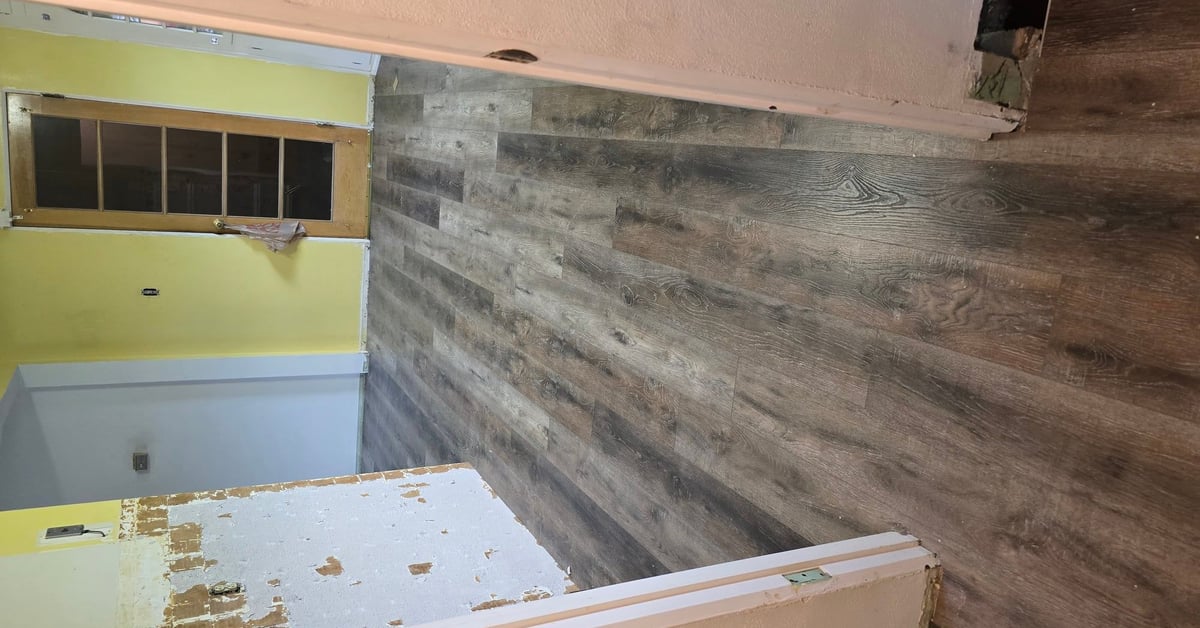
Basement Flooring Restoration Work in Progress
Overhead view into a basement area during renovation, featuring partially installed dark wood-grain laminate or vinyl plank flooring covering most of the floor space. Yellow painted drywall walls on both sides, an open wooden door with glass panels, a white bathtub or shower enclosure in the corner, exposed subfloor in patches, minor debris, and construction edges visible. Suggests water damage restoration with flooring replacement underway.
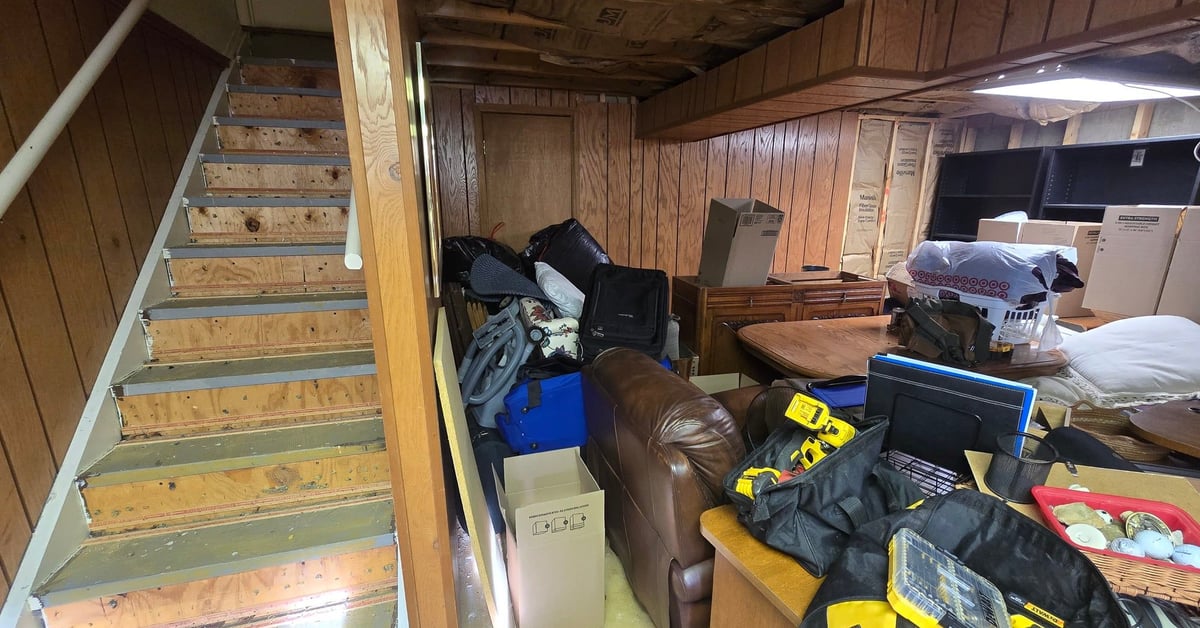
Cluttered Basement Before Restoration Work
A cluttered unfinished basement with wooden paneled walls, exposed wooden beams and pink insulation on the ceiling. A wooden staircase with railing descends from the left side. The floor space is filled with household items including a brown leather armchair, wooden desk cluttered with tools like a yellow drill and cases, multiple cardboard boxes, blue plastic bins, black garbage bags, pillows, baskets, and scattered debris. Fluorescent lighting illuminates the area, suggesting preparation for cleanup or restoration.
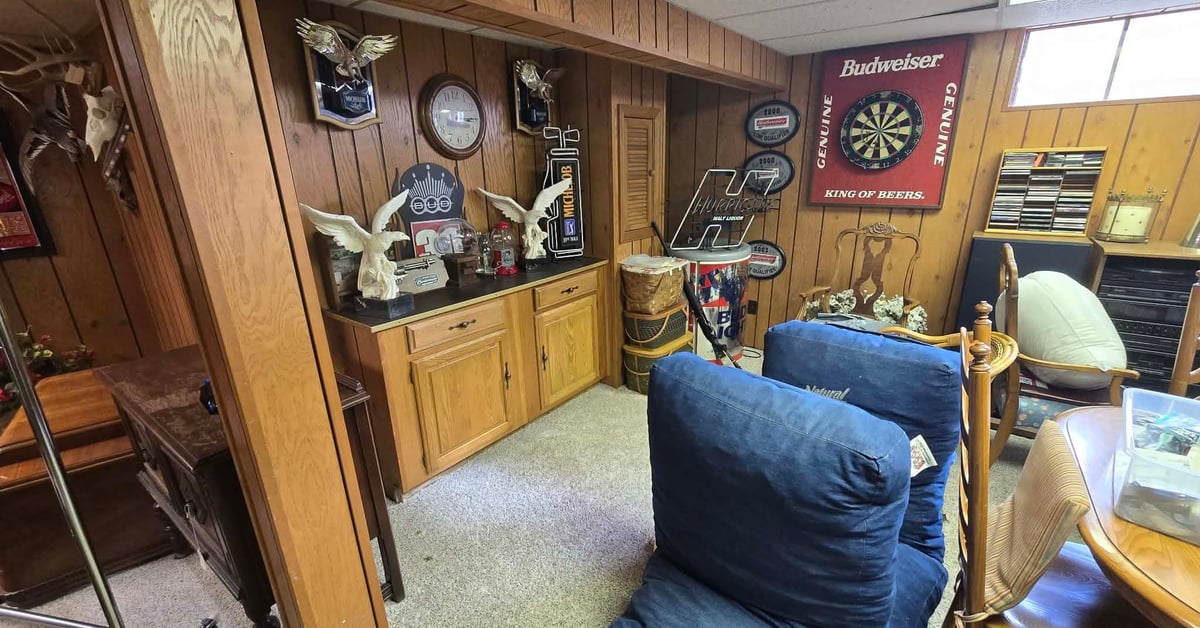
Cozy Wood-Paneled Basement Man Cave Bar
A finished basement recreation room with warm wood paneling on walls and ceiling. Features include mounted deer heads and antlers, Budweiser beer signs, dartboard, shelves displaying figurines, bottles, and collectibles, a bar area with stools, blue bean bag chairs, wooden table and chairs, and various rustic decor elements creating a classic man cave atmosphere.
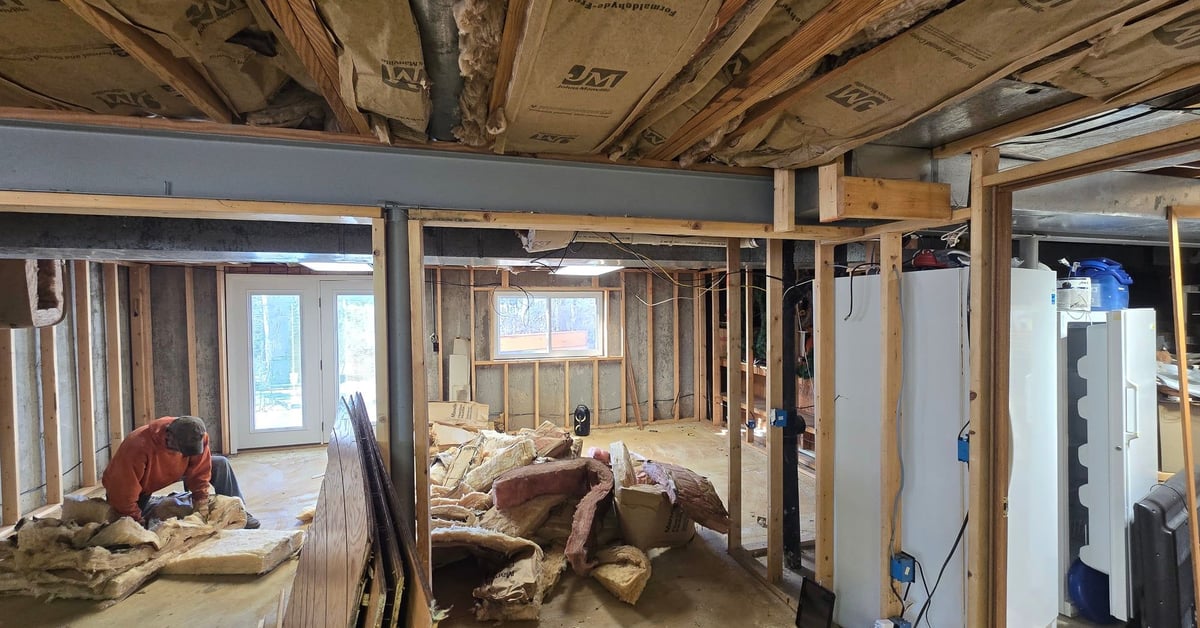
Worker Remodeling Basement with Framing and Insulation
In this basement renovation scene, a worker dressed in an orange uniform and protective gear kneels on the plywood subfloor, working on construction materials. The ceiling features exposed wooden joists wrapped in pink fiberglass insulation batts, some labeled. Walls are framed with wooden studs and metal beams, with partial drywall installation on some sections. Construction debris including wood scraps, insulation remnants, and tools litters the floor. Framed windows and doors allow natural daylight, and white cabinets or shelving units stand along one wall near blue storage bins.
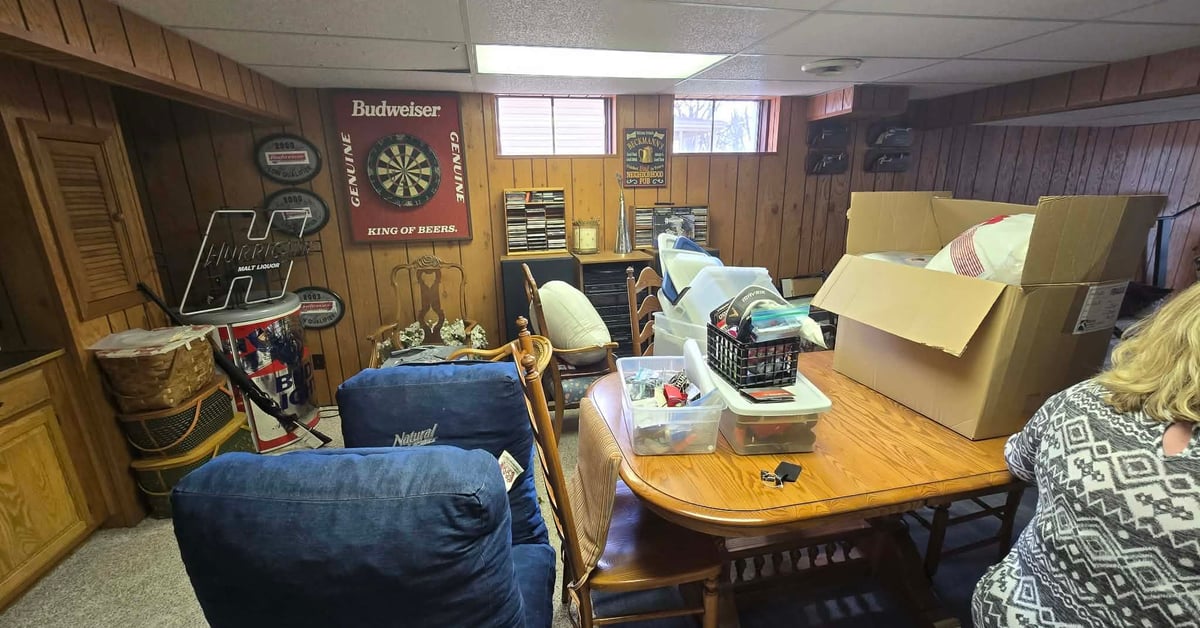
Cluttered Wood-Paneled Basement Rec Room
A basement recreation room with dark wood paneling on walls and ceiling, illuminated by fluorescent lights. Features include a dartboard with Budweiser branding, neon signs, shelves with beer memorabilia, wooden bar stools, blue upholstered armchairs, and an oval wooden table piled high with cardboard boxes, plastic storage bins, and miscellaneous items. A decorative barrel drum sits in one corner, and a woman with long blonde hair in a patterned top stands near the table. The space appears lived-in and cluttered, suggesting preparation for cleanup or restoration.
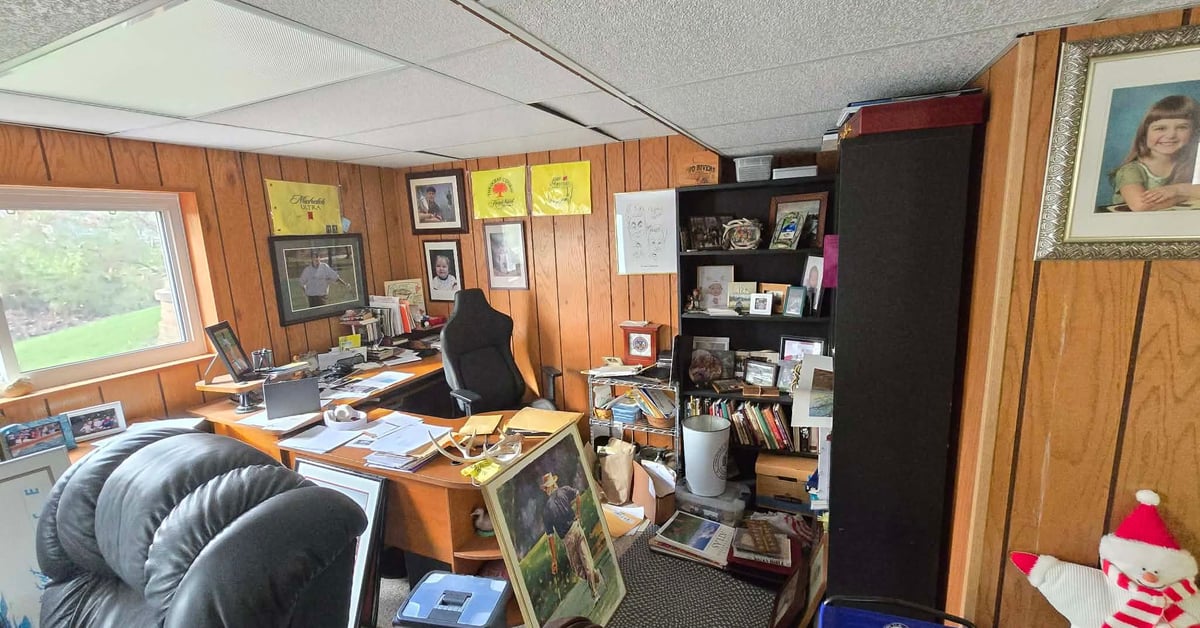
Cluttered Wood-Paneled Basement Home Office
A cluttered basement home office featuring wood-paneled walls, drop ceiling with fluorescent lighting, a large wooden desk with dual computer monitors, keyboard, papers, and office supplies, an ergonomic black gaming chair, additional leather chairs, overloaded bookshelves with books, photo frames, knick-knacks, and storage bins, framed pictures and posters on walls, a window with view of green grass outside, a Santa Claus plush doll, plants in frames, and various personal decorations scattered around the carpeted floor.
What Saint Charles Homeowners Say
Read reviews from homeowners throughout Saint Charles, O'Fallon, St. Peters, and the St. Louis metro who have trusted us with their basement drainage systems.
"Chad fixed my mold. He explained to me exactly how the mold happened and why it would not happen again. He was very kind to me. I explained I was suffering from a medical level of anxiety and he was very understanding. Every day, Chad made sure to communicate clearly and keep me informed throughout the entire process."
Bob Gaines
3 months ago
"Eversafe Restoration was incredible to work with. We had unexpected water damage and Chad responded quickly and professionally. He explained everything clearly and made sure we understood the repair process. The crew was efficient and thorough. Highly recommend!"
Andrea Herron
6 months ago
"They took care in giving me the best service. Very detailed oriented in repairing and finishing moisture damage in my home. They did such an excellent job, I won't think twice about calling Eversafe for anymore restoration needs I have in the future!"
Ryan McGovern
6 months ago
"11/10 would recommend! Great job, great price, and it took them no time at all."
Corey Holmes
3 months ago
"Did a great job."
Matt Guthrie
6 months ago
"Excellent service from start to finish. Professional and reliable."
Destiny Boschert
6 months ago
French Drain Installation FAQ
Get answers to common questions about French drain installation, basement drainage systems, and waterproofing costs in the Saint Charles and St. Louis area.
How much does a French drain installation cost?
French drain installation costs in the Saint Charles and St. Louis area typically range from $50 to $100 per linear foot for interior systems and $75 to $150 per linear foot for exterior systems. For a standard basement perimeter, interior French drain installation usually costs between $4,000 and $12,000, depending on basement size, accessibility, and whether a sump pump system is included. Exterior French drains require excavation and landscaping restoration, which increases costs. The final price depends on factors like soil conditions (Missouri clay is more labor-intensive), the depth of your foundation footer, and whether the project includes waterproofing membrane installation. At Eversafe Restoration, we provide free detailed estimates with transparent per-foot pricing so you know exactly what to expect before work begins.
Do French drains really work for basements?
Yes, French drains are the gold standard solution for basement water problems caused by hydrostatic pressure, which is the primary cause of basement flooding in the St. Louis metro area. When groundwater rises during heavy rains or spring snowmelt, it creates tremendous pressure against your foundation walls and floor, forcing water through any available path including cracks, joints, and porous concrete. A properly installed French drain intercepts this water before it can enter your basement by creating a pathway of least resistance. The perforated pipe embedded in gravel collects water from the surrounding soil and channels it to a sump pump or gravity discharge. In Missouri's clay soils, which hold water exceptionally well, French drains are particularly effective because they address the root cause of water intrusion rather than just treating symptoms.
What is the difference between interior and exterior French drains?
Interior and exterior French drains serve the same purpose of managing groundwater but are installed in different locations with different advantages. Interior French drains, also called perimeter drains or drain tile systems, are installed inside your basement along the perimeter where the floor meets the walls. They involve cutting a channel in the concrete floor, laying perforated pipe in gravel, and connecting to a sump pump. Interior systems are faster to install, less expensive, do not disturb landscaping, and effectively handle rising water tables. Exterior French drains are installed outside your foundation, typically at the footer level, and redirect water away from your home entirely. They require significant excavation, are more expensive, and involve landscaping restoration. Exterior drains are ideal when you have severe water infiltration through foundation walls, when yard grading directs water toward your home, or when waterproofing membranes need to be applied to the foundation exterior. Many homeowners benefit from a combination approach based on their specific water entry points and property conditions.
How long does it take to install a French drain?
Most interior French drain installations in Saint Charles County homes are completed in 2 to 4 days, depending on the basement size and project complexity. A standard 1,000 square foot basement with a full perimeter drain typically takes 2 to 3 days. The timeline includes concrete cutting and removal on day one, drain system installation on day two, and concrete finishing plus cleanup on day three. Finished basements require additional time for removing and reinstalling flooring, drywall, and trim along the affected walls. Exterior French drain installations take longer, typically 4 to 7 days, due to excavation requirements and the need for proper soil compaction and landscaping restoration. Weather can impact exterior projects, so we often recommend interior installations for Missouri homeowners who need work done during rainy seasons. We always provide a detailed timeline during your free estimate so you can plan accordingly.
Will a French drain increase my home value?
A professionally installed French drain system can significantly increase your home's value and marketability, particularly in the Saint Charles and St. Louis real estate market where basement water issues are common concerns for buyers. Homes with documented basement waterproofing solutions sell faster and often command higher prices than homes with known or suspected water problems. During inspections, water staining, efflorescence, or musty odors raise immediate red flags for buyers and can derail sales or lead to significant price negotiations. A French drain system with transferable warranty documentation provides peace of mind that the basement will remain dry. Beyond sale value, you are also protecting your home from costly damage. A single basement flood can result in $10,000 to $50,000 in damage from ruined flooring, drywall, furniture, and mold remediation. The investment in a French drain system typically pays for itself by preventing just one major water damage event.
Do I need a sump pump with a French drain?
Almost all interior French drain systems in the St. Louis metro area require a sump pump because the collected water needs to be actively removed from your basement. Unlike exterior drains that can sometimes use gravity to direct water away from the foundation, interior drains collect water at or below floor level where gravity discharge is rarely possible. The French drain channels water to a sump pit, where a submersible pump activates when water reaches a certain level and pumps it out through a discharge line to your yard or storm drain. We recommend installing a battery backup sump pump alongside your primary pump to provide protection during power outages, which often coincide with severe storms when you need the system most. For homes with high water tables or heavy groundwater infiltration, we may recommend a dual primary pump system with alternating operation to extend equipment life. Our installations include properly sized pumps, quality check valves, and discharge lines that extend at least 10 feet from your foundation.
How do I maintain my French drain system?
French drain systems are designed to be low-maintenance, but a few simple annual tasks ensure optimal long-term performance. First, check your sump pump operation by pouring water into the pit to verify the pump activates, runs smoothly, and the check valve prevents backflow. Test your battery backup system if you have one. Second, inspect any clean-out ports we installed along your drain system by removing the cap and checking that the pipe is clear of debris or sediment buildup. Third, trace your discharge line outside and ensure the outlet is clear of leaves, dirt, ice, or other obstructions. Fourth, listen for unusual pump cycling patterns during rain events that might indicate a clogged drain line or failing pump. We recommend scheduling a professional inspection every 3 to 5 years to assess pipe condition and system performance. Our installations include strategically placed clean-out ports specifically to make future maintenance and inspection accessible without disturbing your basement floor.
Can a French drain handle heavy St. Louis rainstorms?
Yes, a properly designed French drain system is engineered to handle the heavy rainstorms common in the St. Louis metro area, including the intense storms that can drop 2 to 3 inches of rain in a few hours. The system's capacity depends on correct sizing of three key components: the perforated pipe diameter, the gravel bed volume, and the sump pump capacity. We use 4-inch perforated schedule 40 PVC pipe as a minimum, with larger diameter pipe in high-inflow areas. The gravel bed acts as a reservoir, providing storage capacity during peak rainfall and allowing gradual drainage to the sump pump. For pump sizing, we calculate based on your basement's square footage, local water table levels, and historical rainfall intensity. Most residential installations use 1/3 to 1/2 horsepower primary pumps capable of moving 2,000 to 3,500 gallons per hour. Unlike simple gutter extensions that can be overwhelmed by heavy rain, a French drain system manages groundwater pressure regardless of how quickly rain falls because it addresses subsurface water rather than surface runoff.
Still have questions?
We're here to help you find the answers.
Stop Basement Flooding Permanently
A professionally installed French drain system protects your home, your belongings, and your family from the stress and damage of basement water problems. Schedule your free inspection today.