Professional Mold Remediation in St. Louis
St. Louis humidity and older homes create ideal conditions for mold growth. Our IICRC-certified technicians provide comprehensive mold inspection, testing, and remediation services. From black mold abatement to attic and basement mold removal, we restore healthy indoor air quality throughout the St. Louis metro area.
Why St. Louis Homes Are Prone to Mold Problems
Understanding local conditions helps you protect your home and family from mold's health risks.
St. Louis presents a perfect storm of conditions for mold growth. Our humid subtropical climate brings summer relative humidity that regularly exceeds 70%, creating moisture-rich air that penetrates homes and condenses on cooler surfaces. The region averages over 40 inches of annual rainfall, with severe thunderstorms that can dump inches of rain in hours, overwhelming drainage systems and causing basement flooding. These environmental factors mean St. Louis homeowners face elevated mold risks compared to drier regions.
The age and construction of St. Louis housing stock compounds these challenges. The metro area contains tens of thousands of homes built before 1950, many featuring construction methods that inadvertently promote moisture problems. Balloon-frame construction in historic neighborhoods like Soulard, Lafayette Square, and Tower Grove allows moisture migration between floors. Limestone and brick foundations common in older homes are porous and allow groundwater seepage. Original plaster walls hold moisture differently than modern drywall. Even homes built in the mid-century often lack adequate vapor barriers and insulation by current standards.
Basements are particularly problematic in St. Louis. The region's clay-heavy soils expand when wet and contract when dry, creating hydrostatic pressure against foundation walls and floor slabs. Combined with aging drainage systems and sump pumps, basement moisture intrusion is extremely common. Many St. Louis homeowners accept a damp, musty basement as normal, but that moisture supports continuous mold growth that affects indoor air quality throughout the house. Hidden mold in basements, attics, crawlspaces, and within wall cavities can release millions of spores into your living environment without any visible signs.
High Humidity Climate
St. Louis summers regularly exceed 70% relative humidity, ideal for mold growth
Historic Home Construction
Older building methods and porous foundations promote moisture intrusion
Basement Moisture Issues
Clay soils and aging drainage systems make basement mold extremely common
Comprehensive Mold Removal & Abatement in St. Louis
Professional mold remediation that addresses both visible growth and hidden contamination, with protocols designed for St. Louis's unique climate and housing conditions.
HEPA-Filtered Containment to Prevent Cross-Contamination
Before any mold removal begins, we establish professional containment using heavy plastic sheeting, negative air pressure machines, and HEPA filtration. This critical step prevents mold spores from spreading to unaffected areas of your St. Louis home during remediation. Negative air pressure ensures that air flows into the contained area rather than out, while HEPA filters capture 99.97% of particles as small as 0.3 microns, including mold spores. For historic St. Louis homes where complete room isolation is challenging due to architectural features, we adapt our containment strategies to maintain protection while respecting your home's character. Our technicians wear full personal protective equipment including respirators, suits, and gloves throughout the remediation process.
Safe Removal of Mold-Infested Materials
Porous materials that mold has colonized typically cannot be adequately cleaned and must be safely removed. This includes mold-infested drywall, wet insulation, water-damaged carpet and padding, and severely affected wood materials. Our removal process minimizes spore release through careful technique: materials are misted with antimicrobial solution before cutting, placed directly into sealed bags, and removed from your home through designated exit routes that avoid clean areas. For St. Louis homes with plaster walls, we assess whether removal is necessary or if the plaster can be treated in place. We document all removed materials with photographs for insurance purposes and ensure proper disposal at certified facilities.
Antimicrobial Fogging and Surface Treatment
After removing affected materials, we treat all remaining surfaces with EPA-registered antimicrobial agents specifically designed for mold remediation. Unlike household bleach, which only addresses surface mold and can actually increase moisture, professional antimicrobials penetrate into materials to kill embedded mold roots (hyphae) at their source. Antimicrobial fogging distributes fine mist throughout the contained area, reaching into cracks, crevices, and irregular surfaces that manual application might miss. This is particularly important in St. Louis homes with ornate architectural details, exposed brick, or textured surfaces common in historic properties. The treatment creates a protective barrier that inhibits future mold growth, providing lasting protection against our region's persistent humidity.
Post-Remediation Verification Testing
We do not consider a mold remediation project complete until independent testing confirms success. Post-remediation verification (PRV) testing involves collecting air samples from the remediated area and comparing spore counts to outdoor baseline levels and unaffected indoor areas. Samples are analyzed by accredited third-party laboratories, providing objective verification that remediation was successful. This testing protects you by ensuring the job was done correctly and provides documentation valuable for insurance claims, real estate transactions, and peace of mind. If PRV testing reveals elevated spore counts, we continue remediation at no additional cost until the area passes. This commitment to verified results distinguishes professional remediation from DIY approaches that have no way to confirm success.
Concerned About Mold?
Schedule a professional inspection to assess your St. Louis home.
Serving Downtown, Central West End, Tower Grove, Clayton, and all St. Louis Metro
Certified Mold Inspection and Testing Services
Accurate assessment is the foundation of effective mold remediation. Our comprehensive testing protocols identify the extent, type, and source of mold problems in your St. Louis home.
Visual Inspection with Advanced Moisture Detection
Our inspection begins with a thorough visual examination of your home, focusing on areas where mold commonly develops: basements, bathrooms, kitchens, attics, crawlspaces, and around windows. We look for visible mold growth, water staining, efflorescence on masonry, peeling paint, and other indicators of moisture problems. But visible signs tell only part of the story.
Professional moisture meters allow us to measure moisture content in walls, floors, and ceilings without destructive testing. Elevated readings indicate hidden moisture that may support hidden mold growth. Infrared thermal imaging cameras reveal temperature variations that indicate moisture presence behind walls, under floors, and in ceiling cavities. These non-invasive technologies are particularly valuable in St. Louis's historic homes where minimizing damage to original materials is important. By mapping moisture throughout your home, we identify not just where mold exists but also areas at risk of future problems.
Air and Surface Sampling with Laboratory Analysis
When testing is warranted, we collect samples using methods validated by industry standards and accepted by insurance companies. Air sampling uses calibrated pumps that draw measured volumes of air through collection cassettes, capturing airborne spores. We typically collect samples from the area of concern, an unaffected interior area for comparison, and outdoors to establish baseline spore counts. Surface sampling using tape lifts, swabs, or bulk material samples identifies the specific mold species present.
All samples are analyzed by accredited third-party laboratories using microscopic examination and, when appropriate, culture analysis. Laboratory reports identify mold genera and species, quantify spore concentrations, and provide context for interpreting results. Species identification matters because some molds like Stachybotrys (black mold) and certain Aspergillus species produce mycotoxins with significant health implications, while others are relatively benign. Understanding exactly what you are dealing with allows us to develop appropriate remediation protocols and helps you make informed decisions about your family's health.
Detailed Reports with Remediation Protocols
Following inspection and testing, we provide a comprehensive written report documenting our findings. This report includes photographs of affected areas, moisture readings and thermal images, laboratory results with interpretation, identification of moisture sources, and a detailed remediation protocol if mold treatment is needed. For insurance claims, this documentation provides the evidence adjusters require to evaluate coverage.
Our remediation protocols follow IICRC S520 standards, the industry reference for mold remediation. We specify containment requirements, removal procedures, treatment methods, and verification testing appropriate to the specific conditions in your home. If your situation does not require professional remediation, minor surface mold in a bathroom for example, we will tell you honestly and provide guidance for addressing it yourself. Our goal is solving your mold problem appropriately, not selling unnecessary services.
Specialized Attic and Crawlspace Mold Treatment
Attics and crawlspaces present unique mold challenges that require specialized approaches. Attic mold in St. Louis homes often results from inadequate ventilation, bathroom exhaust fans venting into the attic rather than outside, or ice dam-related moisture intrusion during winter. The confined space, difficult access, and presence of insulation complicate remediation. Our attic mold treatment involves careful removal of affected insulation, HEPA vacuuming of all surfaces including rafters and sheathing, antimicrobial treatment, and addressing ventilation deficiencies to prevent recurrence.
Crawlspace mold is particularly common in St. Louis due to ground moisture, poor ventilation, and the region's high water table in many areas. Moldy crawlspaces can significantly impact indoor air quality in the living space above, as air naturally rises from crawlspaces into the home. Our crawlspace remediation addresses existing mold growth, but we also work with waterproofing specialists when needed to install vapor barriers, improve drainage, and dehumidify the space to prevent future problems. Solving crawlspace mold without addressing the underlying moisture is a temporary fix at best.
Where Mold Hides in St. Louis Homes
Mold thrives wherever moisture persists, often in locations homeowners rarely see or access. Understanding where mold commonly develops helps you identify problems early and take preventive action. In St. Louis homes, certain locations present elevated risks due to our climate and typical housing construction.
Basements are the most common site of mold problems in St. Louis. The region's clay soils create hydrostatic pressure that forces moisture through foundation walls and floor slabs. Older homes with limestone or brick foundations are particularly susceptible. Even homes with modern poured concrete foundations experience seepage if drainage is inadequate. Finished basements often hide mold behind drywall, under carpet, and within built-in cabinetry where moisture accumulates invisibly until significant growth develops.
Attics harbor mold when ventilation is insufficient or when moisture from the living space below enters the attic. In St. Louis, bathroom exhaust fans improperly vented into attics rather than outside are a frequent cause. The warm, moist air condenses on cold roof sheathing during winter, creating ideal conditions for mold on the underside of the roof deck. Ice dams during St. Louis winters can also drive water under shingles and into attic spaces.
Most Common Mold Locations:
- Basements: walls, floors, finished spaces
- Attics: roof sheathing, insulation, rafters
- Bathrooms: behind tiles, under vanities, ceilings
- Crawlspaces: joists, subfloor, insulation
- HVAC systems: ducts, drip pans, coils
Warning Signs of Hidden Mold:
- Musty, earthy odors without visible source
- Respiratory symptoms that improve away from home
- Water staining on walls or ceilings
- Peeling paint or wallpaper
- Condensation on windows or pipes
Understanding Mold Health Risks
Mold exposure affects different people in different ways. Understanding the risks helps you make informed decisions about protecting your family.
Mold produces allergens, irritants, and in some species, toxic substances called mycotoxins. When mold colonies grow indoors, they release millions of microscopic spores into the air. These spores are easily inhaled and can cause a range of health effects depending on the mold species, the concentration of spores, the duration of exposure, and individual sensitivity. Some people experience significant symptoms from relatively low exposures, while others seem less affected.
Allergic reactions are the most common health effect of mold exposure. Symptoms include sneezing, runny or stuffy nose, itchy or watery eyes, skin rashes, and worsening of asthma symptoms. These reactions can occur immediately upon exposure or may be delayed. Many people dismiss these symptoms as seasonal allergies without realizing that indoor mold is the actual trigger. When symptoms improve significantly when away from home and worsen upon returning, indoor mold should be suspected.
More serious health effects can occur with exposure to toxic molds or in sensitive individuals. Stachybotrys chartarum (commonly called black mold) and certain Aspergillus species produce mycotoxins that can cause respiratory distress, persistent headaches, difficulty concentrating, memory problems, and fatigue. Immunocompromised individuals, infants, elderly family members, and those with chronic respiratory conditions face elevated risks. While the connection between mycotoxin exposure and serious illness remains an active area of research, the potential for harm warrants taking mold problems seriously.
Higher Risk Groups
- ! Infants and young children
- ! Elderly family members
- ! People with asthma or allergies
- ! Immunocompromised individuals
- ! Those with chronic lung disease
Protect Your Family
- Address water leaks promptly
- Control indoor humidity below 60%
- Ensure proper ventilation
- Test if you suspect hidden mold
- Professional remediation for significant mold
Complete Restoration Services in St. Louis
Mold problems often connect to water damage and moisture intrusion. We provide comprehensive solutions under one roof.
Water Damage Restoration St. Louis
Water damage and mold go hand in hand. Our 24/7 emergency water damage restoration prevents mold growth by rapidly drying affected areas before colonies can establish.
Learn More About Water Damage RestorationBasement Waterproofing St. Louis
Stop basement mold at its source with professional waterproofing. Interior drainage systems, sump pumps, and vapor barriers eliminate the moisture that mold needs to thrive.
Learn More About Basement WaterproofingMold Remediation Results in St. Louis
See the transformations we have achieved for St. Louis homeowners dealing with mold problems. From basement mold to attic infestations, our team restores healthy indoor environments.
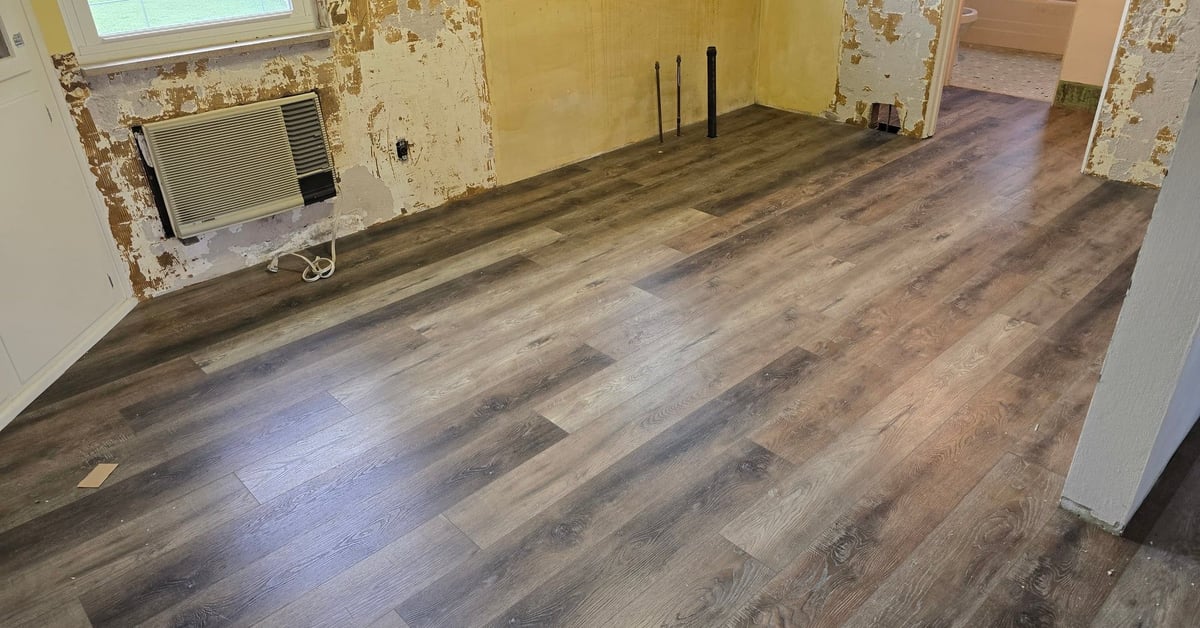
Water Damaged Bathroom Walls with New Flooring
A room undergoing restoration shows severely damaged walls with peeling yellowed plaster and exposed wooden studs, particularly around a window-mounted air conditioning unit. Freshly installed dark laminate flooring with a wood-grain pattern covers the entire floor. An open doorway reveals an adjacent bathroom featuring a white bathtub and tiled walls. Two metal poles stand in one corner, and minor debris is present, indicating active renovation work likely due to prior water damage.
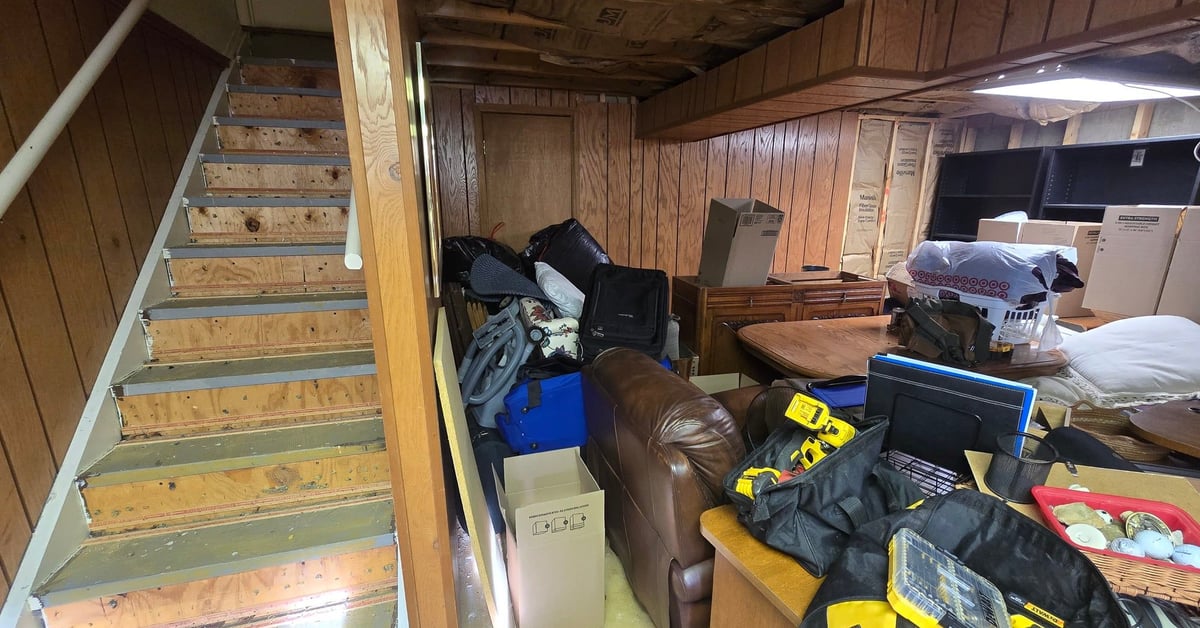
Cluttered Basement Before Restoration Work
A cluttered unfinished basement with wooden paneled walls, exposed wooden beams and pink insulation on the ceiling. A wooden staircase with railing descends from the left side. The floor space is filled with household items including a brown leather armchair, wooden desk cluttered with tools like a yellow drill and cases, multiple cardboard boxes, blue plastic bins, black garbage bags, pillows, baskets, and scattered debris. Fluorescent lighting illuminates the area, suggesting preparation for cleanup or restoration.
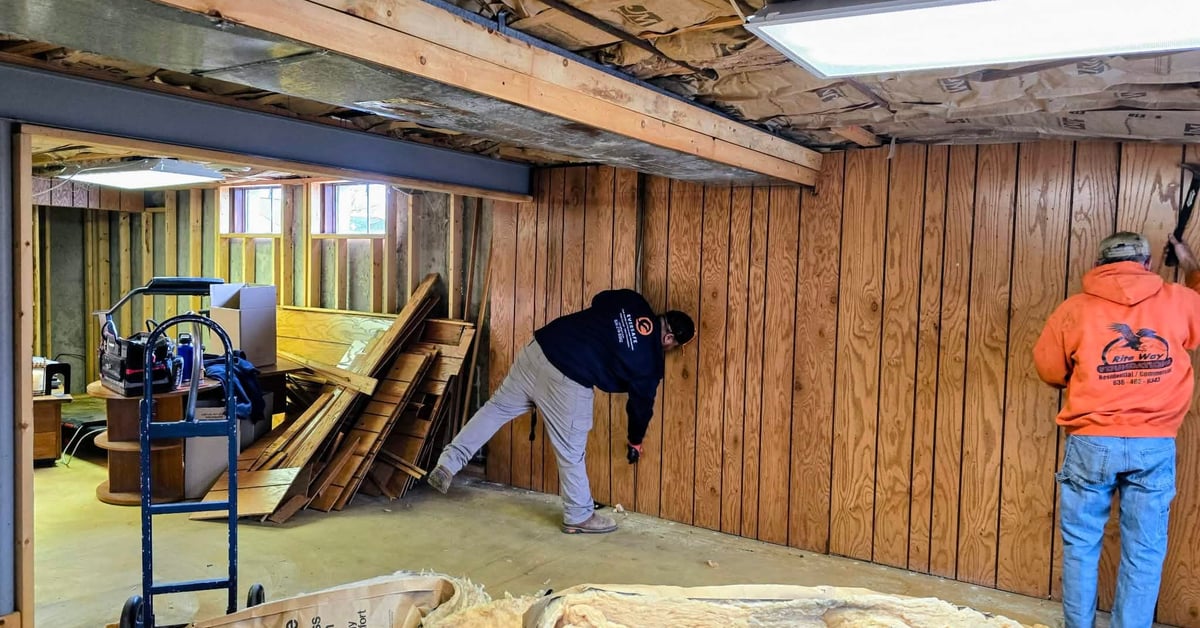
Workers Performing Basement Mold Remediation
In a dimly lit basement with wood-paneled walls partially removed, two workers from Eversafe Restoration LLC are actively engaged in remediation work. One technician, dressed in a blue hoodie, gray pants, and gloves, is crouched low, inspecting or removing sections of wood paneling and exposed pink fiberglass insulation from the wall. The other worker, wearing an orange hoodie and blue jeans, stands nearby observing. Scattered debris including wood scraps, insulation pieces, and plywood sheets lie on the concrete floor. Overhead, exposed wooden beams, yellow electrical wiring, and ductwork are visible under fluorescent lighting. This scene depicts ongoing mold remediation or water damage restoration efforts.
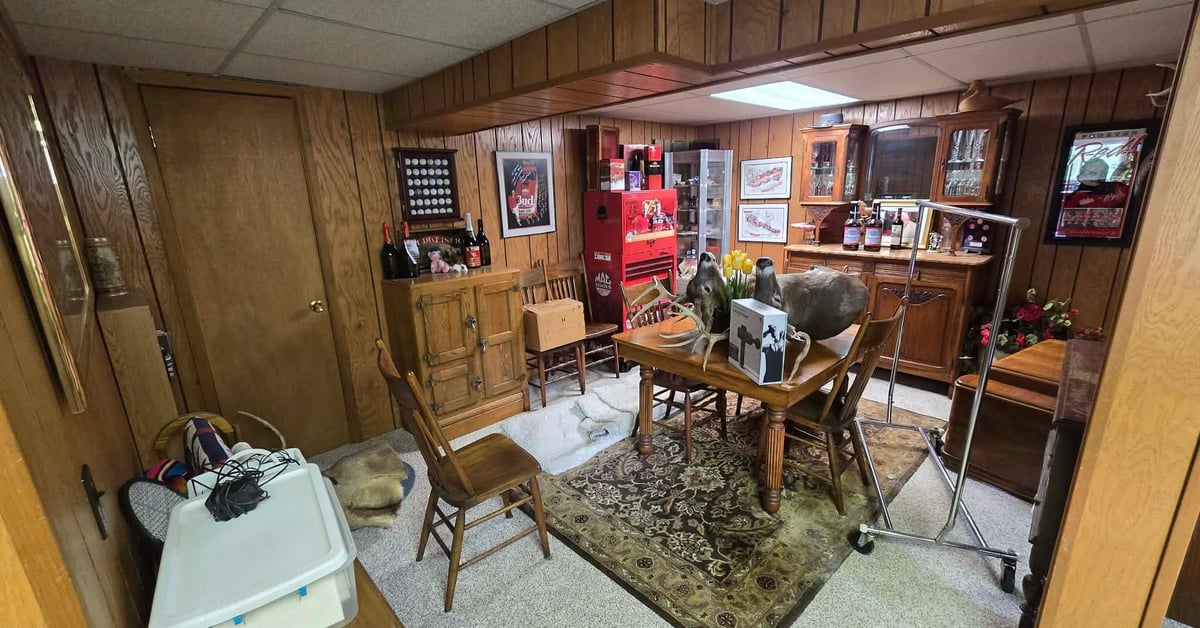
Cluttered Wood-Paneled Basement Bar Before Restoration
A detailed view of a finished basement recreation room with dark wood paneling on walls and ceiling, featuring a vintage red Coca-Cola vending machine, wooden bar cabinets stocked with liquor bottles, glasses, and memorabilia, a wooden dining table with four chairs, an office printer on a stand, area rugs, potted plants, framed posters, shelves with collectibles, and a clothes rack. The space appears lived-in and cluttered, suggesting a need for cleanup and restoration, likely due to potential water damage common in basements.
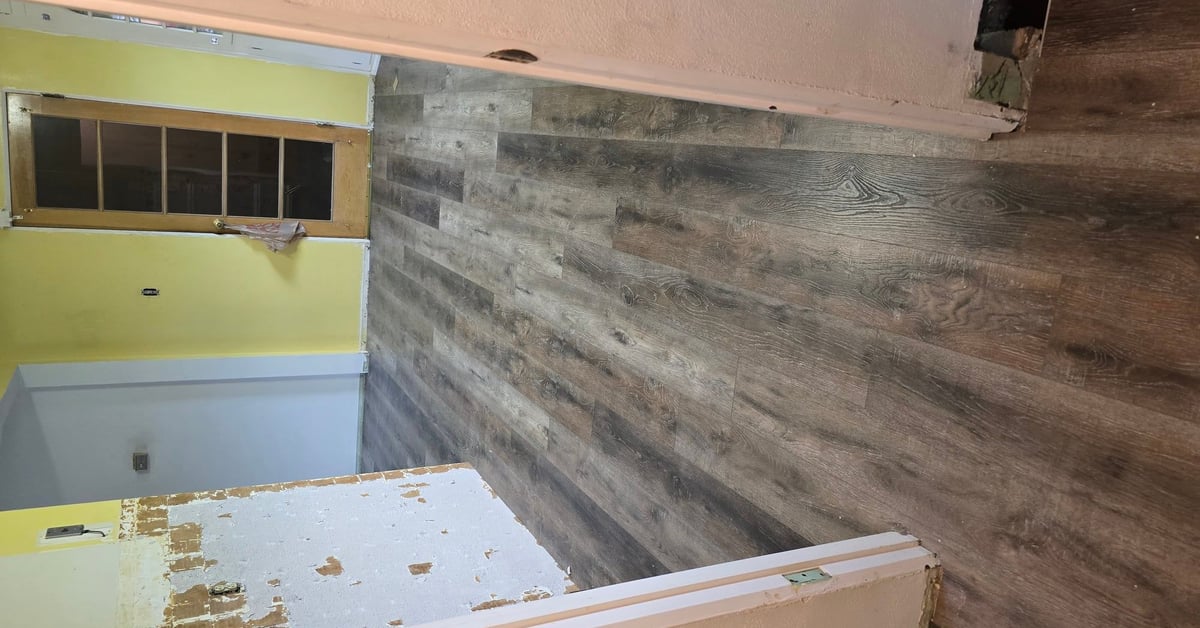
Basement Flooring Restoration Work in Progress
Overhead view into a basement area during renovation, featuring partially installed dark wood-grain laminate or vinyl plank flooring covering most of the floor space. Yellow painted drywall walls on both sides, an open wooden door with glass panels, a white bathtub or shower enclosure in the corner, exposed subfloor in patches, minor debris, and construction edges visible. Suggests water damage restoration with flooring replacement underway.
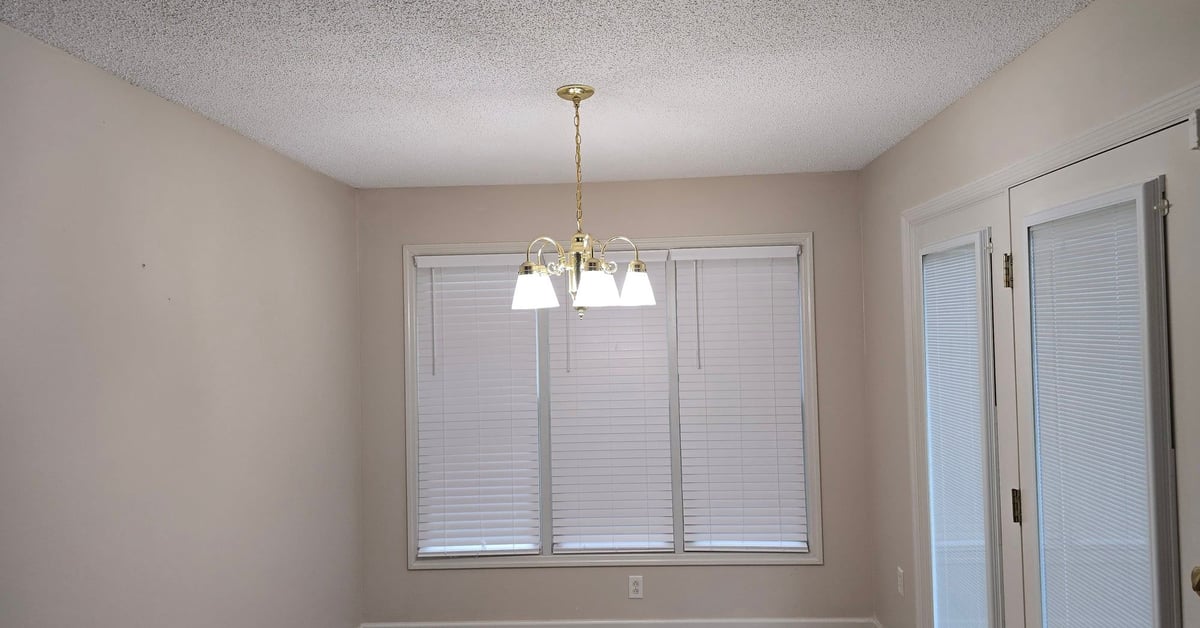
Empty Dining Room with Chandelier and Blinds
A spacious, empty dining room featuring light beige walls, a textured popcorn ceiling, a centered gold-toned four-arm chandelier with glass shades hanging from a chain, three large windows on the left covered with white horizontal blinds, a glass-paneled door on the right with blinds, and brown ceramic tile flooring. The room is clean, well-lit from natural light, and appears freshly restored with no visible damage or furnishings.
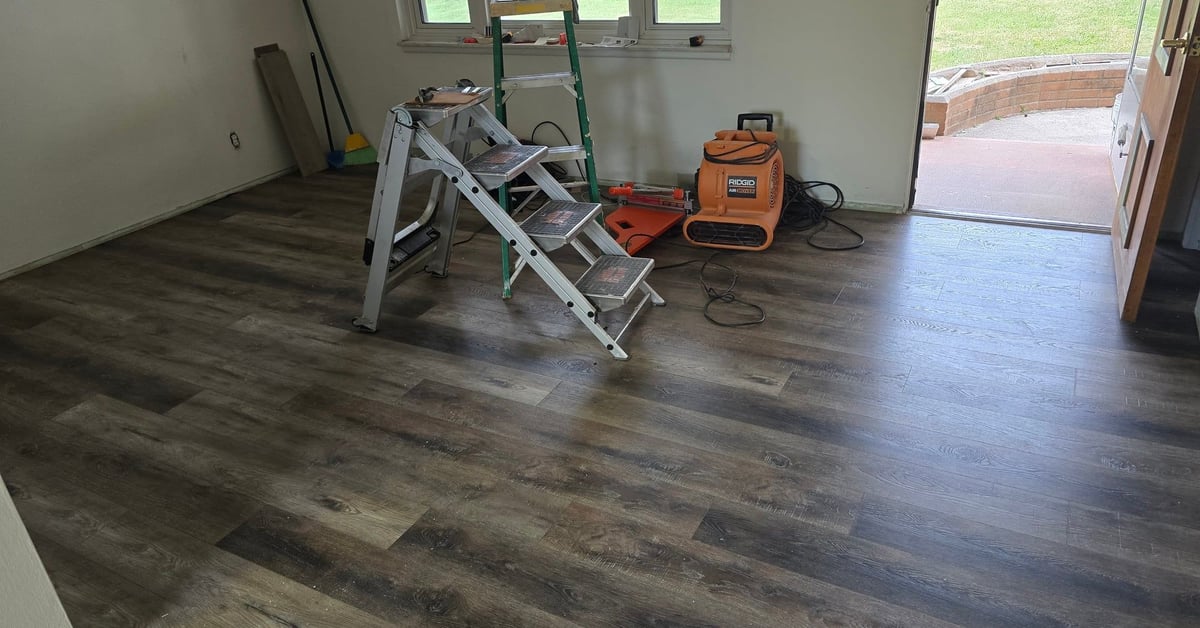
Room Restoration with New LVP Flooring and Equipment
Spacious empty room during restoration work, featuring freshly installed gray luxury vinyl plank (LVP) flooring throughout. An orange commercial air mover/dehumidifier is plugged in and operating in one corner, with orange extension cords nearby. Two aluminum ladders—one extended and one folded—are leaning against the wall, along with a broom, cardboard sheet, and minor wall patch. White walls, large window with view of grass outside, open door showing red truck parked on gravel driveway. Clean, well-lit space with visible electrical outlets and switch plate.
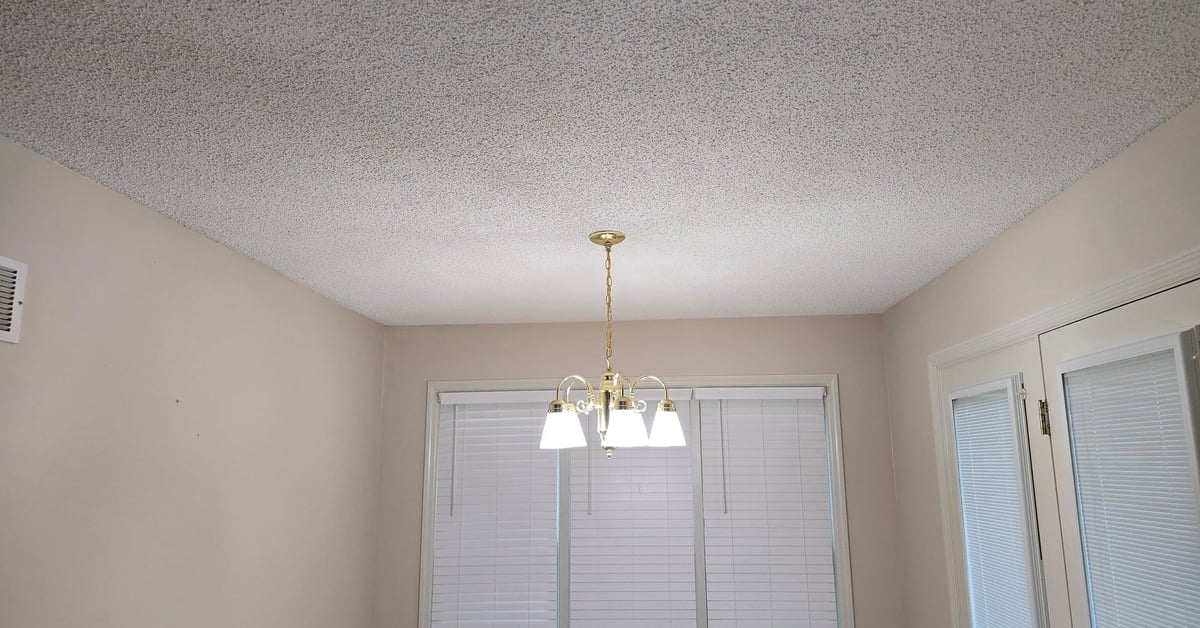
Clean dining room with chandelier and beige walls
A spacious, empty dining room featuring a textured popcorn ceiling, elegant gold chandelier with four bulb fixtures, light beige walls, large triple window covered with white horizontal blinds, and glass-paneled French doors. The room is well-lit, spotless, and appears freshly restored with no signs of damage or ongoing work.
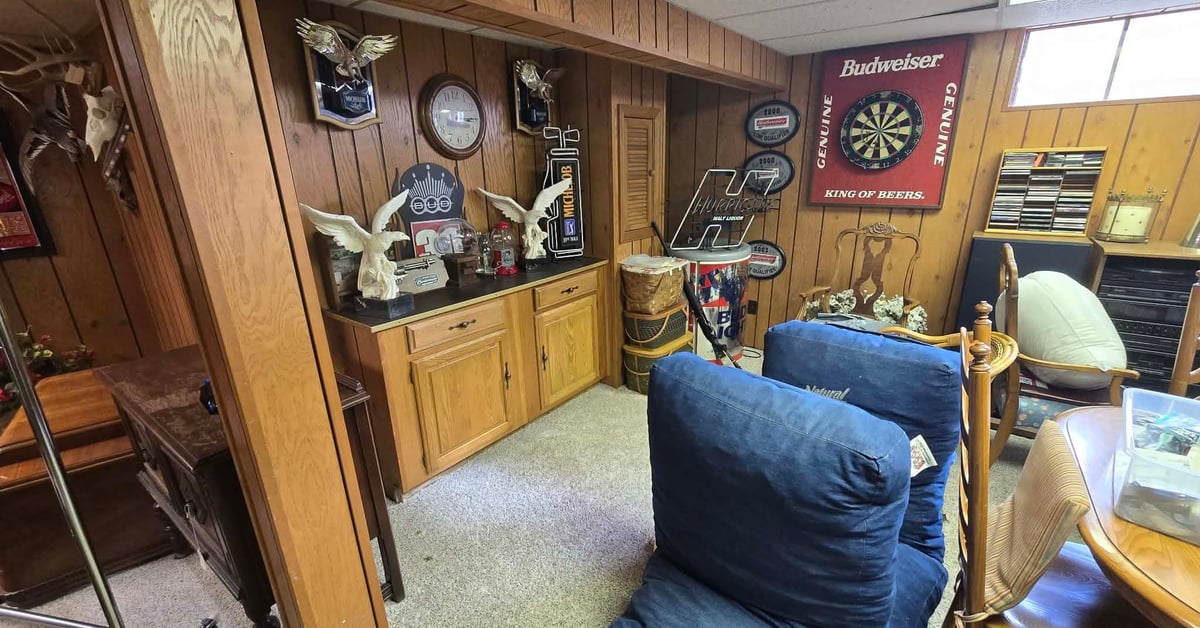
Cozy Wood-Paneled Basement Man Cave Bar
A finished basement recreation room with warm wood paneling on walls and ceiling. Features include mounted deer heads and antlers, Budweiser beer signs, dartboard, shelves displaying figurines, bottles, and collectibles, a bar area with stools, blue bean bag chairs, wooden table and chairs, and various rustic decor elements creating a classic man cave atmosphere.
What St. Louis Homeowners Say
Hear from homeowners across St. Louis who trusted us with their mold remediation needs. We are honored to have helped them restore healthy living environments.
"Chad fixed my mold. He explained to me exactly how the mold happened and why it would not happen again. He was very kind to me. I explained I was suffering from a medical level of anxiety and he was very understanding. Every day, Chad made sure to communicate clearly and keep me informed throughout the entire process."
Bob Gaines
3 months ago
"Eversafe Restoration was incredible to work with. We had unexpected water damage and Chad responded quickly and professionally. He explained everything clearly and made sure we understood the repair process. The crew was efficient and thorough. Highly recommend!"
Andrea Herron
6 months ago
"They took care in giving me the best service. Very detailed oriented in repairing and finishing moisture damage in my home. They did such an excellent job, I won't think twice about calling Eversafe for anymore restoration needs I have in the future!"
Ryan McGovern
6 months ago
"11/10 would recommend! Great job, great price, and it took them no time at all."
Corey Holmes
3 months ago
"Did a great job."
Matt Guthrie
6 months ago
"Excellent service from start to finish. Professional and reliable."
Destiny Boschert
6 months ago
Mold Remediation Questions for St. Louis Homeowners
Get answers to the most common questions about mold remediation costs, insurance coverage, and our remediation process in St. Louis.
How much does mold remediation cost in St. Louis?
Mold remediation costs in St. Louis typically range from $1,500 to $5,000 for most residential projects, though larger infestations or whole-house remediation can exceed $10,000. Several factors influence the final price. The size of the affected area is the primary cost driver. A small bathroom mold problem costs far less than mold throughout a basement or attic. The type and location of mold matters as well. Attic mold remediation in St. Louis's older homes often requires working in tight spaces with limited access, increasing labor time. Basement mold, extremely common in the St. Louis area due to our humid climate and older foundation construction, may require addressing underlying moisture issues for lasting results. The extent of material removal affects cost significantly. Surface mold on non-porous materials like tile can sometimes be cleaned in place, while mold that has penetrated drywall, insulation, wood framing, or carpeting requires removal and replacement of those materials. Black mold (Stachybotrys) and other toxic varieties require additional safety protocols that add to costs. We provide free on-site inspections and detailed written estimates before any work begins. Many St. Louis homeowners are surprised to learn that mold remediation following water damage may be covered by their homeowner's insurance if the water event itself was covered.
What is the difference between mold and mildew?
While both mold and mildew are fungi that thrive in damp conditions, they differ significantly in their growth patterns, health risks, and remediation requirements. Mildew is a surface-level fungus that typically appears as flat, powdery patches in white, gray, or light brown colors. It grows on damp surfaces like bathroom tiles, window sills, and fabrics but remains on the surface and rarely penetrates materials. Mildew can often be cleaned with household products and improved ventilation. Mold is far more invasive and potentially dangerous. It penetrates deep into porous materials like drywall, wood, carpet, and insulation, sending root-like structures called hyphae into the material. Mold appears in various colors including black, green, blue, and orange, often with a fuzzy or slimy texture. Some mold species, particularly Stachybotrys chartarum (black mold) and Aspergillus, produce mycotoxins that can cause serious health problems including respiratory issues, neurological symptoms, and immune system suppression. St. Louis's humid summers and the prevalence of older homes with basement moisture issues make mold a particular concern in our area. Professional remediation addresses mold at its structural root, removing not just visible growth but the embedded hyphae and affected materials. Simply cleaning the surface of a mold infestation without addressing the underlying growth allows it to return quickly.
Is black mold removal from drywall possible?
When black mold infests drywall, removal of the affected drywall sections is almost always necessary rather than attempting to clean it in place. Drywall is a porous material with a paper facing that provides an ideal food source for mold. Once mold colonizes drywall, the hyphae (root structures) penetrate deep into the gypsum core and paper backing where surface cleaning cannot reach. Attempting to clean mold-infested drywall typically fails because the visible mold is only a fraction of the actual growth. The embedded growth remains and quickly regenerates visible colonies. Additionally, the cleaning process can release millions of spores into the air, spreading contamination throughout your home. Our remediation process for mold-infested drywall involves establishing containment with negative air pressure to prevent spore spread, cutting out affected drywall sections extending at least two feet beyond visible mold growth, HEPA vacuuming exposed framing and applying antimicrobial treatments, verifying remediation success through post-remediation testing, and then reconstruction with new drywall. For St. Louis homes with plaster walls, common in historic neighborhoods like Soulard, Lafayette Square, and the Central West End, the approach differs somewhat as plaster is less porous than drywall, but severely affected sections still require removal. We always prioritize preserving historic materials when safely possible while ensuring complete mold elimination.
How do I know if I need a mold test?
Several signs indicate that professional mold testing may be warranted for your St. Louis home. The most obvious indicator is visible mold growth, though even a small visible patch often indicates larger hidden colonies. Musty, earthy odors without visible mold strongly suggest hidden growth behind walls, under floors, or in HVAC systems. These odors result from microbial volatile organic compounds (MVOCs) that mold releases during growth. Recent water damage is a major risk factor. If your home experienced flooding, a burst pipe, roof leak, or sewage backup within the past several weeks or months, mold testing can reveal whether remediation is needed before an infestation becomes severe. St. Louis's humid summers and frequent severe storms make water intrusion common. Health symptoms in family members can indicate mold exposure, particularly if symptoms improve when away from home and worsen when returning. Common symptoms include persistent respiratory issues, sinus congestion, coughing, eye irritation, skin rashes, headaches, and fatigue. Those with asthma, allergies, or compromised immune systems are particularly susceptible. If you are buying or selling a St. Louis home, mold testing provides important information about the property's condition. Real estate transactions involving homes with previous water damage or basement moisture issues particularly benefit from professional testing. Our testing services include visual inspection with moisture meters and thermal imaging, air sampling to measure airborne spore counts, and surface sampling of suspicious areas. Results from accredited third-party laboratories provide definitive answers about mold presence and species identification.
Does insurance cover mold removal?
Insurance coverage for mold removal in St. Louis depends primarily on what caused the mold growth. Most homeowner policies cover mold remediation when it results from a sudden, accidental water event that the policy covers, such as a burst pipe, water heater failure, or storm damage. If water damage from a covered peril led to mold growth, the subsequent remediation is typically included in the claim. However, mold resulting from gradual leaks, deferred maintenance, or general humidity is usually excluded from standard policies. A slow leak under a sink that went unnoticed for months, or basement moisture from foundation seepage, typically does not trigger coverage because these are considered maintenance issues rather than sudden accidents. St. Louis's humid climate creates challenging conditions for many homes, particularly those with older construction, but humidity-related mold is rarely covered. Many policies also include specific mold caps or sublimits, often ranging from $5,000 to $25,000, that limit total mold-related payouts regardless of actual remediation costs. Some policies require separate mold endorsements for any coverage at all. Review your policy carefully or contact your agent to understand your specific coverage. Eversafe Restoration works extensively with insurance companies serving St. Louis homeowners. We provide detailed documentation including moisture readings, photographs, laboratory test results, and itemized remediation plans that adjusters need to process claims. We can often bill insurance directly and help navigate the claims process. Our experience with local adjusters from carriers like State Farm, Allstate, and Farmers helps ensure your claim is handled smoothly.
How long does the mold removal process take?
Most residential mold remediation projects in St. Louis take between 2 and 4 days to complete, though the timeline varies based on the scope of infestation and type of affected materials. A small, contained mold problem in a bathroom or utility room might be resolved in one to two days. Extensive basement mold, attic remediation, or mold affecting multiple rooms typically requires three to five days. Whole-house remediation or situations involving significant structural components can extend beyond a week. The process follows a specific sequence that cannot be rushed without compromising results. Day one typically involves detailed inspection, establishing containment with plastic sheeting and negative air machines, and beginning removal of affected materials. Subsequent days continue removal, HEPA vacuuming of all surfaces, antimicrobial treatment, and thorough cleaning of the contained area. The containment must remain in place until the work is complete and verified. Post-remediation verification (PRV) testing is a critical final step that adds time but ensures the job is done correctly. We collect air samples from the remediated area and send them to an accredited laboratory for analysis. Results typically return within 24 to 48 hours. Only after test results confirm that spore counts have returned to normal background levels do we remove containment and consider the project complete. For St. Louis homes with extensive mold in difficult-to-access areas like attics or crawlspaces, additional time may be needed. We provide realistic timeline estimates during our initial inspection and keep you informed throughout the process.
Can I stay in my house during mold remediation?
Whether you can remain in your St. Louis home during mold remediation depends on the location and extent of the mold, the sensitivity of household members, and the specific work being performed. In many cases, occupants can stay in unaffected areas of the home while remediation proceeds in contained zones. Professional containment using plastic sheeting, negative air pressure, and HEPA filtration prevents spores from migrating to occupied areas. If mold is confined to a basement, bathroom, or single bedroom, the rest of the house typically remains safe for occupancy. We seal off the affected area completely, and air scrubbers ensure that any escaping spores are captured before reaching living spaces. You should avoid entering the containment zone during active remediation. However, certain situations warrant temporary relocation. If mold affects large portions of the home, particularly if it involves HVAC systems that serve the entire house, staying elsewhere during remediation is advisable. Households with members who have asthma, severe allergies, compromised immune systems, or respiratory conditions should consider relocating even for smaller projects. Infants, elderly family members, and pregnant women face elevated risks from mold exposure. When remediation involves toxic black mold (Stachybotrys) or other particularly hazardous species, we typically recommend relocation as an extra precaution. The aggressive removal techniques required for toxic mold, even with proper containment, create more disturbance than routine remediation. We assess each situation individually and provide honest recommendations about whether relocation is advisable for your specific circumstances.
What kills mold permanently?
Killing mold permanently requires a two-part approach: eliminating the existing growth and removing the moisture conditions that allowed it to develop. Simply killing mold spores without addressing moisture virtually guarantees the mold will return, often within weeks. This is why DIY approaches using bleach or household cleaners typically fail. They may kill surface mold temporarily but do not address embedded growth or moisture sources. Professional mold remediation achieves permanent results through comprehensive treatment. HEPA vacuuming removes loose spores from all surfaces, preventing them from settling elsewhere and starting new colonies. Antimicrobial agents designed specifically for mold remediation penetrate porous materials to kill embedded hyphae that surface treatments miss. These professional-grade products differ significantly from household cleaners in their ability to reach deep into materials. Removal of porous materials with extensive mold colonization (drywall, insulation, carpet) eliminates the bulk of the infestation. Mold cannot regrow on materials that no longer exist. Antimicrobial fogging treats the entire contained space, reaching areas that manual cleaning might miss. But none of these treatments matter long-term if moisture returns. In St. Louis, where humid summers, basement moisture, and aging infrastructure create persistent dampness challenges, addressing the moisture source is essential. This might involve repairing leaks, improving drainage, installing dehumidification, fixing foundation seepage, or addressing HVAC issues. Our remediation process includes identifying moisture sources and recommending solutions. We partner with waterproofing specialists when foundation issues are involved. The goal is not just removing today's mold but preventing tomorrow's infestation.
Still have questions?
We're here to help you find the answers.
Serving St. Louis from Saint Charles
Our Saint Charles headquarters provides comprehensive mold remediation services throughout St. Louis city and county. We serve downtown, Central West End, Tower Grove, Clayton, and all surrounding communities.
Hours
Monday - Friday: 9am - 6pm
Saturday: 9am - 5pm
Sunday: Closed
Suspect Mold in Your St. Louis Home? Get Answers.
Do not let mold compromise your family's health or your home's value. Our IICRC-certified technicians provide thorough inspections with honest assessments. If mold is present, we will explain your options clearly and provide a detailed written estimate before any work begins.
Ready to Eliminate Mold from Your St. Louis Home?
Our Saint Charles team provides comprehensive mold inspection, testing, and remediation services throughout St. Louis. From black mold abatement to attic and basement mold removal, we restore healthy indoor air quality. Call now for a free inspection or request a detailed estimate.