Professional Crawl Space Mold Removal & Encapsulation in St. Charles
Eliminate moisture, mold, and musty odors from beneath your home. IICRC-certified technicians with complete encapsulation systems and vapor barrier installation. Free crawl space inspections.
Your Crawl Space Affects Your Entire Home
Up to 50% of the air you breathe on the first floor of your home comes from the crawl space below. In Missouri's humid climate, damp crawl spaces breed mold, attract pests, and cause structural damage to floor joists. If you notice musty odors, cold floors, or high humidity inside your home, your crawl space is likely the source.
Why St. Louis Homes Have Crawl Space Problems
Missouri's unique climate and soil conditions create the perfect environment for crawl space moisture issues. Understanding these factors helps explain why professional remediation is essential.
High Summer Humidity
St. Louis summers regularly exceed 80% relative humidity. Traditional vented crawl spaces actually pull this humid air inside, where it condenses on cooler surfaces like floor joists and subflooring, creating ideal conditions for mold growth.
- Average summer humidity: 70-85%
- Condensation on ductwork
- Mold thrives above 60% RH
Missouri Clay Soils
The heavy clay soils throughout St. Charles County hold water against your foundation instead of draining away. This creates constant hydrostatic pressure that forces moisture through foundation walls and up through the crawl space floor.
- Poor natural drainage
- Foundation wall seepage
- Standing water after rain
Extreme Temperature Swings
Missouri experiences temperature swings from below zero in winter to over 100 degrees in summer. This thermal stress causes foundation cracks that allow water intrusion, and creates condensation when warm humid air meets cold surfaces in your crawl space.
- Foundation crack formation
- Cold floors in winter
- Summer condensation issues
Homes built before the 1990s in St. Charles, O'Fallon, and Wentzville were typically constructed with vented crawl spaces following the building codes of that era. We now understand that vented crawl spaces actually worsen moisture problems in humid climates rather than solving them. The combination of Missouri's clay soils, seasonal humidity, and temperature extremes makes crawl space encapsulation essential for protecting your home's structural integrity and indoor air quality.
Expert Crawl Space Mold Remediation & Vapor Barriers
Our IICRC-certified technicians follow a comprehensive protocol designed specifically for Missouri crawl spaces. Every step addresses both the mold present and the underlying moisture that caused it.
Inspection & Assessment
We begin with a comprehensive crawl space inspection including moisture mapping, mold sampling, and structural assessment. Our thermal imaging identifies hidden moisture pockets in joists and subflooring that visual inspection cannot detect.
HEPA Vacuuming & Cleaning
Comprehensive HEPA vacuuming removes active mold spores from floor joists, rim joists, subflooring, and sill plates. We remove loose debris, old insulation, and any organic material that could harbor future mold growth.
Antimicrobial Treatment
Application of EPA-registered antimicrobial sealants to all wood surfaces. These professional-grade treatments penetrate into wood fibers to eliminate mold roots and create a protective barrier against future fungal growth and wood rot.
Vapor Barrier Installation
Installation of high-durability 20-mil vapor barriers covering the crawl space floor and extending up foundation walls. All seams are overlapped and sealed, creating a continuous moisture barrier that isolates your home from ground moisture.
Addressing Missouri's Clay Soil Drainage
Beyond mold removal, we address the root causes of crawl space moisture specific to Missouri homes. Our drainage solutions account for the heavy clay soils that hold water against foundations throughout St. Charles County. This may include interior drain tile installation, sump pump systems, or exterior grading corrections depending on your specific situation.
For severe groundwater issues common in low-lying areas of O'Fallon and Wentzville, we install commercial-grade sump pump systems with battery backup to ensure your crawl space stays dry even during power outages from Missouri storms. Every solution is designed for the specific challenges of your property.
The Benefits of Crawl Space Encapsulation
Complete crawl space encapsulation transforms this hidden area of your home into a clean, dry, conditioned space. The benefits extend throughout your entire home and last for decades.
Improved Indoor Air Quality
Up to 50% of the air you breathe on the first floor comes from your crawl space. Encapsulation eliminates mold spores, musty odors, and allergens from entering your living space, providing cleaner, healthier air for your family.
Lower Energy Bills
Encapsulation stabilizes temperatures beneath your flooring, reducing the workload on your HVAC system. Homeowners typically see 15-20% reductions in heating and cooling costs as the conditioned air in their home no longer escapes through the crawl space.
Structural Protection
Eliminating moisture protects floor joists, subflooring, and sill plates from wood rot and decay. Encapsulation also deters termites, carpenter ants, and other wood-boring insects that are attracted to damp wood.
Increased Property Value
A dry, clean, warranted crawl space is a significant selling point. Home buyers and inspectors recognize the value of professional encapsulation, and our transferable warranty provides added confidence during real estate transactions.
Our Complete Encapsulation System
Every component of our encapsulation system is selected for the demanding Missouri climate and backed by manufacturer warranties.
20-Mil Vapor Barrier
Heavy-duty reinforced polyethylene rated for below-grade installation with antimicrobial properties.
Foundation Wall Attachment
Mechanical fastening and sealing system that extends coverage up foundation walls to the sill plate.
Vent Sealing
Complete closure of foundation vents that allow humid outside air into the crawl space.
Commercial Dehumidifier
Santa Fe or AprilAire commercial dehumidifier sized for your crawl space with automatic drainage.
Drainage Solutions
Interior drain tile and sump pump systems where groundwater is present.
Vented vs. Encapsulated Crawl Spaces
For decades, building codes required vented crawl spaces. Modern building science has proven this approach actually worsens moisture problems in humid climates like Missouri.
Traditional Vented Crawl Space
- Allows humid summer air to enter and condense on cool surfaces
- Creates temperature extremes that stress HVAC systems
- Provides entry points for pests and rodents
- Fiberglass insulation absorbs moisture and falls
- Promotes mold growth on wood structures
Outdated building practice that actually increases moisture problems in Missouri's humid climate.
Encapsulated Crawl Space
- Complete vapor barrier seals out ground moisture
- Controlled humidity prevents mold growth
- Stable temperatures reduce energy costs
- Sealed vents eliminate pest entry points
- Clean, usable storage space beneath your home
Modern building science solution that permanently solves crawl space moisture problems.
Signs You Need Crawl Space Remediation
Many crawl space problems manifest inside your living space before you ever look beneath your home. Watch for these common warning signs.
Musty Odors Inside
Earthy, damp smells on the first floor that persist despite cleaning, especially noticeable in summer.
Cupping Hardwood Floors
Hardwood flooring that cups, warps, or shows gaps between boards due to moisture from below.
Cold or Bouncy Floors
Floors that feel cold in winter or bounce excessively, indicating moisture damage to subflooring.
High Indoor Humidity
Persistent humidity above 50% indoors despite air conditioning, often traced to crawl space moisture.
Allergy Symptoms
Unexplained allergies, respiratory issues, or symptoms that improve when away from home.
Pest Activity
Increased termite, ant, or rodent activity, as these pests are attracted to damp environments.
Crawl Space Services Throughout St. Louis Metro
Our IICRC-certified crawl space remediation and encapsulation services are available throughout St. Charles County and the greater St. Louis metro area.
Don't see your city? We serve the entire St. Louis metro area. Contact us to confirm service in your area.
Protect Your Home from Crawl Space Moisture
Our certified technicians will inspect your crawl space, identify moisture sources, and provide a detailed remediation and encapsulation plan. No obligation, no pressure.
Related Services
Attic Mold Remediation
Professional attic mold removal with ventilation correction to prevent regrowth.
French Drain Installation
Effective drainage solutions to keep crawl spaces and basements dry.
Mold Inspection & Testing
Professional mold testing and inspection to assess air quality and hidden contamination.
Crawl Space Remediation Projects
See examples of our crawl space mold removal and encapsulation work throughout St. Charles County. From moisture control to complete encapsulation systems, we restore crawl spaces to clean, dry conditions.
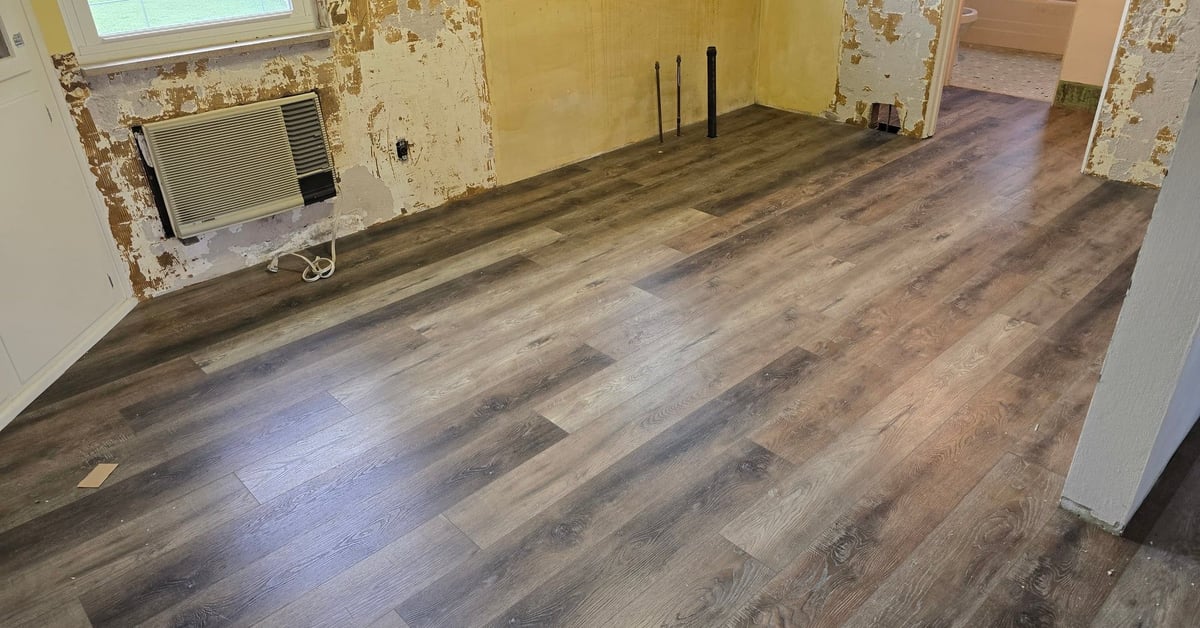
Water Damaged Bathroom Walls with New Flooring
A room undergoing restoration shows severely damaged walls with peeling yellowed plaster and exposed wooden studs, particularly around a window-mounted air conditioning unit. Freshly installed dark laminate flooring with a wood-grain pattern covers the entire floor. An open doorway reveals an adjacent bathroom featuring a white bathtub and tiled walls. Two metal poles stand in one corner, and minor debris is present, indicating active renovation work likely due to prior water damage.
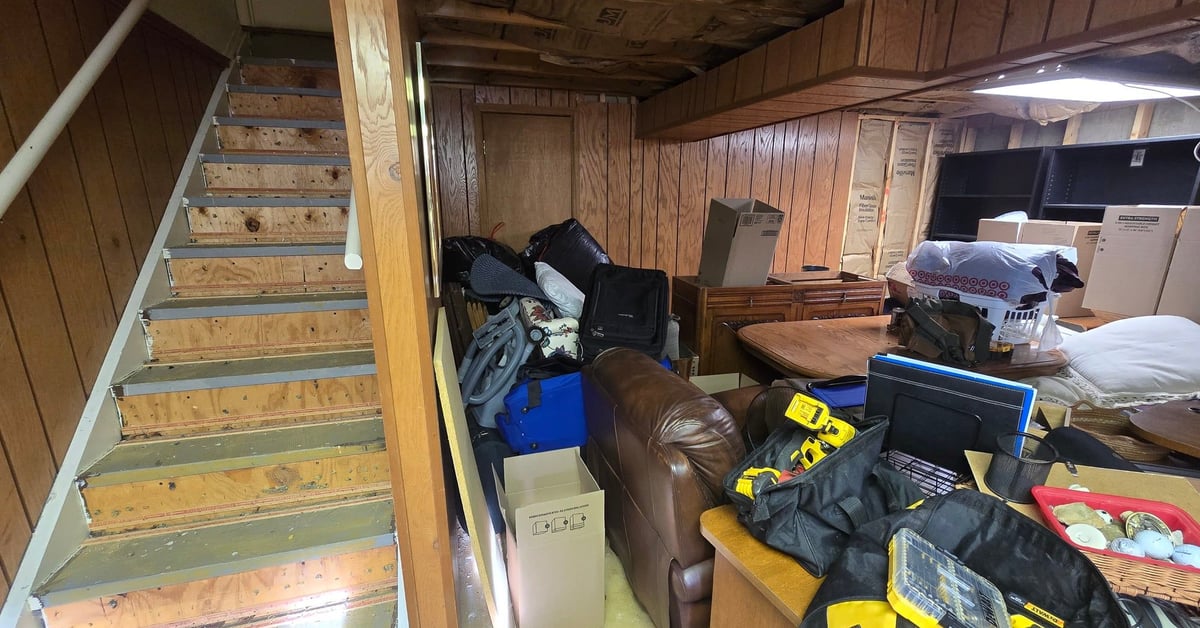
Cluttered Basement Before Restoration Work
A cluttered unfinished basement with wooden paneled walls, exposed wooden beams and pink insulation on the ceiling. A wooden staircase with railing descends from the left side. The floor space is filled with household items including a brown leather armchair, wooden desk cluttered with tools like a yellow drill and cases, multiple cardboard boxes, blue plastic bins, black garbage bags, pillows, baskets, and scattered debris. Fluorescent lighting illuminates the area, suggesting preparation for cleanup or restoration.
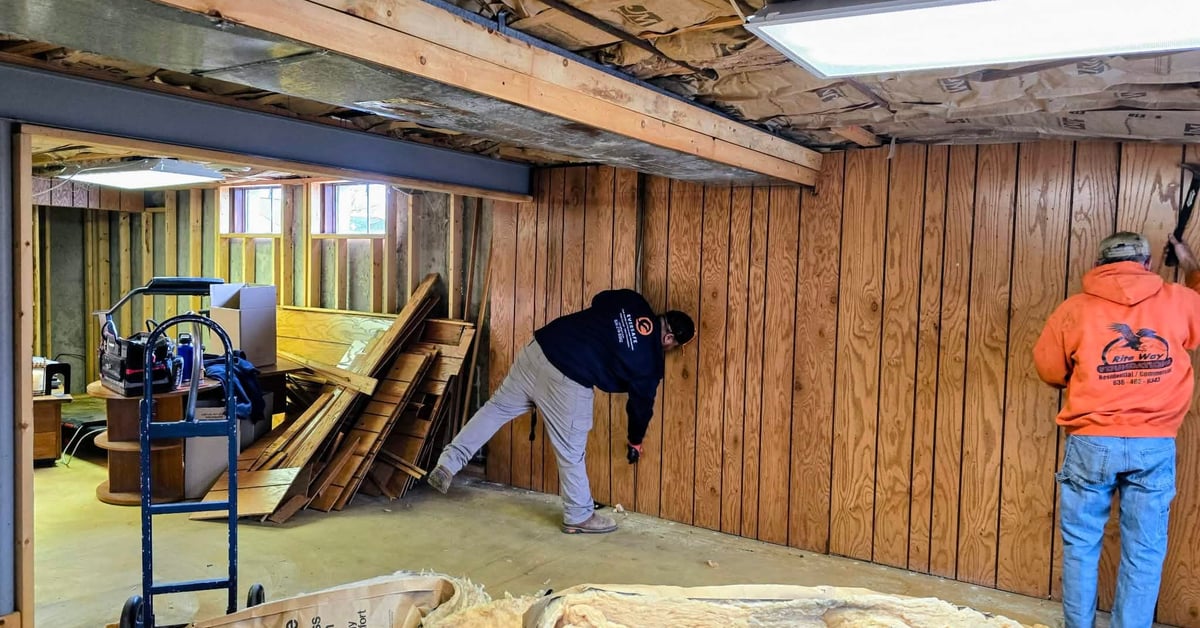
Workers Performing Basement Mold Remediation
In a dimly lit basement with wood-paneled walls partially removed, two workers from Eversafe Restoration LLC are actively engaged in remediation work. One technician, dressed in a blue hoodie, gray pants, and gloves, is crouched low, inspecting or removing sections of wood paneling and exposed pink fiberglass insulation from the wall. The other worker, wearing an orange hoodie and blue jeans, stands nearby observing. Scattered debris including wood scraps, insulation pieces, and plywood sheets lie on the concrete floor. Overhead, exposed wooden beams, yellow electrical wiring, and ductwork are visible under fluorescent lighting. This scene depicts ongoing mold remediation or water damage restoration efforts.
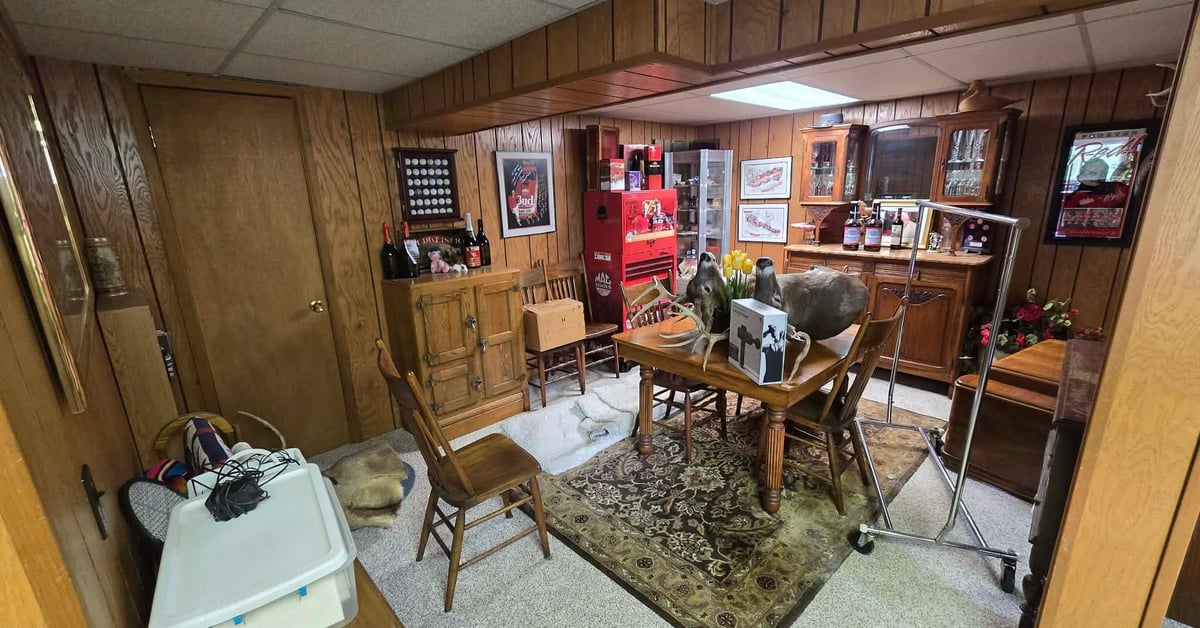
Cluttered Wood-Paneled Basement Bar Before Restoration
A detailed view of a finished basement recreation room with dark wood paneling on walls and ceiling, featuring a vintage red Coca-Cola vending machine, wooden bar cabinets stocked with liquor bottles, glasses, and memorabilia, a wooden dining table with four chairs, an office printer on a stand, area rugs, potted plants, framed posters, shelves with collectibles, and a clothes rack. The space appears lived-in and cluttered, suggesting a need for cleanup and restoration, likely due to potential water damage common in basements.
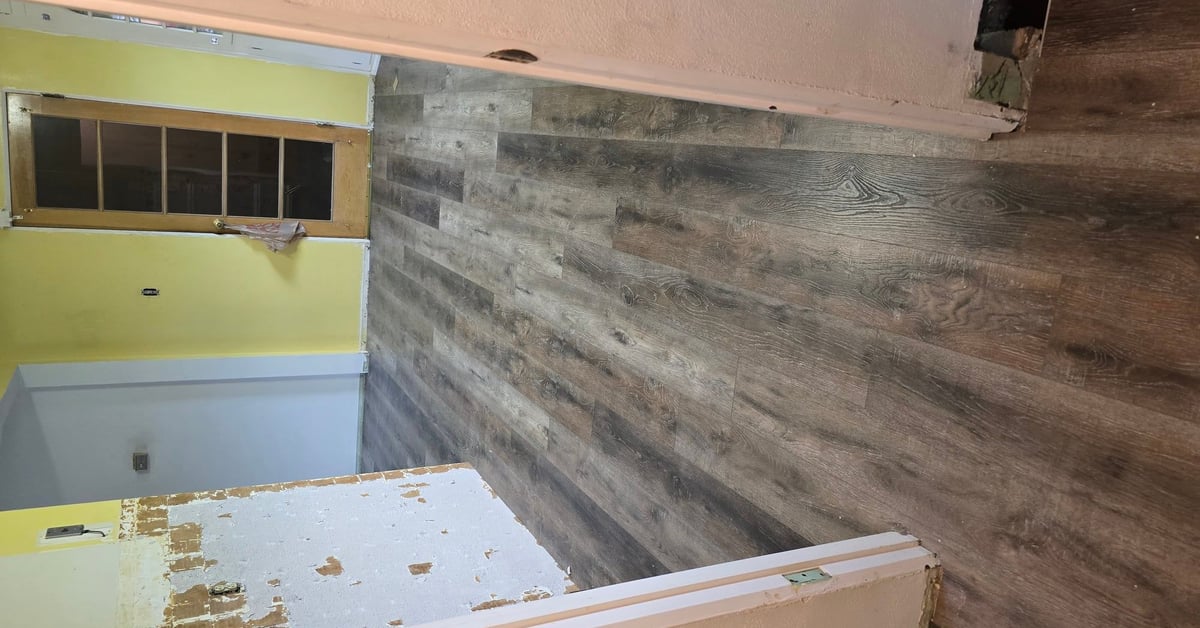
Basement Flooring Restoration Work in Progress
Overhead view into a basement area during renovation, featuring partially installed dark wood-grain laminate or vinyl plank flooring covering most of the floor space. Yellow painted drywall walls on both sides, an open wooden door with glass panels, a white bathtub or shower enclosure in the corner, exposed subfloor in patches, minor debris, and construction edges visible. Suggests water damage restoration with flooring replacement underway.
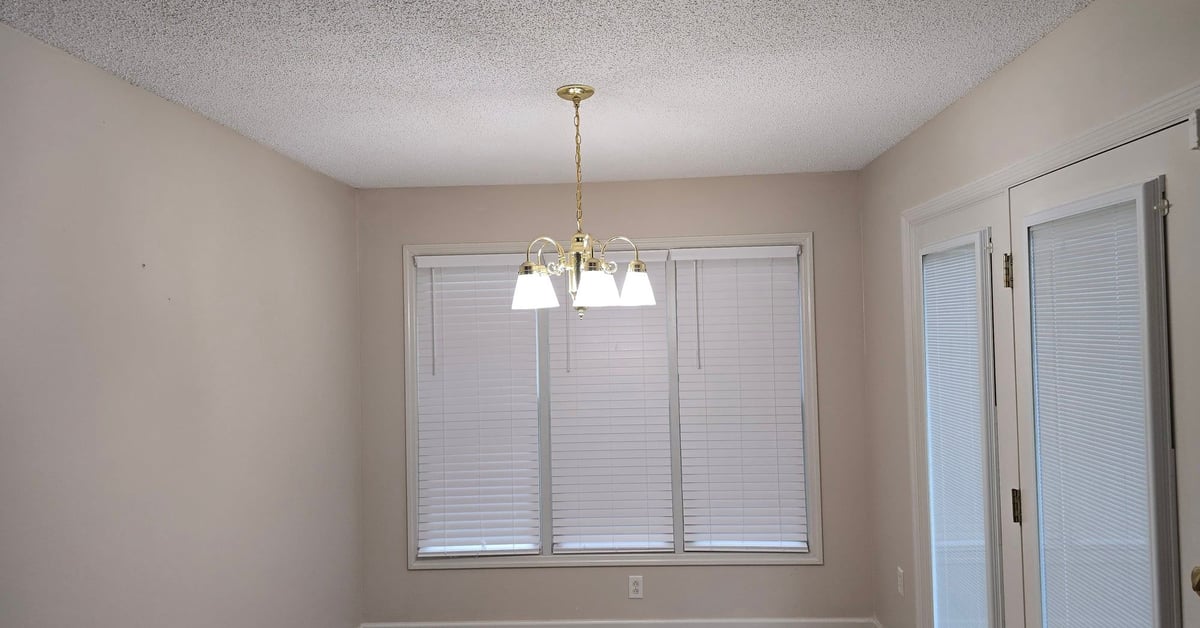
Empty Dining Room with Chandelier and Blinds
A spacious, empty dining room featuring light beige walls, a textured popcorn ceiling, a centered gold-toned four-arm chandelier with glass shades hanging from a chain, three large windows on the left covered with white horizontal blinds, a glass-paneled door on the right with blinds, and brown ceramic tile flooring. The room is clean, well-lit from natural light, and appears freshly restored with no visible damage or furnishings.
What St. Charles Homeowners Say
Read reviews from families throughout St. Charles, O'Fallon, and Wentzville who trusted us to remediate their crawl space mold and install encapsulation systems.
"Chad fixed my mold. He explained to me exactly how the mold happened and why it would not happen again. He was very kind to me. I explained I was suffering from a medical level of anxiety and he was very understanding. Every day, Chad made sure to communicate clearly and keep me informed throughout the entire process."
Bob Gaines
3 months ago
"Eversafe Restoration was incredible to work with. We had unexpected water damage and Chad responded quickly and professionally. He explained everything clearly and made sure we understood the repair process. The crew was efficient and thorough. Highly recommend!"
Andrea Herron
6 months ago
"They took care in giving me the best service. Very detailed oriented in repairing and finishing moisture damage in my home. They did such an excellent job, I won't think twice about calling Eversafe for anymore restoration needs I have in the future!"
Ryan McGovern
6 months ago
"11/10 would recommend! Great job, great price, and it took them no time at all."
Corey Holmes
3 months ago
"Did a great job."
Matt Guthrie
6 months ago
"Excellent service from start to finish. Professional and reliable."
Destiny Boschert
6 months ago
Crawl Space Mold & Encapsulation FAQ
Get answers to common questions about crawl space mold removal, encapsulation systems, and vapor barrier installation in St. Louis area homes.
Is mold in my crawl space dangerous?
Yes, mold in your crawl space poses significant health and structural risks that should not be ignored. Due to a phenomenon called the stack effect, air naturally rises through your home, meaning that up to 50 percent of the air you breathe on the first floor originates from the crawl space. When mold is present below your home, spores travel upward through gaps in flooring, around plumbing penetrations, and through HVAC returns located near floor level. Family members may experience respiratory issues including chronic coughing, wheezing, and aggravated asthma symptoms. Allergic reactions such as sneezing, runny nose, and itchy eyes are common, especially in children and sensitive individuals. Beyond health concerns, mold actively degrades the structural integrity of floor joists, rim joists, and subflooring. Wood rot caused by prolonged mold exposure can lead to sagging floors, structural instability, and costly repairs. In the humid St. Louis climate, crawl space mold problems tend to worsen rapidly during summer months, making early intervention essential.
How much does crawl space cleaning cost in St. Charles?
Crawl space mold remediation and cleaning costs in St. Charles typically range from $2,000 to $8,000, depending on several key factors. The square footage of your crawl space is the primary cost driver, with larger spaces requiring more labor, materials, and equipment time. The severity of mold growth significantly impacts pricing; surface mold on a few joists costs considerably less to treat than extensive contamination covering subflooring, insulation, and foundation walls. Whether you opt for basic mold removal or complete encapsulation also affects the total investment. A standalone mold treatment runs less than a comprehensive encapsulation system that includes vapor barrier installation, dehumidification, and drainage improvements. We provide free crawl space inspections with detailed written estimates that break down each component of the recommended work. Many homeowners find that encapsulation provides better long-term value than repeated mold treatments, as it addresses the underlying moisture problem permanently.
How long does the crawl space remediation process take?
Most crawl space mold remediation projects in St. Charles take between 2 to 4 days to complete, though the timeline varies based on the scope of work and size of your crawl space. Day one typically involves assessment, containment setup, and the initial mold removal process including HEPA vacuuming of joists, subflooring, and sill plates. Antimicrobial treatments are applied and require 12 to 24 hours of drying time before additional work can proceed. If encapsulation is included, installation of the vapor barrier system, seam sealing, and wall attachment typically requires an additional 1 to 2 days depending on crawl space accessibility and square footage. Dehumidifier installation and final system testing complete the project. For crawl spaces with severe water intrusion requiring drainage solutions or sump pump installation, the project may extend to 5 days. We provide a detailed timeline during your free inspection so you can plan accordingly. Our goal is thorough remediation rather than rushing through the process.
What are the signs I have a wet crawl space?
Several warning signs indicate moisture problems in your crawl space, many of which are noticeable inside your living areas. Musty, earthy odors in your home, particularly on the first floor, are often the first indication of crawl space moisture and mold growth. These odors tend to intensify during humid summer months or after rain events. Hardwood floors that cup, warp, or feel bouncy underfoot suggest moisture is affecting your subflooring from below. Condensation on HVAC ductwork running through the crawl space indicates excessive humidity levels. If you venture into the crawl space itself, look for standing water, damp soil, water stains on foundation walls, visible mold on wood surfaces, and deteriorating or falling insulation. High indoor humidity levels that persist despite air conditioning use often trace back to crawl space moisture. Some homeowners notice increased pest activity, as termites, carpenter ants, and other wood-destroying insects are attracted to damp, moldy wood. If you observe any of these signs, schedule a professional crawl space inspection before problems worsen.
Do I need a dehumidifier after encapsulation?
In the St. Louis metro area, we strongly recommend installing a dehumidifier as part of your crawl space encapsulation system. While the vapor barrier dramatically reduces moisture intrusion from the ground, Missouri's humid summers can still allow moisture to accumulate through foundation walls, pipe penetrations, and the air that enters when the crawl space door is opened. A properly sized dehumidifier maintains relative humidity below 55 percent year-round, which is the threshold below which mold cannot actively grow. We install commercial-grade crawl space dehumidifiers rated for the demanding below-grade environment, as residential units lack the capacity and durability for this application. These units feature automatic drainage, allowing them to run continuously without emptying a collection tank. The dehumidifier also protects your encapsulation investment by preventing condensation on the vapor barrier itself. Most homeowners appreciate the energy efficiency gains from the dehumidifier, as removing excess moisture reduces the load on your home's air conditioning system during summer months.
Can I remove crawl space mold myself?
While DIY mold removal might seem cost-effective, we strongly advise against attempting crawl space mold remediation yourself for several important reasons. Crawl spaces present significant safety hazards including limited headroom, restricted ventilation, electrical wiring, and potentially compromised structural members. Without proper personal protective equipment including full-face respirators with P100 filters, Tyvek suits, and gloves, you risk serious respiratory exposure to concentrated mold spores. Perhaps more importantly, disturbing mold without proper containment spreads spores throughout your home via the natural stack effect, potentially contaminating areas that were previously clean. Homeowners lack access to commercial HEPA filtration equipment, professional-grade antimicrobial treatments, and the industrial dehumidifiers necessary for thorough remediation. Surface cleaning with bleach or household cleaners fails to address mold that has penetrated into wood fibers and does nothing to resolve the underlying moisture problem. Many homeowners who attempt DIY mold removal find themselves facing recurring growth within months, ultimately spending more than if they had hired professionals initially. IICRC-certified remediation ensures the job is done safely and completely the first time.
Will encapsulation stop my floors from being cold?
Yes, crawl space encapsulation significantly improves floor comfort and reduces the cold, drafty feeling many homeowners experience during winter months. Traditional vented crawl spaces allow cold outside air to flow directly beneath your floors, chilling the subflooring and any ductwork running through the space. Encapsulation seals these vents and creates a controlled environment that stays closer to your home's interior temperature. The vapor barrier itself provides a small amount of insulation, but the real benefit comes from eliminating the constant influx of cold winter air. Many encapsulation projects include installing rigid foam insulation on foundation walls, further improving thermal performance. Homeowners routinely report that their floors feel noticeably warmer after encapsulation, and rooms over the crawl space maintain more consistent temperatures. Energy efficiency gains are substantial as well, with some homeowners reporting 15 to 20 percent reductions in heating and cooling costs. Your HVAC system works more efficiently when the crawl space temperature is moderated rather than subject to extreme seasonal swings.
Is crawl space mold covered by homeowners insurance?
Insurance coverage for crawl space mold depends primarily on the source and cause of the moisture problem. Most homeowners insurance policies cover mold remediation when it results from a sudden, accidental event such as a burst pipe, water heater failure, or storm damage that causes immediate flooding. However, policies typically exclude coverage for mold resulting from long-term seepage, groundwater intrusion, poor drainage, or what insurers term gradual damage. Maintenance-related issues like slow plumbing leaks that develop over months are generally not covered. We recommend reviewing your specific policy language and speaking with your insurance agent to understand your coverage. When we perform mold remediation resulting from a covered water damage event, we provide comprehensive documentation including moisture readings, photographs, and detailed scope of work reports that support your insurance claim. We can also communicate directly with your adjuster to explain the necessary work. Even when mold remediation is not covered, encapsulation as a preventive measure may qualify for energy efficiency incentives or improve your insurability.
Still have questions?
We're here to help you find the answers.
Crawl Space Services in Saint Charles
Serving St. Charles County and the greater St. Louis metro area with professional crawl space remediation and encapsulation.
Hours
Monday - Friday: 9am - 6pm
Saturday: 9am - 5pm
Sunday: Closed
Ready for a Dry, Healthy Crawl Space?
Free inspections. IICRC-certified technicians. 25-year vapor barrier warranty. Serving St. Louis and St. Charles 24/7.