What to Do After a House Flood: 7 Emergency Steps
Your home just flooded. You are overwhelmed, anxious, and unsure where to start. Take a breath. This guide walks you through exactly what to do in the critical first 24 hours to protect your family, minimize damage, and start the recovery process. Our St. Charles team is standing by 24/7 to help.
Your House Just Flooded. Here Is What to Do Next.
A flooded home is one of the most stressful experiences any homeowner can face. Whether you have just discovered water pouring into your basement during a Missouri thunderstorm, returned home to find your first floor submerged after a Missouri River overflow event, or are dealing with the aftermath of a burst pipe, the feeling of helplessness can be overwhelming.
Take a breath. You have found this guide, which means you are already taking the right steps. The actions you take in the next 24 to 48 hours will significantly impact how much damage your home sustains, how successful your insurance claim will be, and how quickly you can return to normal life. This is not the time to panic, but it is the time to act decisively.
Living in the St. Louis metro area means living with flood risk. The Missouri River, Mississippi River, and their many tributaries create flooding hazards that affect communities from Wentzville to Wildwood, from O'Fallon to Chesterfield. Add in our region's intense spring and summer thunderstorms that can drop inches of rain in hours, and flooding becomes a reality many St. Charles County homeowners eventually face.
This guide provides the exact steps you need to take after discovering a flood in your home. Follow these steps in order, and you will minimize damage, protect your family's health, and position yourself for a successful insurance claim and recovery.
Quick Reference: The 7 Emergency Steps
- 1 Stay Safe - Do not enter flood water. Check for electrical and gas hazards.
- 2 Cut Power - Turn off electricity at the main breaker (only if safe to access).
- 3 Call Restoration - Contact a 24/7 emergency flood cleanup company immediately.
- 4 Document Everything - Take photos and videos before anything is moved.
- 5 Contact Insurance - Report the claim and document your conversation.
- 6 Protect Valuables - Move undamaged items to safety if you can do so safely.
- 7 Begin Cleanup - Allow professionals to extract water and start drying.
Emergency Flood Response: The First 24 Hours
The actions you take in the first day after a flood determine whether your situation is a manageable restoration or a major catastrophe. Here is exactly what to do, in order.
Safety First: Protect Yourself and Your Family
Before you do anything else, assess the safety of the situation. Flood water creates multiple hazards that can injure or kill. Do not enter standing water, especially if it could be in contact with electrical outlets, wiring, or appliances. Even a few inches of water can conduct enough electricity to cause electrocution if energized circuits are present.
If you smell gas, leave the property immediately and call your gas company from a safe distance. Do not flip any switches, light matches, or create any sparks. Natural gas accumulates at floor level, exactly where flood water sits, creating explosion risk. If the flood is from storm damage, be aware that structural elements may be compromised. Look for sagging ceilings, bulging walls, or floors that feel soft or unstable.
When to cut power and gas: If your electrical panel is located in a dry area and you can access it without walking through water, turn off the main breaker. This eliminates electrocution risk for everyone in the home. If the panel is in a flooded area, call Ameren Missouri's emergency line to request a remote disconnect. For gas, if you can safely reach your meter's shutoff valve without entering water, turn it to the perpendicular position to stop gas flow. Otherwise, evacuate and call your utility.
Never assume flood water is clean. Even clear-looking water from storms carries bacteria, sewage, and chemicals.
Call a Professional Restoration Company Immediately
This is not a step you should delay. Call a professional flood restoration company before calling anyone else. Why? Because the clock is ticking. Mold can begin growing within 24-48 hours. Structural damage increases every hour water sits in your home. Professional-grade water extraction equipment removes water dramatically faster than anything you can rent or buy, and starting extraction immediately is the single most important factor in minimizing long-term damage.
At Eversafe Restoration, we answer emergency calls 24 hours a day, 7 days a week at (636) 219-9302. A live dispatcher will assess your situation over the phone and dispatch a crew with the appropriate equipment. For properties in Saint Charles County, O'Fallon, St. Peters, or Wentzville, we typically arrive within 60 minutes.
While you wait for the restoration team, use this time to make your other calls (insurance, utilities) and begin documenting the damage. But get professionals en route first. The extraction process cannot begin until they arrive, and every minute counts.
Document Everything Before Anything Moves
Your insurance claim depends on documentation. Before anyone moves furniture, removes belongings, or begins extraction, capture extensive photo and video evidence. Use your smartphone to methodically record every affected area. Take wide shots showing the overall extent of flooding and close-up shots of damaged items, materials, and structural elements.
Walk through each room on video, narrating what you see. Point out the water line on walls, show ruined furniture and belongings, open closets and cabinets to record their contents. If items are floating or submerged, document them in place before moving anything. Include something for scale in photos, like a ruler or a common object. Photograph a dated newspaper or your phone's screen to establish the timeline.
Create an inventory: As you document, start a mental or written list of damaged items. You will formalize this later, but begin noting valuable items, their approximate age, and condition before the flood. Serial numbers for electronics are helpful if you can locate them safely.
Keep samples: Your insurance adjuster may want to examine damaged materials. Set aside small samples of damaged carpet, padding, drywall, or flooring in a plastic bag with a date label. This evidence can be crucial if there are disputes about the extent of damage.
Contact Your Insurance Company
After you have documented the damage and called for emergency restoration, contact your insurance company to report the claim. Most policies require prompt notification, and getting your claim on record quickly helps ensure coverage. Have your policy number ready before you call.
What to expect: The insurance company will open a claim and assign a claim number. Write this down immediately. They will schedule an adjuster to visit your property, though this may take several days depending on claim volume after major weather events. Do not wait for the adjuster before beginning water extraction. Mitigation (stopping the damage from getting worse) is required by most policies and is covered. Waiting to extract water causes more damage, which actually jeopardizes your claim.
Important distinction: Understand that standard homeowners insurance typically covers water damage from internal sources (burst pipes, appliance failures) but not flooding from external sources (storms, river overflow). For external flooding, you need separate flood insurance, usually through FEMA's National Flood Insurance Program. If you have both policies, you may need to file separate claims.
Document your call: Note the date, time, and name of the representative you spoke with. Request confirmation of your claim submission in writing or via email. Keep records of all communications throughout the claims process.
Protect What You Can Save
After documenting the scene, if you can safely do so without wading through contaminated water, begin moving undamaged or salvageable items to dry areas. Focus on high-value items, irreplaceable personal items, and anything that has not yet been touched by flood water.
Elevate furniture: If moving large furniture is not practical, place aluminum foil, wood blocks, or plastic containers under furniture legs to lift them off wet carpet. This prevents staining from furniture dyes and reduces water absorption. Toss cushions and pillows that are on furniture and might absorb water.
Remove rugs and artwork: Roll up area rugs and move them to a dry location. Take down artwork and photographs from walls, especially in areas where water might wick up behind frames.
What to move: Important documents, photo albums, electronics that are dry, jewelry, medications (check for water contamination), and family heirlooms should be prioritized. If the power is off and it is safe, empty your refrigerator and freezer of perishables rather than letting them spoil.
What NOT to do: Do not attempt to operate any appliances that may have been in contact with water. Do not use household electrical vacuums to remove water. Do not enter areas with standing water deeper than a few inches without professional guidance.
Why Rapid Extraction Is Critical to Prevent Mold
You have heard us mention the 24-48 hour window multiple times in this guide. Here is why it matters so much. Mold spores are naturally present in every home and in outdoor air. Under normal conditions, they remain dormant and harmless. But give them moisture, warmth, and an organic food source (like your drywall, carpet, or wooden studs), and they spring to life with alarming speed.
Within the first 24 hours after flooding, mold spores begin landing on wet surfaces and germinating. Between 24 and 48 hours, active mold growth begins as hyphal networks extend through porous materials. By 72 hours, visible mold colonies often appear, and by that point, extensive growth is typically occurring in hidden areas like wall cavities, beneath flooring, and behind cabinets.
Missouri's humid climate accelerates this timeline, especially during our warm, wet spring and summer months. The St. Louis metro area's average summer humidity provides ideal conditions for rapid mold proliferation. This is why professional extraction that begins within hours, not days, makes such a dramatic difference in outcomes.
Professional restoration companies use industrial-grade equipment that removes water far more completely and quickly than consumer equipment. LGR dehumidifiers, high-velocity air movers, and moisture monitoring technology work together to bring your home back to safe moisture levels within the critical window. A flood cleanup that costs several thousand dollars can become a $20,000+ mold remediation project if the initial response is delayed.
Navigating the Restoration and Insurance Process
Once the emergency response is underway, understanding what comes next helps you navigate the restoration process with confidence.
Who to Call First: Insurance Agent vs. Restoration Professional
Many homeowners wonder whether to call their insurance company or a restoration company first. Our answer is always: call restoration first. Here is the logic. Water extraction must begin as soon as possible to prevent secondary damage. A restoration company can dispatch immediately, often arriving within the hour. Insurance companies, while important to notify promptly, will take time to assign an adjuster who may not visit for several days after a major weather event. Your policy requires you to mitigate damage, which means extraction cannot wait. Additionally, professional restoration companies provide detailed documentation that supports your insurance claim, often more thoroughly than homeowner-generated records.
Understanding Category 3 Water: When Professional Gear Is Required
The restoration industry classifies water damage into three categories based on contamination level. Category 1 is clean water from supply lines. Category 2 is gray water with some contamination, like washing machine overflow. Category 3, also called black water, is grossly contaminated and includes floodwater from storms, river overflow, and any water containing sewage. All natural flooding in the St. Louis area from Missouri River overflow, flash floods, or storm surge is Category 3 by definition. This water contains bacteria, viruses, parasites, chemicals, pesticides, and raw sewage. It requires professional-grade personal protective equipment (PPE) including respirators, protective suits, and chemical-resistant gloves. Attempting DIY cleanup of Category 3 water exposes you to serious health risks including gastrointestinal illness, respiratory infections, skin infections, and exposure to dangerous pathogens like E. coli and Hepatitis A.
The Structural Drying Process: What to Expect
After water extraction, structural drying begins. This is not simply setting up fans and waiting. Professional structural drying uses specialized equipment strategically placed to create optimal drying conditions. LGR (low-grain refrigerant) dehumidifiers remove moisture from the air far more effectively than household units. High-velocity air movers create airflow patterns that accelerate evaporation from flooring, walls, and other surfaces. For hardwood floors, we may use floor mat systems that apply vacuum pressure to draw moisture upward without damaging the wood. Expect drying to take 3-5 days for most residential floods, though severe cases may take longer. Our technicians visit daily to take moisture readings at multiple points and adjust equipment placement as needed. Drying is complete only when moisture meters confirm that all materials have returned to acceptable levels.
How Eversafe Advocates for You
Dealing with insurance companies during a flood emergency adds stress to an already overwhelming situation. Our team has extensive experience working with insurance adjusters and understands exactly what documentation they need to process your claim efficiently.
We understand the difference between homeowners insurance, flood insurance, and sewer backup riders. We help ensure your claim is filed correctly with the right coverage and provide the professional documentation that supports full reimbursement.
(636) 219-9302Local to St. Charles County
Our headquarters in Saint Charles positions us for rapid response throughout the metro area. We understand local flood risks from the Missouri River, Dardenne Creek, and storm patterns unique to our region.
7 Costly Mistakes Homeowners Make After a Flood
In the chaos of a flood emergency, well-meaning homeowners often make mistakes that increase damage, compromise insurance claims, or create health hazards.
Waiting to Call for Help
Every hour of delay allows water to soak deeper into materials and accelerates mold growth. Do not wait until morning or until the storm passes. Call immediately.
Walking Through Contaminated Water
Flood water from storms contains sewage, chemicals, and bacteria. Wading through it exposes you to serious illness and tracks contamination throughout your home.
Using Household Vacuums
Regular vacuums, even wet/dry shop vacs, are not designed for flood water. They can cause electrocution, spread contamination, and are simply not powerful enough.
Moving Items Before Documenting
Your insurance claim depends on evidence. Moving or discarding items before thorough photo/video documentation can compromise your coverage.
Turning on HVAC or Heat
Running your HVAC system while ductwork may be contaminated spreads mold spores and bacteria throughout your entire home, including unaffected areas.
Using Bleach on Everything
Bleach does not penetrate porous materials where bacteria and mold grow. It can create toxic fumes and gives a false sense of safety without actual sanitization.
Assuming Insurance Will Cover Everything
Standard homeowners insurance typically does not cover natural flooding. Understanding your coverage before a flood helps set realistic expectations. If you are in a flood-prone area near the Missouri River, consider adding FEMA flood insurance before an event occurs.
Understanding Flood Risks in the St. Louis Metro
Living in the St. Louis metropolitan area means living with flood risk. Our region sits at the confluence of the Missouri and Mississippi Rivers, two of the largest river systems in North America. This geography creates flooding hazards that have shaped our communities for generations, from the historic Great Flood of 1993 to more recent events that have affected homeowners throughout the metro area.
Saint Charles County and surrounding areas face multiple flooding sources. The Missouri River, which runs along the southern border of the county, poses the most significant riverine flood risk. When spring snowmelt combines with heavy rain, river levels can rise rapidly, overwhelming levees and flooding low-lying communities. Areas near the river in St. Charles, Chesterfield, and even further upstream in Wentzville and O'Fallon can experience backwater flooding as tributaries back up.
Flash flooding from severe thunderstorms is equally common and often more sudden. Missouri's storm season, typically April through August, regularly produces intense rainfall that overwhelms storm drainage systems. Properties that never experience river flooding can still face significant flood damage when 3-4 inches of rain falls in an hour and has nowhere to go. The Dardenne Creek watershed, which runs through much of St. Charles County, is particularly prone to flash flooding during severe storms.
The clay-heavy soils common in our region compound these problems. Unlike sandy soils that absorb water, our clay soil becomes saturated quickly and sheds water into low-lying areas, basements, and crawl spaces. Many homes in older neighborhoods were built before modern drainage standards, making them particularly vulnerable to basement flooding even during moderate rain events.
Know Your Flood Risk
FEMA flood maps show designated flood zones throughout the St. Louis metro area. Properties in high-risk zones (Zone A or AE) are required to carry flood insurance if they have federally-backed mortgages. However, over 20% of flood insurance claims come from properties outside designated flood zones. We recommend flood insurance for all homeowners in our region.
Check your flood zone status at FEMA's Flood Map Service Center or contact your insurance agent for a risk assessment.
Flood Restoration in Action
See real flood cleanup and restoration projects from homes throughout St. Charles County and the St. Louis metro area. Every project demonstrates our commitment to thorough, professional restoration.
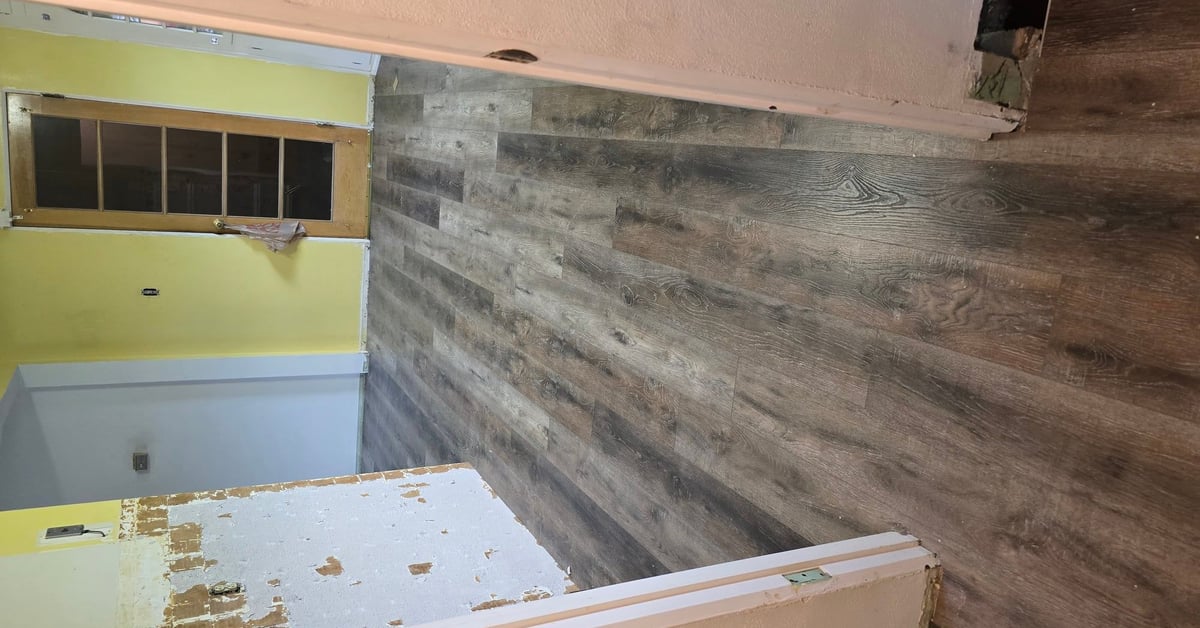
Basement Flooring Restoration Work in Progress
Overhead view into a basement area during renovation, featuring partially installed dark wood-grain laminate or vinyl plank flooring covering most of the floor space. Yellow painted drywall walls on both sides, an open wooden door with glass panels, a white bathtub or shower enclosure in the corner, exposed subfloor in patches, minor debris, and construction edges visible. Suggests water damage restoration with flooring replacement underway.
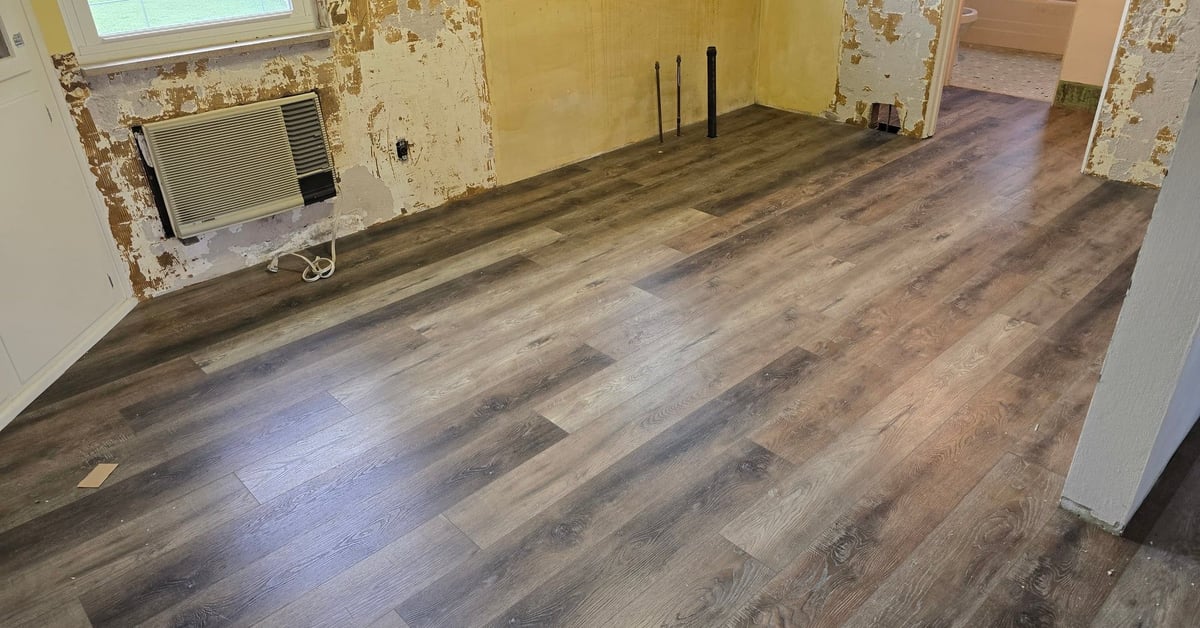
Water Damaged Bathroom Walls with New Flooring
A room undergoing restoration shows severely damaged walls with peeling yellowed plaster and exposed wooden studs, particularly around a window-mounted air conditioning unit. Freshly installed dark laminate flooring with a wood-grain pattern covers the entire floor. An open doorway reveals an adjacent bathroom featuring a white bathtub and tiled walls. Two metal poles stand in one corner, and minor debris is present, indicating active renovation work likely due to prior water damage.
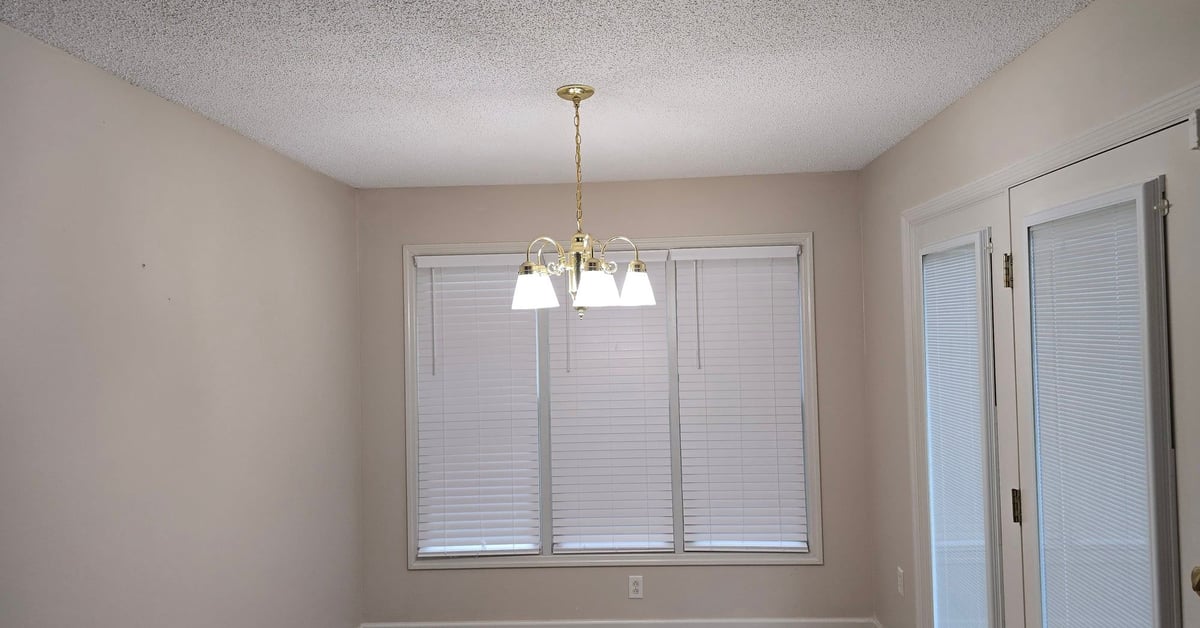
Empty Dining Room with Chandelier and Blinds
A spacious, empty dining room featuring light beige walls, a textured popcorn ceiling, a centered gold-toned four-arm chandelier with glass shades hanging from a chain, three large windows on the left covered with white horizontal blinds, a glass-paneled door on the right with blinds, and brown ceramic tile flooring. The room is clean, well-lit from natural light, and appears freshly restored with no visible damage or furnishings.
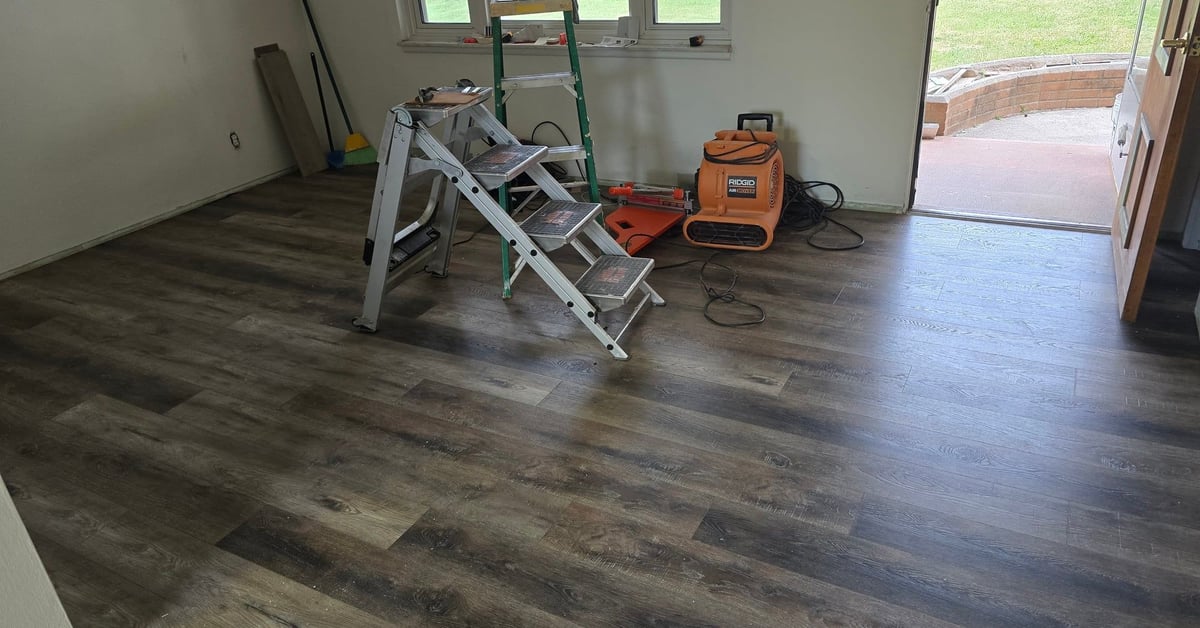
Room Restoration with New LVP Flooring and Equipment
Spacious empty room during restoration work, featuring freshly installed gray luxury vinyl plank (LVP) flooring throughout. An orange commercial air mover/dehumidifier is plugged in and operating in one corner, with orange extension cords nearby. Two aluminum ladders—one extended and one folded—are leaning against the wall, along with a broom, cardboard sheet, and minor wall patch. White walls, large window with view of grass outside, open door showing red truck parked on gravel driveway. Clean, well-lit space with visible electrical outlets and switch plate.
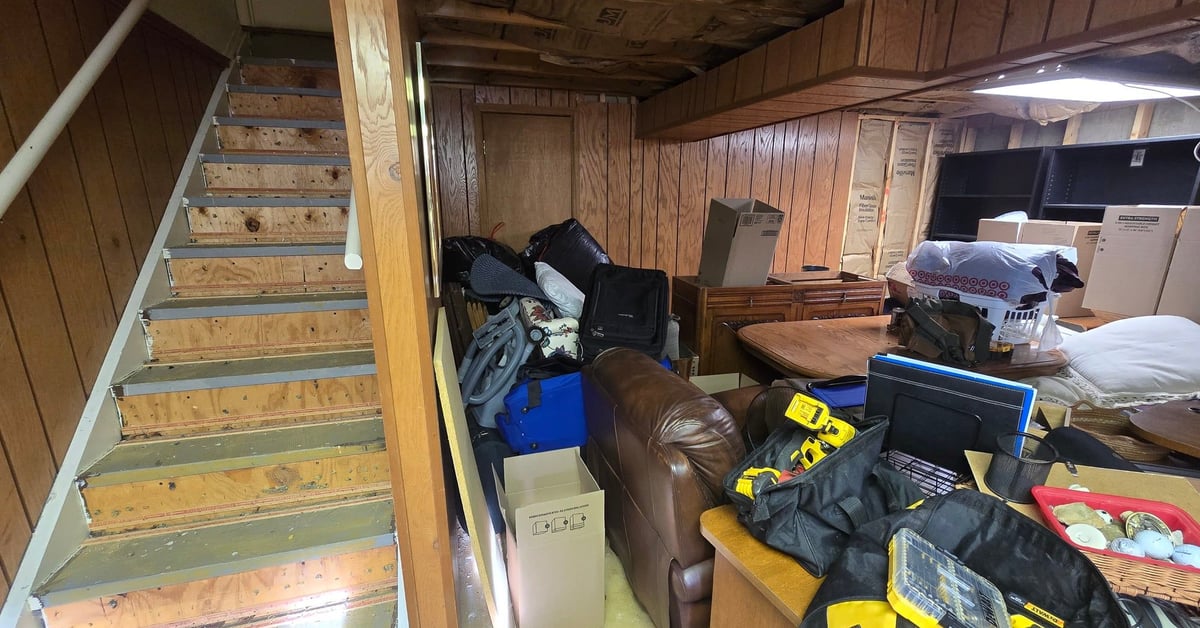
Cluttered Basement Before Restoration Work
A cluttered unfinished basement with wooden paneled walls, exposed wooden beams and pink insulation on the ceiling. A wooden staircase with railing descends from the left side. The floor space is filled with household items including a brown leather armchair, wooden desk cluttered with tools like a yellow drill and cases, multiple cardboard boxes, blue plastic bins, black garbage bags, pillows, baskets, and scattered debris. Fluorescent lighting illuminates the area, suggesting preparation for cleanup or restoration.
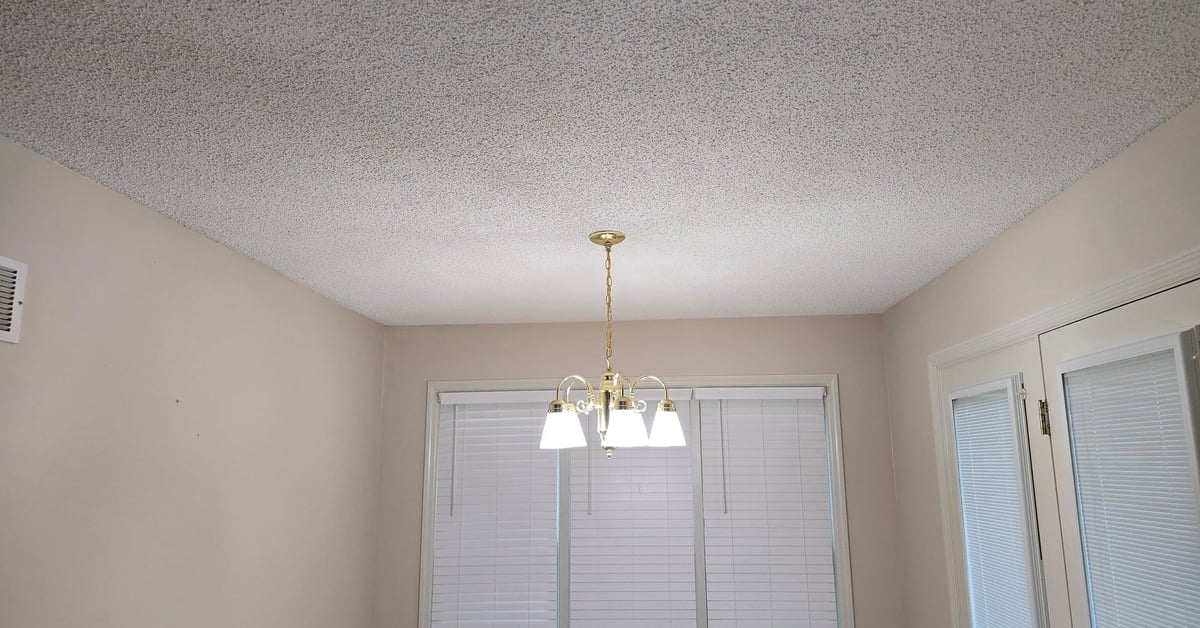
Clean dining room with chandelier and beige walls
A spacious, empty dining room featuring a textured popcorn ceiling, elegant gold chandelier with four bulb fixtures, light beige walls, large triple window covered with white horizontal blinds, and glass-paneled French doors. The room is well-lit, spotless, and appears freshly restored with no signs of damage or ongoing work.
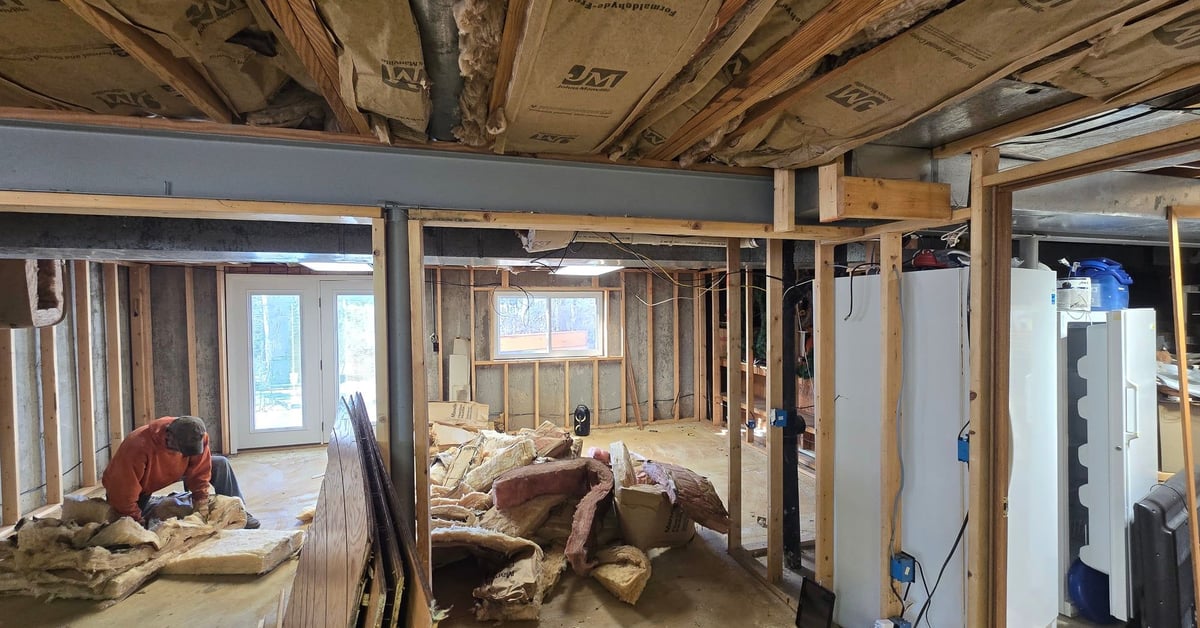
Worker Remodeling Basement with Framing and Insulation
In this basement renovation scene, a worker dressed in an orange uniform and protective gear kneels on the plywood subfloor, working on construction materials. The ceiling features exposed wooden joists wrapped in pink fiberglass insulation batts, some labeled. Walls are framed with wooden studs and metal beams, with partial drywall installation on some sections. Construction debris including wood scraps, insulation remnants, and tools litters the floor. Framed windows and doors allow natural daylight, and white cabinets or shelving units stand along one wall near blue storage bins.
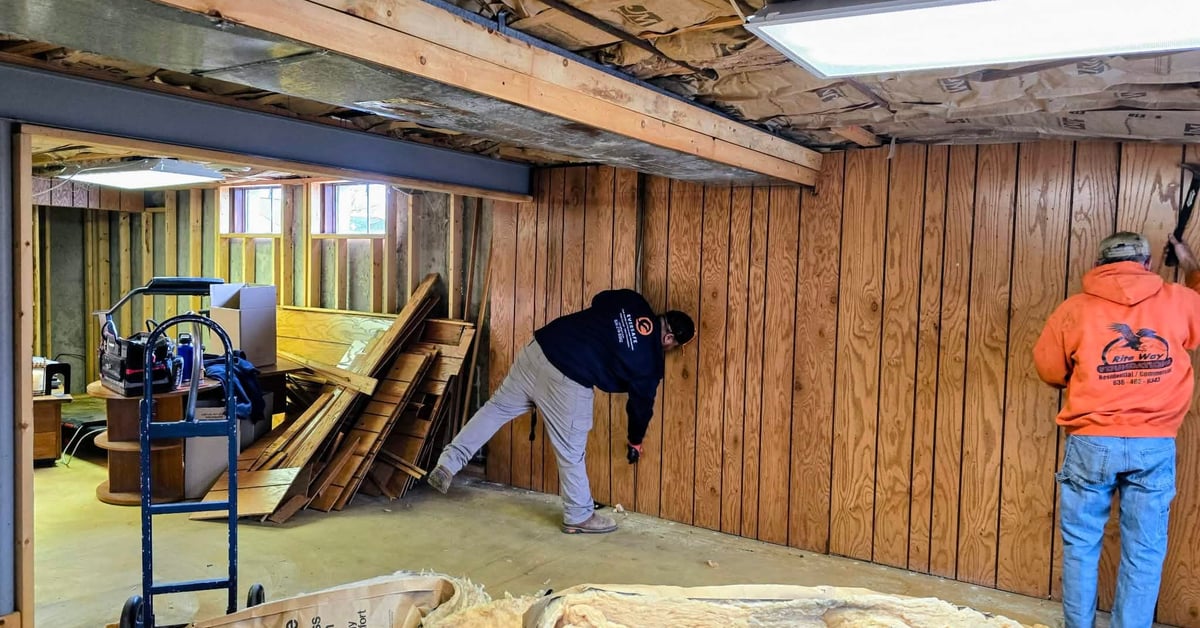
Workers Performing Basement Mold Remediation
In a dimly lit basement with wood-paneled walls partially removed, two workers from Eversafe Restoration LLC are actively engaged in remediation work. One technician, dressed in a blue hoodie, gray pants, and gloves, is crouched low, inspecting or removing sections of wood paneling and exposed pink fiberglass insulation from the wall. The other worker, wearing an orange hoodie and blue jeans, stands nearby observing. Scattered debris including wood scraps, insulation pieces, and plywood sheets lie on the concrete floor. Overhead, exposed wooden beams, yellow electrical wiring, and ductwork are visible under fluorescent lighting. This scene depicts ongoing mold remediation or water damage restoration efforts.
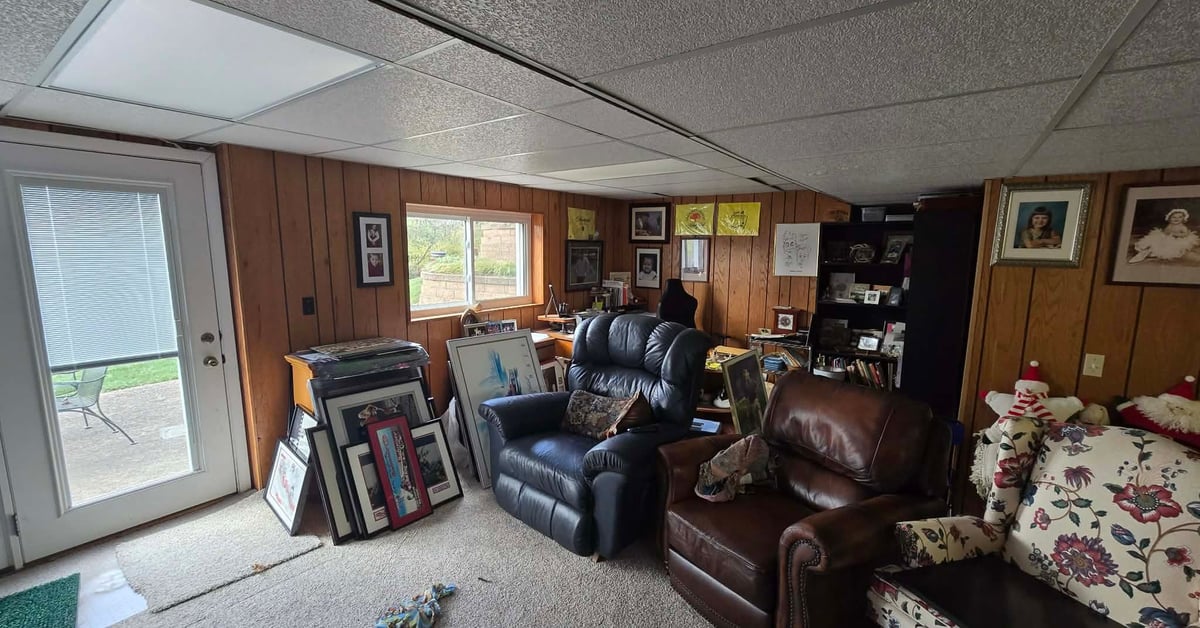
Cozy Basement Family Room with Recliners and Decor
A comfortably furnished basement living room featuring wood-paneled walls, a drop ceiling with fluorescent light panels, and beige carpeted flooring. Two black leather recliner chairs are positioned in the center, one occupied by a small dog. Surrounding furniture includes bookshelves stocked with books and decorative frames, multiple framed pictures and artwork on the walls, a side table with a lamp, scattered toys on the floor, and a glass door with blinds leading to an outdoor area. The room appears clean, organized, and inviting.
Trusted by St. Charles Homeowners
When disaster strikes, our neighbors trust Eversafe Restoration to respond quickly, work professionally, and restore their homes completely.
"Chad fixed my mold. He explained to me exactly how the mold happened and why it would not happen again. He was very kind to me. I explained I was suffering from a medical level of anxiety and he was very understanding. Every day, Chad made sure to communicate clearly and keep me informed throughout the entire process."
Bob Gaines
3 months ago
"Eversafe Restoration was incredible to work with. We had unexpected water damage and Chad responded quickly and professionally. He explained everything clearly and made sure we understood the repair process. The crew was efficient and thorough. Highly recommend!"
Andrea Herron
6 months ago
"They took care in giving me the best service. Very detailed oriented in repairing and finishing moisture damage in my home. They did such an excellent job, I won't think twice about calling Eversafe for anymore restoration needs I have in the future!"
Ryan McGovern
6 months ago
"11/10 would recommend! Great job, great price, and it took them no time at all."
Corey Holmes
3 months ago
"Did a great job."
Matt Guthrie
6 months ago
"Excellent service from start to finish. Professional and reliable."
Destiny Boschert
6 months ago
Frequently Asked Questions About Flood Cleanup
Get detailed answers to common questions about what to do after a house flood, insurance coverage, costs, and the restoration process.
Should I turn off electricity after a flood?
Yes, turning off electricity should be one of your first priorities after discovering a flood in your home, but only if you can do so safely. Water and electricity create a deadly combination, and electrocution is a serious risk in flooded homes. If your electrical panel is located in an area that is dry and you can reach it without walking through standing water, turn off the main breaker immediately. If your panel is in a flooded basement or you would need to wade through water to reach it, do not attempt it yourself. Instead, call your utility company's emergency line and request they disconnect power remotely or send a technician. In Saint Charles County, Ameren Missouri can be reached at their 24-hour emergency line. Once power is disconnected, avoid touching any electrical appliances, outlets, or wiring that may have been in contact with flood water until a licensed electrician inspects them. Even after the water recedes and everything appears dry, electrical systems that were submerged can remain hazardous and may cause fires if energized without proper inspection. This is especially important in older homes common in historic areas of St. Charles and St. Louis, where wiring may already be compromised.
Who should I call first after a house flood?
In an active flooding emergency, your first call should be to a professional restoration company like Eversafe Restoration at (636) 219-9302. Here is why: time is your greatest enemy when dealing with flood water, and a restoration company can begin emergency water extraction immediately while you handle other calls. Every hour that water sits increases damage exponentially and accelerates mold growth. A professional team will arrive with commercial-grade pumps and extraction equipment to stop the damage from spreading. Your second call should be to your insurance company to report the claim. Most policies require prompt notification, and getting your claim on record quickly helps ensure coverage. Have your policy number ready and document the time of your call. Third, if you have not already done so, contact your utility companies if you need help disconnecting power or gas. For gas leaks or if you smell gas, evacuate immediately and call from outside the home. Finally, if the flooding is due to a plumbing failure or burst pipe, call a plumber to address the source of the water. However, do not wait for the plumber before calling for water extraction. The restoration process should begin immediately regardless of whether the water source has been fixed. Our team at Eversafe can help coordinate these calls and guide you through the process.
Can I stay in my house after it floods?
Whether you can safely stay in your home after a flood depends on several factors, but in most cases involving significant flooding, especially from external sources like storms or river overflow, we recommend finding alternative accommodations at least until the water is extracted and the property is assessed. Floodwater from outdoor sources is classified as Category 3 or black water, meaning it contains sewage, bacteria, viruses, chemicals, and other hazardous contaminants. Breathing air in a flooded home exposes you to these pathogens, and the risk increases as the water sits and bacteria multiply. Children, elderly family members, and anyone with respiratory conditions or compromised immune systems are particularly vulnerable. Structural integrity is another concern. Prolonged water exposure can weaken floors, especially in older homes. Walking on waterlogged subflooring or flooring that has been lifted by water can result in falls or collapse. Additionally, the humidity levels in a flooded home create an extremely uncomfortable and unhealthy environment, with air quality deteriorating rapidly as mold begins growing within 24-48 hours. If your insurance policy includes Loss of Use coverage, which is standard in most Missouri homeowner policies, it will pay for hotel accommodations, meals, and other expenses while your home is uninhabitable. Document your evacuation and keep all receipts for reimbursement. Our team can help you understand your coverage and provide documentation your insurance company will need.
How long does it take for mold to grow after a flood?
Mold can begin growing within 24 to 48 hours after flooding under the right conditions, and Missouri's humid climate creates ideal conditions for rapid mold proliferation. This timeline is why immediate water extraction is so critical. Mold spores are naturally present everywhere in the air, and they need only three things to colonize: moisture, an organic food source (like drywall, wood, carpet, or insulation), and time. Floodwater provides abundant moisture and saturates the organic materials throughout your home. The warm, humid conditions typical in the St. Louis metro area during spring and summer further accelerate growth. In the first 24 hours, mold spores land on wet surfaces and begin germinating. Between 24 and 48 hours, hyphal growth begins as the mold establishes itself. By 72 hours, visible mold colonies often appear, though mold may be growing extensively in hidden areas like wall cavities well before you see any visible signs. Different materials support mold growth at different rates. Paper-faced drywall, carpet padding, and wood are highly susceptible and can show mold growth within a day or two. Concrete and other harder surfaces take longer but are not immune. The key to preventing mold is rapid water extraction and professional structural drying that brings moisture levels back to normal within 3 to 5 days. This window is why we emphasize 24/7 emergency response. Every hour of delay increases your risk of a flood cleanup becoming a more extensive and expensive mold remediation project.
What should I throw away after a flood?
After a flood, particularly one involving Category 3 water from storms, river overflow, or sewage backup, many items cannot be safely salvaged and must be discarded. The general rule is that porous materials that have absorbed contaminated flood water cannot be adequately cleaned or disinfected. Mattresses, box springs, and pillows should be discarded. These items absorb water deeply and cannot be dried or sanitized effectively. Contaminated bedding becomes a health hazard and breeding ground for mold. Upholstered furniture, including couches, stuffed chairs, and recliners, typically cannot be saved after flood exposure. The padding and fabric absorb contaminants that cannot be removed. Carpet padding must be removed and discarded even if the carpet itself might be salvageable (though carpet exposed to Category 3 water usually cannot be saved either). All food items that may have been in contact with flood water or were stored in flooded areas must be thrown away, including canned goods with dented, rusted, or damaged labels. Medications and cosmetics exposed to flood water are also contaminated and unsafe. Drywall that has been saturated typically requires removal, often up to at least a foot above the visible water line because water wicks upward through the paper facing. Insulation that has absorbed water, particularly fiberglass batts, must be removed. Particle board furniture, pressed wood, and laminate items that have absorbed water will swell, delaminate, and cannot be restored. Electronics and appliances that were submerged should be professionally inspected before any attempt to use them. Keep samples and photographs of all discarded items for your insurance claim documentation.
How do I document flood damage for insurance?
Thorough documentation is essential for a successful insurance claim after a flood. Begin documenting immediately, even before water extraction begins if you can do so safely. Use your smartphone to take extensive photographs and video of all affected areas. Capture wide shots showing the extent of flooding and close-up shots of damaged items, materials, and structural elements. Include a reference for scale, such as a ruler or common object, and photograph date stamps on newspapers or your phone screen to establish the timeline. Walk through each affected room systematically, narrating what you see on video. Document the water line on walls, damaged flooring, ruined furniture, and any visible mold or contamination. Open closets and cabinets to document their contents. If items are floating or submerged, photograph them before moving anything. Create a detailed inventory list of damaged personal property, including descriptions, approximate age, and estimated replacement cost. Serial numbers for electronics are helpful if available. Keep damaged samples of materials like carpet, drywall, and flooring. Your insurance adjuster may want to examine these, and discarding everything before inspection can complicate your claim. Save all receipts related to the flood, including emergency hotel stays, meals, replacement necessities, and any emergency services. Document all communications with your insurance company, including dates, times, and the names of representatives you speak with. Request that any verbal agreements be confirmed in writing. Professional restoration companies like Eversafe provide detailed documentation including moisture readings, photographs, drying logs, and itemized work reports that support your claim. We work with adjusters regularly and understand what documentation they need to process claims efficiently.
Does standard home insurance cover flooding?
This is one of the most important and misunderstood aspects of flood damage coverage. Standard homeowners insurance policies typically do not cover flood damage from natural external flooding events. There is a critical distinction in insurance terms between water damage and flood damage. Water damage from internal sources, such as burst pipes, appliance failures, water heater leaks, or roof leaks, is usually covered by standard homeowners policies. This is water damage that originates within your property or from precipitation entering through the roof. Flood damage, which is defined as water entering your home from the ground up due to rising water levels, overflowing bodies of water, storm surge, or mudflow, is specifically excluded from standard policies. For flood damage coverage, you need a separate flood insurance policy, most commonly obtained through FEMA's National Flood Insurance Program (NFIP). Properties in designated flood zones, which includes many areas near the Missouri River, Mississippi River, and their tributaries, may be required to carry flood insurance if they have federally-backed mortgages. However, flood insurance is available to any property owner regardless of flood zone designation, and we recommend it for all St. Louis metro homeowners given our region's history. Sewer backup coverage is another consideration. Water that enters your home due to backed-up sewers or drains is often not covered under standard policies but can be added as an endorsement or rider. This coverage is particularly important in older neighborhoods with aging municipal infrastructure. Understanding your coverage before a flood event helps you make informed decisions and avoid unpleasant surprises when filing a claim.
How much does professional flood cleanup cost?
Professional flood cleanup costs in the Saint Charles and St. Louis area typically range from $1,500 for minor incidents to $10,000 or more for extensive flooding, with several factors determining where your project falls in that range. The primary cost factor is the square footage affected. A small bathroom or laundry room flood costs significantly less than a fully flooded basement or main floor. Water extraction is typically priced per square foot, with rates varying based on the volume of water and accessibility of the space. The category of water significantly impacts pricing. Category 1 clean water from a supply line requires less intensive treatment than Category 3 contaminated water from floods, sewage, or outdoor sources. Category 3 water requires full sanitization, antimicrobial treatment, removal of porous materials like drywall and carpet padding, and strict safety protocols that increase labor costs. Structural drying equipment rental adds to the total. Professional-grade LGR dehumidifiers, air movers, and monitoring equipment are essential for proper drying and are typically billed daily. The number of units required depends on the size of the affected area and the materials involved. Most drying takes 3 to 5 days. Additional costs may include demolition and removal of unsalvageable materials, mold prevention treatment, content manipulation (moving and protecting your belongings), and post-drying antimicrobial application. For insurance claims, many of these costs may be covered depending on your policy and the cause of the flood. We provide free on-site assessments and detailed estimates, and we work directly with insurance companies to document damage, maximize your coverage, and handle direct billing when possible. The cost of professional restoration is almost always less than the long-term cost of inadequate cleanup, which often leads to mold remediation projects costing tens of thousands of dollars.
Still have questions?
We're here to help you find the answers.
Flooded Home? We Are Ready to Help.
Every minute counts when your home is flooded. Our Saint Charles team is standing by with commercial-grade equipment ready to respond immediately. Do not wait until tomorrow. Call now and let us help you start recovering.
More Helpful Guides
Flood Cleanup Services
Learn about our professional flood cleanup process, equipment, and how we can help restore your property after water damage.
How Long Does Structural Drying Take?
Understand the drying process timeline, what factors affect duration, and what to expect during professional structural drying.
Need Help After a Flood?
Our Saint Charles team is standing by 24/7 to help with emergency flood cleanup, water extraction, and complete property restoration. Call now for immediate assistance or request a free estimate for non-emergency situations.