8 Warning Signs of Basement Foundation Leaks
Your basement is trying to tell you something. Learn to recognize the early warning signs of foundation water intrusion before small problems become expensive structural repairs. This guide helps St. Louis homeowners identify issues while they are still affordable to fix.
Catching Leaks Early Saves Thousands
Every year, thousands of St. Louis area homeowners discover that their basement has a water problem. Some find standing water after a heavy rain. Others notice a persistent musty smell they cannot quite eliminate. Many simply wake up one day to find white powder coating their basement walls. What all these homeowners have in common is the realization that their foundation has been leaking, sometimes for years, without obvious detection.
The good news is that basement foundation leaks almost always announce themselves before they become emergencies. Your foundation gives you warning signs, subtle at first, then increasingly obvious if ignored. The homeowners who catch these signals early spend hundreds or a few thousand dollars on repairs. Those who miss them or dismiss them as normal basement behavior often face bills of $15,000 or more for structural repairs and mold remediation.
Living in the St. Louis and St. Charles area presents unique challenges for foundation integrity. Our region's clay-heavy soil expands dramatically when wet and contracts when dry, creating a constant push-and-pull pressure against basement walls. Combined with our seasonal weather patterns that bring heavy spring rains followed by summer droughts, local foundations endure stress that accelerates wear and creates pathways for water entry.
This guide will help you recognize the eight most common warning signs of basement foundation leaks. Understanding what to look for empowers you to address problems while they are still manageable. Whether you are a new homeowner learning about your basement or a long-time resident who has noticed changes, this information could save you thousands of dollars and protect your family's health.
The 8 Warning Signs at a Glance
Visual Indicators of Water Intrusion
The most reliable warning signs are often visible if you know where to look. Regular inspection of your basement can catch these indicators before they escalate.
Efflorescence: The White Powder on Your Walls
If you have noticed white, chalky deposits on your basement walls, you are looking at efflorescence, one of the earliest and most reliable indicators that water is infiltrating your foundation. Efflorescence occurs when water moves through concrete or masonry, dissolving naturally occurring mineral salts (primarily calcium carbonate) within the material. As this water reaches the interior surface and evaporates, it leaves behind these mineral deposits as a white, crystalline residue.
While efflorescence itself is not structurally harmful, it is a clear warning sign. Think of it as a message from your foundation: water is getting through. Where efflorescence appears today, active water leaks may appear tomorrow as the microscopic pathways expand. In the St. Louis area, efflorescence commonly increases during our wet spring season when groundwater levels rise and more moisture pushes against foundation walls.
Where to look: Check the lower portions of basement walls, around window wells, along the floor-wall joint (cove joint), and around any visible cracks. Efflorescence often appears in concentrated areas where water entry is most active. Pay special attention to corners, where hydrostatic pressure tends to concentrate.
Do not just clean it away. Wiping off efflorescence without addressing the moisture source means it will return. The deposits themselves are not the problem; they are a symptom.
Foundation Cracks: Horizontal vs. Vertical
Foundation cracks are common in homes of all ages, but not all cracks carry the same implications. Understanding the difference between crack types helps you determine whether you are facing a minor cosmetic issue or a serious structural concern requiring immediate attention.
Horizontal cracks are the most concerning. They indicate lateral pressure against your foundation wall, typically from expanding clay soil or hydrostatic pressure from groundwater. When soil surrounding your foundation becomes saturated, it expands and pushes inward against the walls. Horizontal cracks suggest this pressure is exceeding what the wall can safely absorb. Left unaddressed, horizontal cracks can lead to wall bowing, buckling, and eventual structural failure. In the St. Louis area, horizontal cracks are particularly common due to our expansive clay soil.
Vertical cracks are usually caused by concrete curing and shrinkage and are often less serious from a structural standpoint. However, they can still serve as pathways for water entry and should be sealed. Hairline vertical cracks in poured concrete foundations are common and not necessarily alarming, but any vertical crack that is growing, wider than 1/8 inch, or actively leaking water needs professional evaluation.
Stair-step cracks follow the mortar joints in block or brick foundations in a diagonal pattern. These typically indicate foundation settling or shifting and often appear near corners. Stair-step cracks can allow significant water entry and usually indicate differential settlement, meaning one part of your foundation is moving relative to another.
High-Risk Crack Signs
- Horizontal orientation
- Width greater than 1/4 inch
- Actively growing (fresh concrete dust)
- Wall bowing or displacement
- Water actively flowing through
Lower-Risk Crack Signs
- Vertical orientation, hairline width
- Has not changed over time
- No water entry visible
- Wall is straight, not bowed
- Located away from corners
Cove Joint Staining: Where Wall Meets Floor
The cove joint is the seam where your basement wall meets the floor slab. In most homes, this joint was never sealed during construction because the wall and floor are poured at different times and naturally remain separate. This makes the cove joint the single most common water entry point in residential basements.
Water that accumulates in the soil around and beneath your foundation follows the path of least resistance. The gap at the cove joint provides an easy entry point, especially when hydrostatic pressure builds during and after heavy rains. Once water enters here, it spreads across the floor and can be mistaken for a floor crack or drain problem.
What to look for: Walk the perimeter of your basement and examine where the walls meet the floor. Look for staining, discoloration, mineral deposits, or actual dampness along this seam. Sometimes the evidence is a darker color in the concrete, a slightly different texture, or a visible water line. During or immediately after rain, you may see water actively seeping through or pooling along the cove joint.
In homes built on St. Louis area clay soil, cove joint leaks are especially common because the expansive soil creates voids when it shrinks, allowing water to collect at the base of the foundation. When the soil re-expands, it forces this collected water through the cove joint under pressure.
Peeling Paint and Bubbling Wallpaper
Paint and wallpaper are designed to adhere to dry surfaces. When moisture migrates through foundation walls, it disrupts this adhesion and creates visible damage that serves as an early warning system. These cosmetic failures are actually your home telling you that water is present behind the surface.
Peeling and flaking paint occurs when moisture pushes against the back of the paint film, breaking its bond with the concrete or drywall beneath. You may see paint bubbling away from the wall, creating blisters that contain moisture or air. When these blisters are punctured, they often reveal damp concrete beneath. Paint may also simply flake off in sheets or become powdery to the touch.
Bubbling wallpaper follows the same principle. Moisture behind the wallpaper causes the adhesive to fail and the paper to separate from the wall. Wallpaper may appear wavy, bubble outward, or peel away at seams and edges. In severe cases, wallpaper can completely release from the wall and fall.
Discoloration is another common sign. Yellow, brown, or gray staining on painted surfaces often indicates that water has been present and evaporated, leaving behind mineral deposits or promoting mold growth behind the surface.
If you are considering repainting your basement, take paint failure as an opportunity to investigate the underlying moisture issue. Repainting over a wet wall will only result in repeated failure and wasted money. Address the water intrusion first, then repaint with moisture-resistant products designed for below-grade applications.
The Sensory Signs: Smell and Feel
Not all warning signs are visible. Your nose and your sense of the air quality in your basement can detect problems that your eyes might miss.
Musty Odors: The Hidden Mold Indicator
That characteristic basement smell, often described as musty, earthy, or damp, is not simply how basements are supposed to smell. This odor is produced by mold, mildew, and bacteria releasing volatile organic compounds as they digest organic materials in the presence of moisture. A persistent musty smell is one of the most reliable indicators that hidden microbial growth is occurring somewhere in your basement.
What makes musty odors particularly important as a warning sign is that they often indicate problems you cannot see. Mold can grow extensively behind walls, beneath flooring, inside wall cavities, and in other concealed spaces. By the time you smell it, significant growth may already be present. The organisms producing these odors only need moisture, warmth, and organic food sources, all of which are abundant in most basements.
The health implications matter too. The same MVOCs (microbial volatile organic compounds) that create musty odors can irritate respiratory systems and trigger allergic reactions. Many homeowners become accustomed to their basement's smell over time, not realizing that what they have normalized is actually a sign of chronic mold exposure affecting their indoor air quality.
If your basement has a persistent musty smell, do not assume it is normal. Investigate by looking for visible moisture, checking for hidden leaks behind stored items, and consider professional air quality testing to determine mold spore levels. Addressing the moisture source that is feeding microbial growth is the only permanent solution.
A healthy basement should smell neutral, like the rest of your home. Any persistent earthy or musty odor indicates a moisture problem.
Increased Humidity Levels
If your basement feels noticeably more humid than the rest of your home, or if your dehumidifier runs constantly during humid seasons, water is entering your space faster than normal ventilation and dehumidification can remove it. Elevated humidity is both a symptom of water intrusion and a contributor to ongoing damage.
Ideal basement humidity should stay between 30% and 50% year-round. A simple hygrometer (available at any hardware store for under $20) can tell you your actual humidity level. During Missouri's humid summers, maintaining these levels requires active dehumidification even in well-sealed basements. However, if your dehumidifier is working overtime or your basement's relative humidity regularly exceeds 60%, water is entering somewhere.
Sources of excess humidity include water seeping through foundation walls, moisture wicking up through the floor slab, high water tables that create constant vapor pressure, and inadequate drainage around your foundation. Each of these conditions allows moisture to enter your basement continuously, overwhelming dehumidification equipment designed for normal moisture loads.
The danger of chronic high humidity is that it creates ideal conditions for mold growth, dust mite proliferation, and material degradation even without visible water entry. Wood, cardboard, paper, and fabric stored in humid basements will absorb moisture and can develop mold. High humidity also accelerates concrete deterioration and corrosion of metal components.
Condensation on Surfaces
Water droplets forming on cold water pipes, basement windows, or concrete walls are signs of excessive moisture in the air meeting cooler surfaces. While some condensation is normal in basements, persistent or heavy condensation indicates humidity levels that support mold growth and material damage.
Cold water pipes are natural condensation points because their surface temperature is well below the dew point of humid basement air. A thin film of moisture on pipes during hot, humid weather may be acceptable, but if pipes are constantly dripping or if you see water pooling beneath them, your basement's humidity is too high.
Basement windows that regularly fog over or show water streaming down the glass are another indicator. Single-pane windows in older homes are particularly prone to condensation, but even modern double-pane windows will condense in excessively humid conditions.
Concrete surfaces can also show condensation, though this is sometimes confused with water seeping through the foundation. A simple test: tape a piece of plastic sheeting tightly to the wall for 24-48 hours. If moisture appears on the outside of the plastic (facing the room), you have condensation from humid air. If moisture appears on the inside (against the concrete), water is coming through the foundation.
Condensation by itself may seem harmless, but the moisture it deposits feeds mold growth, rusts metal, damages stored items, and contributes to wood rot in structural components. Additionally, if condensation is occurring, conditions are already favorable for mold growth on cooler surfaces throughout your basement.
Damp Spots, Warped Baseboards, and Flooring Damage
Flooring and baseboards are often the final stop for moisture that has traveled through or beneath your foundation. By the time damage appears at floor level, water has typically been present long enough to cause problems in hidden areas as well.
Damp spots on carpet can indicate water entry from below (through the slab) or from the walls (traveling down to floor level). These spots may appear randomly in the middle of the floor or concentrated along walls. Carpet that has absorbed moisture often feels cold to the touch and develops a musty smell. If you pull back the carpet edge, you may find wet or discolored padding and moisture on the concrete beneath.
Warped or buckling baseboards occur when wood absorbs moisture from the adjacent wall or floor. Baseboards may pull away from the wall, develop a wavy appearance, show discoloration at the bottom edge, or feel soft when pressed. Paint on baseboards may also bubble, peel, or show water staining.
Flooring damage varies by material. Laminate and engineered wood floors are particularly sensitive to moisture, showing warping, buckling, gaps between planks, or separation at seams. Vinyl flooring may develop bubbles or release from the adhesive. Even concrete floors can show damage, including surface spalling, efflorescence, or visible moisture.
Because flooring damage indicates that moisture has been present long enough to penetrate finishing materials, it is often accompanied by hidden damage in wall cavities, subfloor materials, and structural components. When you see flooring damage, a thorough inspection of the moisture source and extent of hidden damage is warranted.
Why St. Louis Area Homes Are Especially Vulnerable
If you own a home in the St. Louis or St. Charles metropolitan area, your foundation faces challenges that homeowners in other regions do not encounter. Understanding why our local conditions create foundation stress helps explain why these warning signs deserve prompt attention.
Expansive clay soil is the primary culprit. Unlike sandy or loamy soils that drain freely and maintain consistent volume, the clay soil prevalent throughout the St. Louis region absorbs enormous amounts of water and expands accordingly. When wet, clay can increase in volume by 10% or more. When dry, it shrinks by similar amounts, leaving gaps around your foundation. This constant expand-and-contract cycle puts tremendous pressure on basement walls during wet periods and allows water to collect at the foundation during dry periods.
Seasonal weather patterns exacerbate the problem. Missouri's climate features distinct wet and dry seasons. Spring typically brings heavy rainfall, saturating clay soil and raising the water table. Summer heat then bakes the soil, causing it to shrink and pull away from foundations. Fall rains re-saturate the soil, and winter introduces freeze-thaw cycles that can crack concrete and expand existing fractures. This continuous cycle ages foundations faster than in more temperate or arid climates.
Foundation construction practices have varied significantly over the decades. Many homes built in the St. Charles area during the 1950s through 1980s lack modern waterproofing systems. Older homes may have block foundations rather than poured concrete, drainage systems that have deteriorated or clogged, or no interior drainage system at all. As these homes age, their vulnerability to water intrusion increases.
Service Area Insight
Our service area includes communities built on some of Missouri's most challenging soil conditions. From older neighborhoods in Saint Charles with clay and fill soil, to newer developments in Wentzville and O'Fallon where construction disturbed native soil profiles, each area presents unique foundation challenges.
What To Do If You Recognize These Signs
If you have identified one or more warning signs in your basement, the next step is professional evaluation. Foundation leak diagnosis requires experience to distinguish between different moisture sources and determine appropriate solutions. What appears to be a simple crack sealing job may actually require interior or exterior drainage improvements. What looks like condensation may actually be active seepage through the foundation.
Free Foundation Inspection
We provide complimentary foundation inspections throughout the St. Louis metro area. Our technicians will identify moisture sources, assess crack severity, and recommend appropriate solutions based on your specific situation and budget.
Do Not Wait for Visible Water
The warning signs discussed in this guide typically appear before active leaking. Addressing these early indicators is far less expensive than waiting for water damage, mold remediation, or structural repairs.
Noticed Any of These Warning Signs?
Schedule your free foundation inspection today. Our Saint Charles team will evaluate your basement, identify moisture sources, and provide honest recommendations. There is no obligation, and catching problems early saves thousands.
Foundation Leak Repairs in Action
See examples of basement waterproofing, crack repair, and moisture remediation projects from homes throughout St. Charles County and the greater St. Louis metro area.
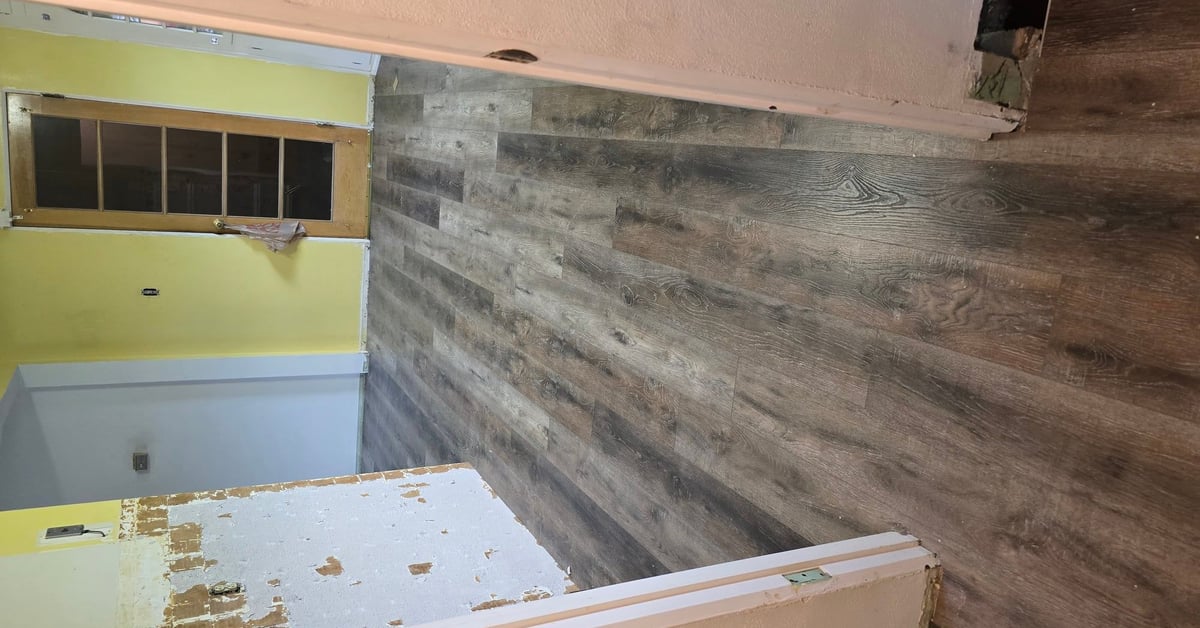
Basement Flooring Restoration Work in Progress
Overhead view into a basement area during renovation, featuring partially installed dark wood-grain laminate or vinyl plank flooring covering most of the floor space. Yellow painted drywall walls on both sides, an open wooden door with glass panels, a white bathtub or shower enclosure in the corner, exposed subfloor in patches, minor debris, and construction edges visible. Suggests water damage restoration with flooring replacement underway.
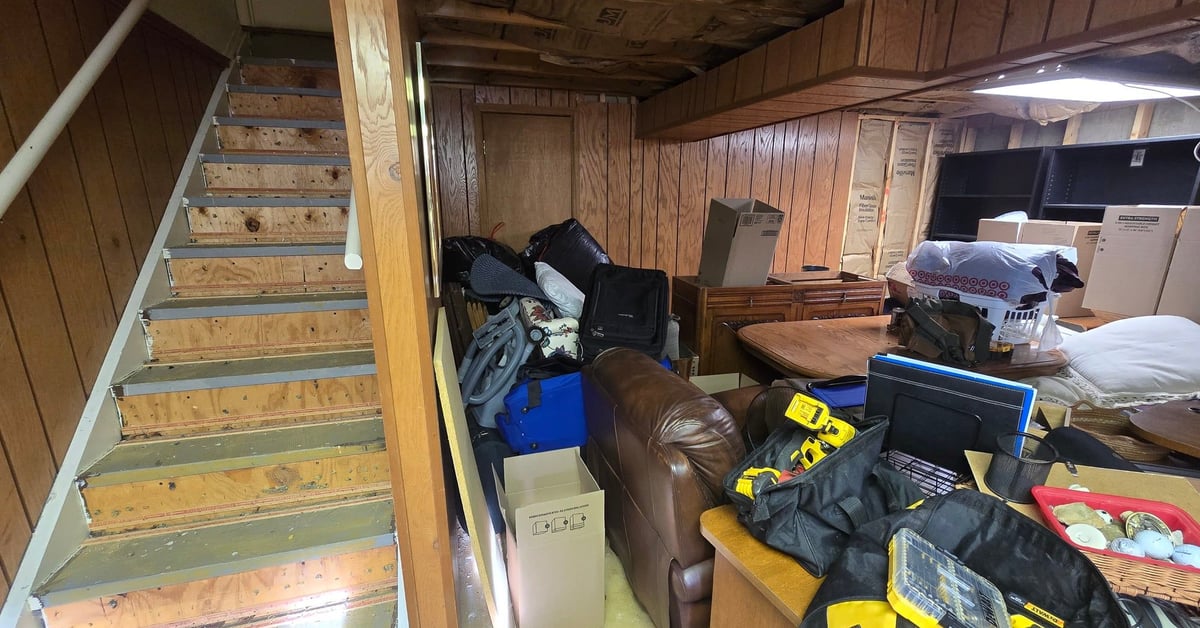
Cluttered Basement Before Restoration Work
A cluttered unfinished basement with wooden paneled walls, exposed wooden beams and pink insulation on the ceiling. A wooden staircase with railing descends from the left side. The floor space is filled with household items including a brown leather armchair, wooden desk cluttered with tools like a yellow drill and cases, multiple cardboard boxes, blue plastic bins, black garbage bags, pillows, baskets, and scattered debris. Fluorescent lighting illuminates the area, suggesting preparation for cleanup or restoration.
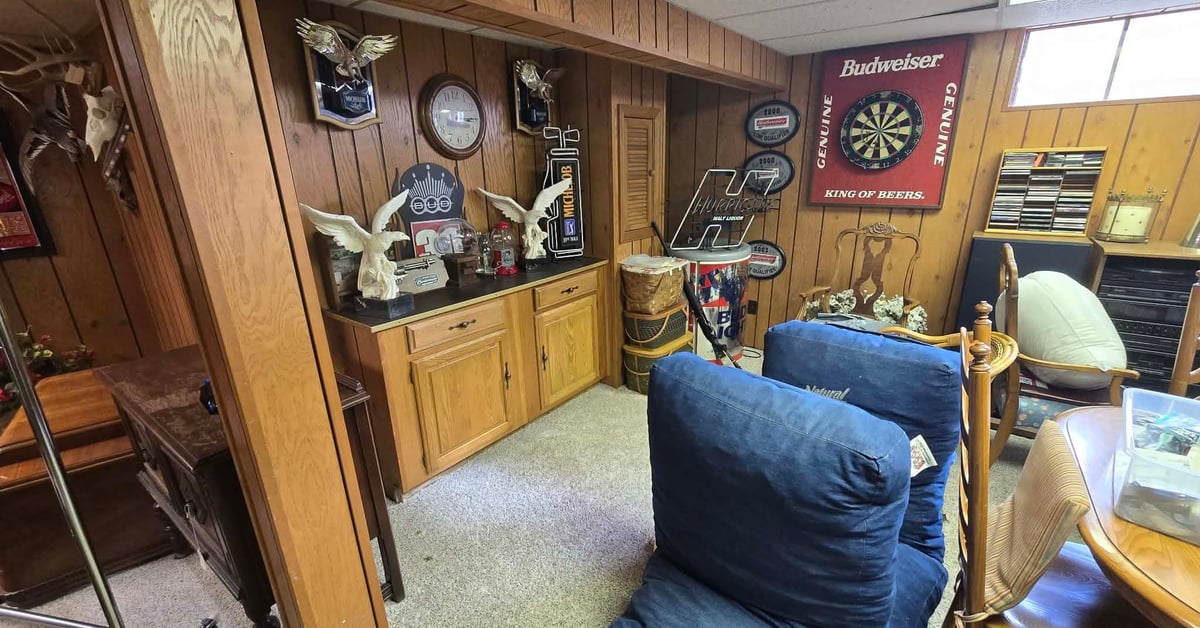
Cozy Wood-Paneled Basement Man Cave Bar
A finished basement recreation room with warm wood paneling on walls and ceiling. Features include mounted deer heads and antlers, Budweiser beer signs, dartboard, shelves displaying figurines, bottles, and collectibles, a bar area with stools, blue bean bag chairs, wooden table and chairs, and various rustic decor elements creating a classic man cave atmosphere.
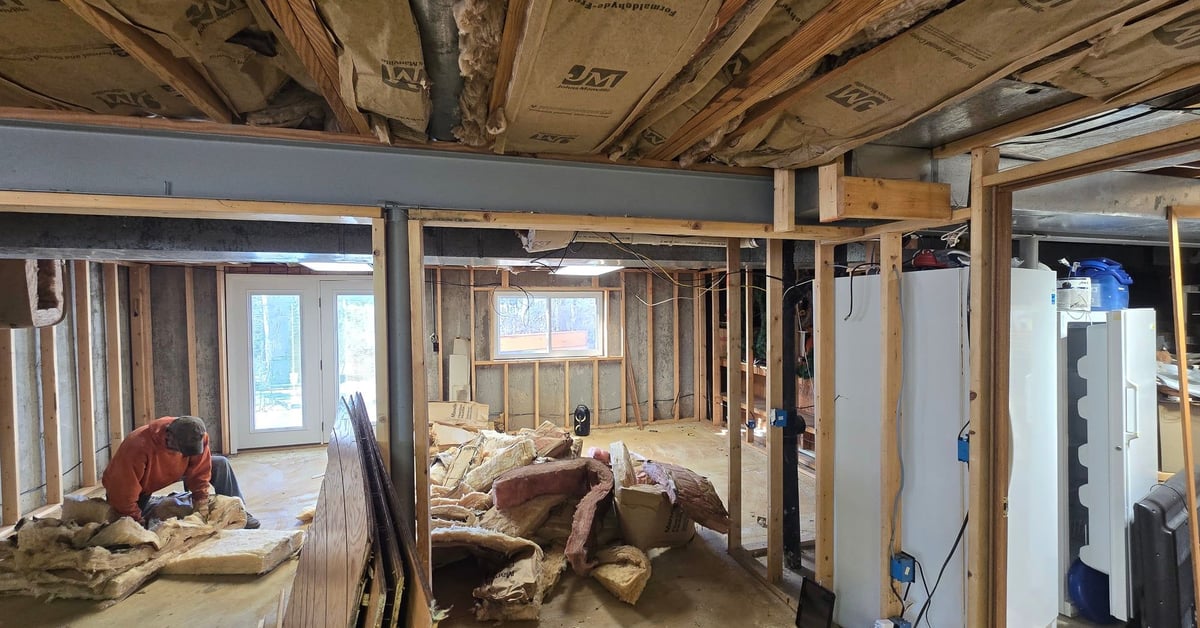
Worker Remodeling Basement with Framing and Insulation
In this basement renovation scene, a worker dressed in an orange uniform and protective gear kneels on the plywood subfloor, working on construction materials. The ceiling features exposed wooden joists wrapped in pink fiberglass insulation batts, some labeled. Walls are framed with wooden studs and metal beams, with partial drywall installation on some sections. Construction debris including wood scraps, insulation remnants, and tools litters the floor. Framed windows and doors allow natural daylight, and white cabinets or shelving units stand along one wall near blue storage bins.
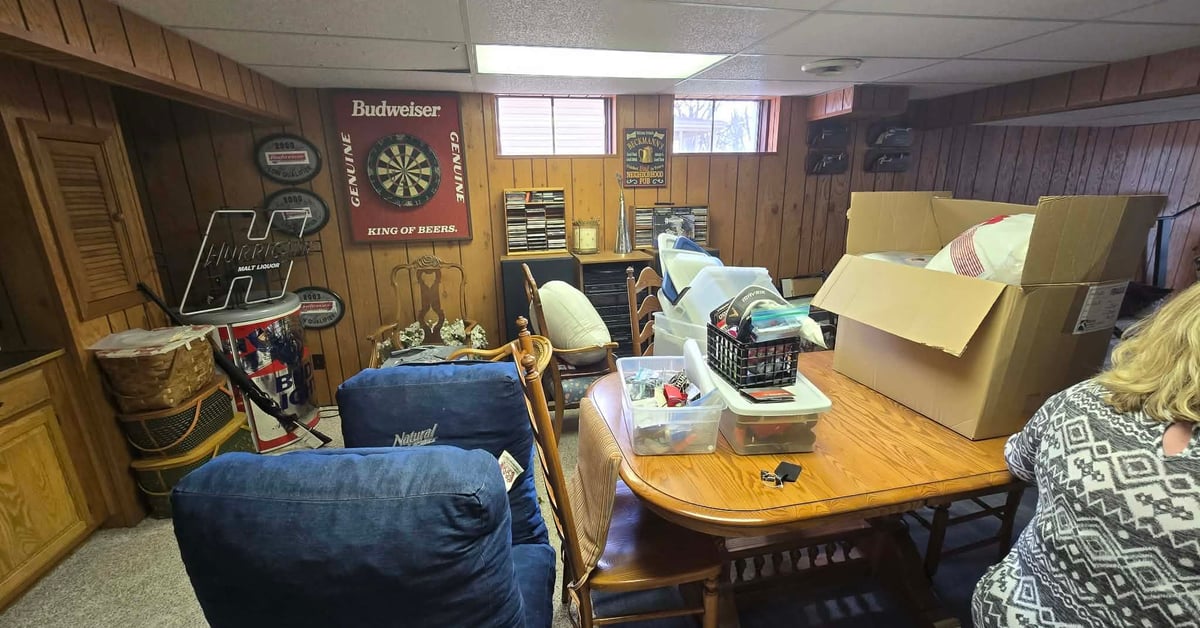
Cluttered Wood-Paneled Basement Rec Room
A basement recreation room with dark wood paneling on walls and ceiling, illuminated by fluorescent lights. Features include a dartboard with Budweiser branding, neon signs, shelves with beer memorabilia, wooden bar stools, blue upholstered armchairs, and an oval wooden table piled high with cardboard boxes, plastic storage bins, and miscellaneous items. A decorative barrel drum sits in one corner, and a woman with long blonde hair in a patterned top stands near the table. The space appears lived-in and cluttered, suggesting preparation for cleanup or restoration.
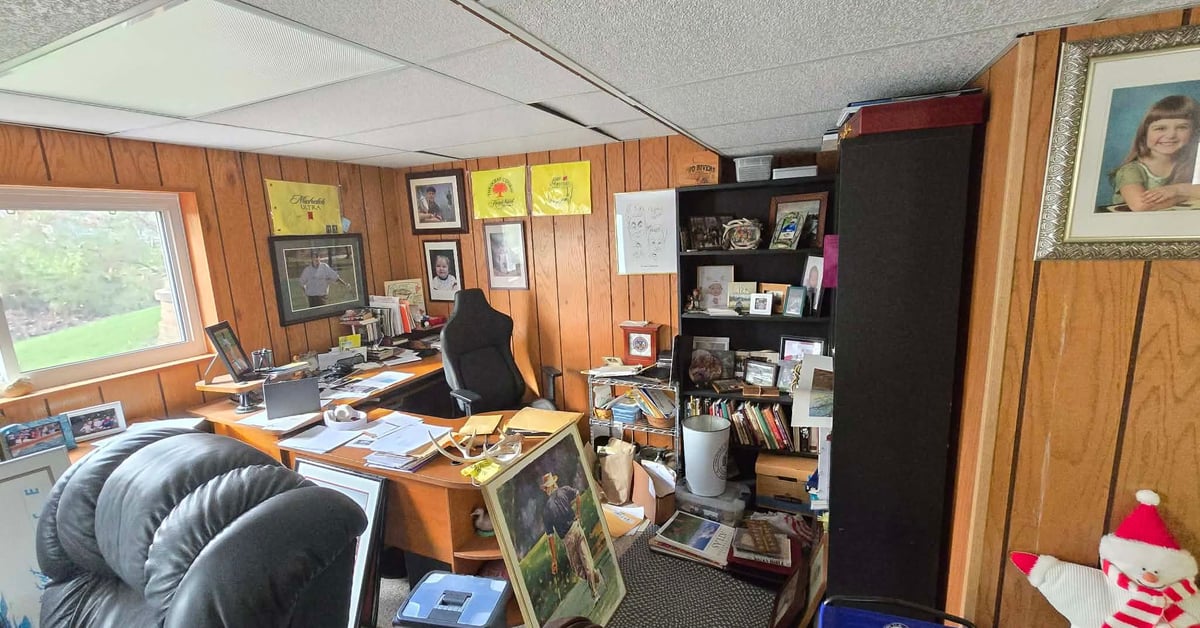
Cluttered Wood-Paneled Basement Home Office
A cluttered basement home office featuring wood-paneled walls, drop ceiling with fluorescent lighting, a large wooden desk with dual computer monitors, keyboard, papers, and office supplies, an ergonomic black gaming chair, additional leather chairs, overloaded bookshelves with books, photo frames, knick-knacks, and storage bins, framed pictures and posters on walls, a window with view of green grass outside, a Santa Claus plush doll, plants in frames, and various personal decorations scattered around the carpeted floor.
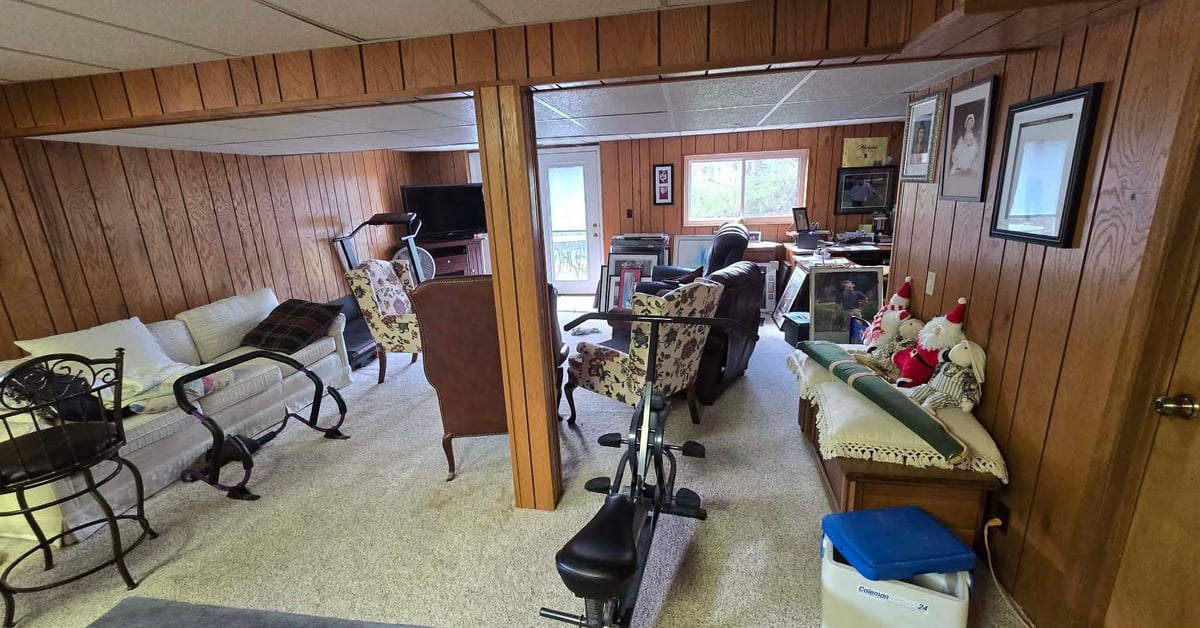
Cluttered Wood-Paneled Basement Living Area
A dimly lit basement room featuring dark wood-paneled walls and ceiling, with a gray carpeted floor. The space includes a large L-shaped couch with white cushions covered in blankets and pillows, several armchairs, a wooden bar stool, a stationary exercise bike, a TV mounted on a stand, framed pictures on the walls, a blue cooler, shelves with books and decorations, stuffed holiday animals on the floor, and an open doorway leading to another area. The room appears lived-in, disorganized, and cluttered with personal items.
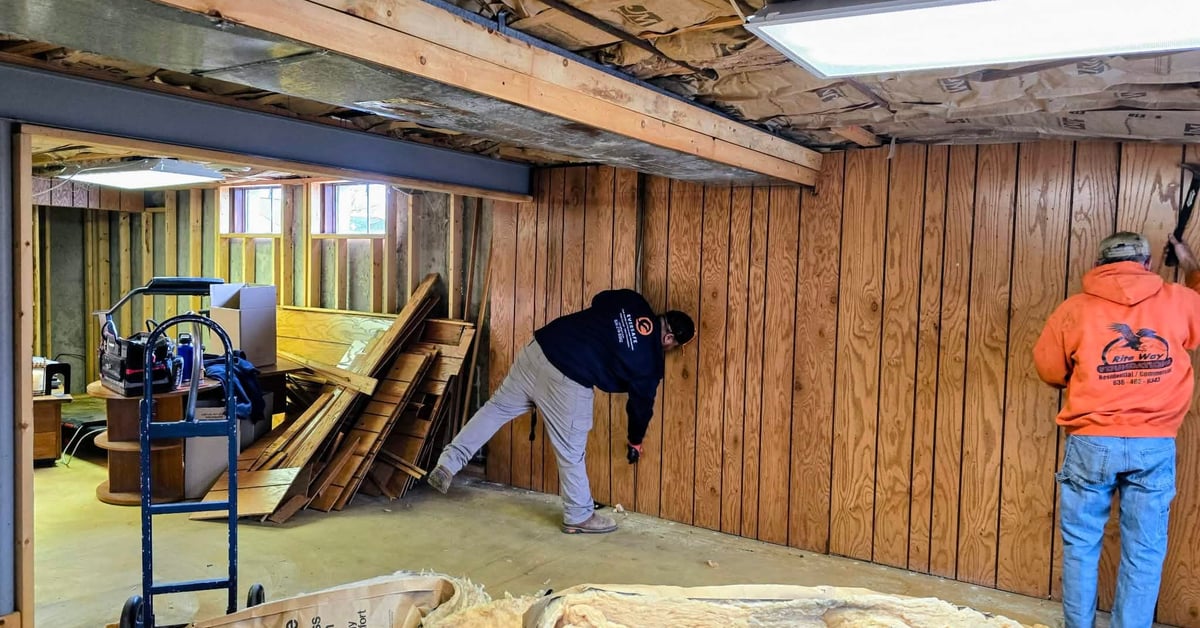
Workers Performing Basement Mold Remediation
In a dimly lit basement with wood-paneled walls partially removed, two workers from Eversafe Restoration LLC are actively engaged in remediation work. One technician, dressed in a blue hoodie, gray pants, and gloves, is crouched low, inspecting or removing sections of wood paneling and exposed pink fiberglass insulation from the wall. The other worker, wearing an orange hoodie and blue jeans, stands nearby observing. Scattered debris including wood scraps, insulation pieces, and plywood sheets lie on the concrete floor. Overhead, exposed wooden beams, yellow electrical wiring, and ductwork are visible under fluorescent lighting. This scene depicts ongoing mold remediation or water damage restoration efforts.
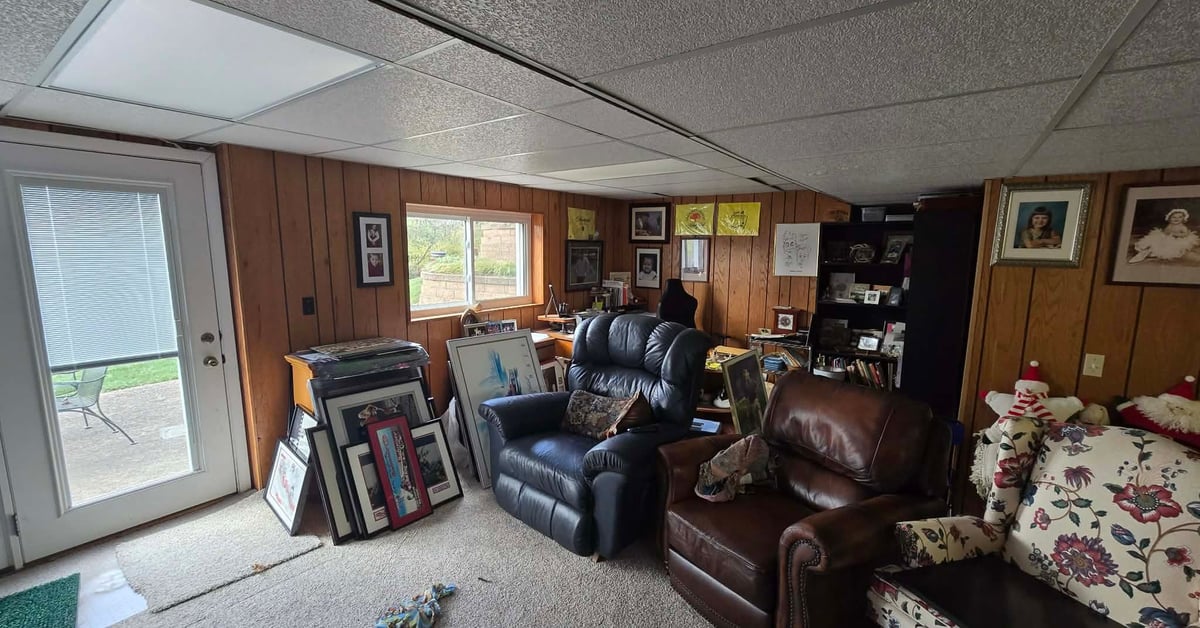
Cozy Basement Family Room with Recliners and Decor
A comfortably furnished basement living room featuring wood-paneled walls, a drop ceiling with fluorescent light panels, and beige carpeted flooring. Two black leather recliner chairs are positioned in the center, one occupied by a small dog. Surrounding furniture includes bookshelves stocked with books and decorative frames, multiple framed pictures and artwork on the walls, a side table with a lamp, scattered toys on the floor, and a glass door with blinds leading to an outdoor area. The room appears clean, organized, and inviting.
Trusted by St. Charles Homeowners
When basement moisture threatens your home, our neighbors trust Eversafe Restoration to provide honest assessments and effective solutions.
"Chad fixed my mold. He explained to me exactly how the mold happened and why it would not happen again. He was very kind to me. I explained I was suffering from a medical level of anxiety and he was very understanding. Every day, Chad made sure to communicate clearly and keep me informed throughout the entire process."
Bob Gaines
3 months ago
"Eversafe Restoration was incredible to work with. We had unexpected water damage and Chad responded quickly and professionally. He explained everything clearly and made sure we understood the repair process. The crew was efficient and thorough. Highly recommend!"
Andrea Herron
6 months ago
"They took care in giving me the best service. Very detailed oriented in repairing and finishing moisture damage in my home. They did such an excellent job, I won't think twice about calling Eversafe for anymore restoration needs I have in the future!"
Ryan McGovern
6 months ago
"11/10 would recommend! Great job, great price, and it took them no time at all."
Corey Holmes
3 months ago
"Did a great job."
Matt Guthrie
6 months ago
"Excellent service from start to finish. Professional and reliable."
Destiny Boschert
6 months ago
Serving the Greater St. Louis Metro Saint Charles
Conveniently located in Saint Charles to serve homeowners throughout the region with foundation inspections and waterproofing services.
Hours
Monday - Friday: 9am - 6pm
Saturday: 9am - 5pm
Sunday: Closed
Frequently Asked Questions About Basement Leaks
Get detailed answers to common questions about foundation leak warning signs, causes, costs, and solutions specific to the St. Louis area.
Why is my basement floor damp?
A damp basement floor typically results from one of three primary causes. First, hydrostatic pressure occurs when the water table rises, especially during Missouri's wet spring and fall seasons. This groundwater pushes up against your foundation from below, forcing moisture through the concrete slab. Second, capillary action allows water to wick upward through porous concrete even without standing water present. Concrete may feel solid, but it contains microscopic pathways that draw moisture through capillary suction. Third, sump pump failure can cause water to accumulate beneath and around your slab if the pump stops working during a storm or loses power. In the St. Louis metro area, our clay-heavy soil compounds these issues because it holds water longer than sandy soils, keeping the soil surrounding your foundation saturated for extended periods. If you notice your basement floor is consistently damp, especially in certain areas or after rain, you should have the foundation inspected to determine the source before moisture leads to mold growth or structural issues.
How to tell if a foundation crack is serious?
Not all foundation cracks are created equal, and understanding which ones signal serious problems can save you thousands in repairs. Horizontal cracks are the most concerning because they indicate lateral pressure against your foundation wall, often from expansive clay soil or hydrostatic pressure. These cracks suggest the wall is being pushed inward and may eventually bow or fail without intervention. Cracks wider than one-quarter inch require immediate professional attention, as they indicate significant movement that will likely worsen over time. Stair-step cracks in block or brick foundations follow the mortar joints in a diagonal pattern and typically indicate settling or shifting of the foundation. Vertical cracks, while common and often less serious, can still allow water intrusion and should be sealed. Cracks that are wider at the top than the bottom may indicate foundation settlement on one side of your home. Any crack that is actively growing, showing fresh concrete dust, or allowing visible water entry needs professional evaluation. In the St. Louis area, our clay soil's shrink-swell cycles put enormous pressure on foundations, making crack monitoring especially important.
What is the white powder on my basement walls?
The white, chalky powder commonly seen on basement walls is called efflorescence, and it is one of the earliest warning signs of water infiltration through your foundation. Efflorescence forms when water moves through concrete or masonry, dissolving mineral salts within the material. As this water reaches the interior surface and evaporates, it leaves these mineral deposits behind as a white crystalline residue. While efflorescence itself is not harmful, it is a clear indicator that water is actively moving through your foundation walls. Where you see efflorescence today, you may see active water leaks tomorrow as the pathways through the concrete expand. The presence of efflorescence often increases during wet seasons when more water is present in the soil surrounding your foundation. In Missouri homes, efflorescence commonly appears along the lower portions of basement walls, around window wells, and near floor-wall joints. Cleaning the efflorescence away without addressing the underlying moisture problem will only result in its return. If you are seeing efflorescence, it is time to investigate the source of moisture and consider waterproofing solutions before the problem escalates to visible water entry or mold growth.
Can a small leak cause structural damage?
Yes, even small leaks can cause significant structural damage over time through several mechanisms. First, water erodes soil around and beneath your foundation footings, creating voids that lead to settling and cracking. This process happens slowly but progressively, with each rain event washing away a bit more supporting soil. Second, persistent moisture causes wood rot in floor joists, sill plates, and other structural wood components that rest on or near the foundation. Once wood rot begins, it accelerates because damaged wood holds moisture longer. Third, the freeze-thaw cycle in Missouri winters turns small cracks into larger ones as water enters cracks, freezes, expands, and widens the opening. Fourth, chronic moisture attracts termites and other wood-destroying insects that can cause extensive hidden damage to your home's structure. Fifth, hydrostatic pressure from accumulated water can push against walls, eventually causing bowing or displacement. Many homeowners are surprised to learn that a seemingly minor seep that has been present for years has caused thousands of dollars in structural damage. The cost of addressing a small leak early is almost always far less than repairing structural damage later. If you notice any persistent moisture in your basement, have it evaluated before small problems become major repairs.
Does Missouri soil cause more foundation leaks?
Yes, Missouri's soil composition is a primary contributor to foundation problems throughout the St. Louis and St. Charles metropolitan area. The majority of our region sits on expansive clay soil, which undergoes significant volume changes as moisture levels fluctuate. During wet periods, clay soil absorbs water and expands dramatically, putting lateral pressure against foundation walls. During dry periods, the same soil shrinks and pulls away from the foundation, leaving gaps that allow water to flow directly against the basement walls during the next rain. This shrink-swell cycle, repeated hundreds of times over the life of a home, places enormous stress on foundations. The St. Louis area's climate exacerbates this problem with distinct wet and dry seasons. Spring brings heavy rainfall that saturates clay soil, while summer heat can create drought conditions that cause significant soil shrinkage. Homes built in the 1950s through 1980s, common throughout St. Charles County and surrounding areas, often lack modern waterproofing methods and are particularly vulnerable to clay soil damage. The combination of expansive clay soil, seasonal moisture variations, and aging foundation systems makes basement waterproofing especially important for Missouri homeowners. Understanding that your foundation is constantly battling soil pressure helps explain why proactive waterproofing is an investment in your home's long-term structural health.
How much does it cost to fix a basement leak?
Basement leak repair costs in the St. Louis metro area vary widely depending on the severity and source of the problem. Minor repairs such as crack injections typically range from $500 to $1,500 per crack. These epoxy or polyurethane injections seal individual cracks from the inside and can be effective for hairline vertical cracks that are not actively growing. However, if the underlying cause of water pressure is not addressed, new cracks may develop nearby. Interior drainage systems, including drain tile installation along the interior perimeter with a sump pump, generally cost between $3,000 and $8,000 depending on the basement's size and accessibility. Exterior waterproofing, which involves excavating around the foundation to apply waterproof membranes and install drainage, ranges from $10,000 to $25,000 or more for complete coverage. For homes with significant structural damage from long-term water exposure, repairs can exceed $30,000 when wall stabilization or foundation reinforcement is required. The key insight for homeowners is that prevention and early intervention are dramatically less expensive than major repairs. A $2,000 waterproofing investment today can prevent a $15,000 structural repair five years from now. During your free foundation inspection, we can provide a detailed assessment of your specific situation and discuss options across a range of budgets.
Is a musty smell always mold?
A musty smell in your basement is almost always an indicator of elevated moisture and microbial activity, though it does not necessarily mean you have a severe mold infestation. The musty odor comes from microbial volatile organic compounds (MVOCs) released by mold, mildew, and bacteria as they metabolize organic materials. Even small amounts of microbial growth in hidden areas can produce noticeable odors. However, other sources can contribute to musty smells. Stagnant water in floor drain traps that have dried out can allow sewer gas to enter, creating unpleasant odors. Stored items like old books, cardboard boxes, and fabric that have absorbed moisture over time can also produce musty smells without active mold growth. That said, if you smell a persistent musty odor in your basement, you should assume moisture is present and investigate thoroughly. Mold can grow extensively behind walls, under carpet, and in other hidden areas where you cannot see it. Air quality testing can determine whether mold spore counts are elevated and what types of mold are present. In many cases, homeowners discover that what they have tolerated as normal basement smell is actually chronic mold exposure that affects their home's air quality and potentially their health. Any persistent musty odor warrants professional evaluation.
Will a dehumidifier fix a basement leak?
No, a dehumidifier cannot fix a basement leak. While dehumidifiers are useful tools for managing humidity levels, they treat the symptom rather than the cause. If water is actively entering your basement through cracks, the cove joint, or porous concrete, a dehumidifier will work continuously to remove moisture from the air while new moisture constantly enters. This is expensive (running a dehumidifier constantly costs $50-100+ per month in electricity), ineffective at preventing damage, and masks the ongoing problem. Think of it this way: a dehumidifier in a leaky basement is like mopping the floor while the faucet is still running. The water keeps coming because the source has not been addressed. Dehumidifiers also do nothing to prevent the damage that occurs inside wall cavities, beneath flooring, and in other areas where moisture accumulates before it reaches the open air. Mold can grow extensively in these hidden spaces while your dehumidifier keeps the air feeling relatively dry. Dehumidifiers have a legitimate role in basement moisture management after proper waterproofing has been completed. They can help maintain optimal humidity levels during humid summer months even in a well-sealed basement. But if you are relying on a dehumidifier to manage an active leak, you are delaying necessary repairs while damage continues to accumulate. The only permanent fix for basement water intrusion is addressing the source through proper waterproofing.
Still have questions?
We're here to help you find the answers.
Learn More About Basement Moisture
Hydrostatic Pressure Explained
Understand why water pushes up through your basement floor and what solutions are available for homes in the St. Louis area.
Basement Waterproofing Costs
Get a realistic understanding of basement waterproofing costs in the St. Louis metro area, from minor crack repairs to complete systems.
Protect Your Foundation Before Problems Escalate
Our Saint Charles team provides free foundation inspections throughout the St. Louis metro area. We will identify moisture sources, assess any damage, and recommend cost-effective solutions. Schedule your inspection today.