Hydrostatic Pressure: Why Water is Coming Up Through Your Basement Floor
If water is seeping up through your basement floor after heavy rain, you are dealing with hydrostatic pressure. This guide explains why it happens in St. Charles area homes, why DIY fixes fail, and how professional drainage systems permanently solve the problem.
Your Basement is Fighting Against Physics
You walk downstairs after a heavy Missouri thunderstorm and discover something alarming: water is seeping up through your basement floor. Not coming in from the walls or windows, but actually rising through the concrete itself, pooling along the edges where the floor meets the walls. This is not a leak in the traditional sense. It is hydrostatic pressure at work, and it is one of the most common basement water problems we see in St. Charles, O'Fallon, St. Peters, and throughout the St. Louis metro area.
Hydrostatic pressure is simply water pressure. When the soil around and beneath your foundation becomes saturated with water, that water exerts tremendous force against every surface it touches, including your basement floor. A cubic foot of water weighs about 62 pounds. When you have thousands of cubic feet of saturated soil pressing against your foundation, the pressure can reach hundreds of pounds per square foot. That is more than enough to force water through the tiny pores in concrete, through hairline cracks you cannot even see, and especially through the cove joint where your basement wall meets the floor.
Understanding why this happens is the first step toward fixing it permanently. This guide explains the science behind hydrostatic pressure, why it is particularly problematic in our region, why most DIY solutions fail, and what actually works to keep your basement dry.
Quick Science: How Water Finds Its Way In
Rain Saturates Soil
Heavy rain fills the soil around your foundation with water that has nowhere to drain.
Pressure Builds
The weight of saturated soil creates immense pressure against your foundation walls and floor.
Water Finds Paths
Under enough pressure, water forces its way through the weakest points: cracks, pores, and the cove joint.
What is Hydrostatic Pressure and How Does it Affect Your Basement?
Understanding the forces at work beneath your foundation helps explain why some solutions work and others fail completely.
Groundwater Rising Against Your Foundation
Beneath every home is a layer of soil that becomes saturated during wet weather. This is the water table, and in many St. Charles County neighborhoods, especially those near the Missouri River, Dardenne Creek, or other waterways, the water table fluctuates significantly throughout the year. During spring rains and snowmelt, the water table can rise several feet, bringing pressurized groundwater directly against the bottom of your basement slab. Your foundation was not designed to be watertight from below. It was designed to rest on compacted soil above the water table. When the water table rises above the bottom of your foundation, you are effectively trying to keep water out of a structure that is partially submerged.
Why St. Charles Clay Soil Makes It Worse
The soil composition throughout the St. Louis metro area works against basement waterproofing. Our region sits on predominantly clay soil, a dense, fine-grained material that absorbs water slowly and releases it even more slowly. Unlike sandy soil that allows water to drain away from foundations quickly, clay soil acts like a sponge wrapped around your basement. When it rains, this clay becomes saturated and holds water against your foundation for days or even weeks. Worse, clay soil expands when wet and contracts when dry, putting additional lateral pressure on foundation walls. This shrink-swell cycle can create cracks and gaps over time that give water easier paths into your basement. Homes built before the 1970s, when many St. Charles County neighborhoods were developed, often have foundations designed without adequate consideration for these soil conditions.
The Cove Joint: Your Basement's Weakest Point
If you notice water entering your basement primarily along the edges where the floor meets the walls, you are seeing water intrusion through the cove joint. This is the most common entry point for hydrostatic pressure-driven water. When your home was built, the foundation walls were poured first, then allowed to cure. The basement floor slab was poured afterward, resting against the walls but not bonded to them. This creates a natural gap, typically between 1/8 and 1/4 inch, that runs around the entire perimeter of your basement. Under normal conditions, this gap is insignificant. But when groundwater pressure builds beneath your floor, this joint provides the path of least resistance. Water under pressure will exploit any opening, and the cove joint essentially provides a continuous pathway around your entire foundation perimeter. This is why you often see water appearing in multiple locations simultaneously after heavy rain rather than from a single crack or hole.
Water Finds Paths Through Porous Concrete
Concrete may look solid, but it is actually a porous material containing millions of tiny air pockets and capillaries. Under normal conditions, these pores are too small to allow significant water movement. But hydrostatic pressure changes the equation. When enough pressure builds beneath your basement floor, water will migrate through concrete's microscopic pore structure, appearing as damp patches or even standing water that seems to come from nowhere. This process is often visible as efflorescence, the white, chalky mineral deposits that appear on concrete surfaces. These deposits are minerals that were dissolved by water as it traveled through the concrete and were left behind when the water evaporated. If you see efflorescence on your basement floor, especially along the perimeter or around cracks, it is direct evidence that water has been moving through the concrete under pressure. This movement also gradually degrades the concrete itself over time.
Signs of Hydrostatic Pressure in Your Basement
- Water appearing along floor-wall joints after rain
- White mineral deposits (efflorescence) on floor or lower walls
- Damp or wet concrete floor even without visible cracks
- Musty odor indicating persistent moisture
- Water seeping up through floor cracks during wet weather
- Peeling paint or coating on basement floor
Permanent Solutions for Basement Seepage Repair
The only way to permanently stop hydrostatic pressure water intrusion is to give the water somewhere else to go. Here is how professional drainage systems work.
Why Waterproof Paint and Sealants Usually Fail
Before discussing what works, it is important to understand why the most common DIY approaches fail. Waterproof paint, epoxy coatings, and penetrating sealers are designed for moisture management in generally dry basements, not for stopping active water intrusion under pressure.
Hydrostatic pressure can exert thousands of pounds of force per square foot. No surface coating can withstand this. When you paint or seal your basement floor, you are essentially trying to hold back a river with a shower curtain. The pressure will continue building until the coating bubbles, peels, or the water finds a new path through your walls. We regularly see basements in St. Charles where homeowners have applied multiple coats of expensive waterproof paint, only to have it peel off within a single wet season. The money is wasted, and the underlying problem remains.
Interior Drainage Systems
Recommended for Most Homes
Interior French drain systems are the most effective and practical solution for most St. Charles area homes experiencing hydrostatic pressure. These systems work by intercepting groundwater before it can enter your living space and directing it to a sump pump for removal.
Advantages:
- Can be installed regardless of weather or season
- No excavation around foundation exterior
- Lower cost than exterior systems
- Does not disturb landscaping or driveways
- Highly effective at relieving hydrostatic pressure
Exterior Drainage Systems
Best for New Construction or Major Renovations
Exterior waterproofing involves excavating around the foundation to install drainage at the footer level and apply waterproof membrane to foundation walls. This approach addresses water before it reaches the foundation but involves significant excavation.
Considerations:
- Requires excavation to footer depth (6-8 feet)
- May damage landscaping, decks, walkways
- Weather-dependent installation window
- Significantly higher cost ($15,000-$30,000+)
- Best when foundation walls also need waterproofing
How an Interior French Drain Relieves Pressure Under the Slab
The most effective solution for hydrostatic pressure works by giving water an easier path than pushing through your floor.
Perimeter Channel
A channel is cut around the basement perimeter, typically 12-18 inches from the walls, and excavated below slab level.
Gravel and Pipe
Washed gravel is placed in the trench, then perforated PVC pipe is installed with proper slope toward the sump pit.
Sump Collection
Water flows through the drain to a sump pit where a submersible pump activates automatically when water reaches trigger level.
Exterior Discharge
The pump pushes water through a discharge line to the exterior, depositing it safely away from your foundation.
The key to understanding why this system works is the concept of path of least resistance. Water under hydrostatic pressure is not trying to enter your basement specifically. It is simply seeking to equalize pressure and will follow whatever path offers the least resistance. When you install an interior French drain below your floor level, you create a path that is far easier for water to follow than pushing through solid concrete or squeezing through the cove joint.
The perforated pipe and gravel bed create a low-pressure zone that actively draws water away from beneath your floor. This is why the system works continuously and automatically. There is no pump running constantly. The drainage system passively collects water by gravity, and the pump only activates when enough water has accumulated to trigger the float switch. In a properly functioning system, your basement floor stays dry because the water never builds enough pressure to push through. It is diverted before it can become a problem.
The Role of a Heavy-Duty Sump Pit
Your sump pit and pump are the heart of your drainage system. When groundwater is diverted by the French drain, it all flows to this collection point. The pit must be properly sized and the pump powerful enough to handle peak water flow during heavy rain events.
Why Battery Backup Matters in Missouri
The worst time for your sump pump to fail is during a heavy storm, and that is exactly when power outages most often occur. Missouri thunderstorms regularly knock out power to thousands of homes, sometimes for hours or days. A battery backup system keeps your pump running even when the grid goes down.
We strongly recommend battery backup for all sump pump installations in the St. Louis area. The additional cost of $500-$1,000 is minimal compared to the potential damage from a flooded basement when your primary pump has no power.
Hydrostatic Pressure in St. Charles County: Local Factors
St. Charles County and the greater St. Louis metro area face unique challenges when it comes to basement water management. Understanding these local factors helps explain why hydrostatic pressure problems are so common here and why professional solutions are often necessary.
Our region sits primarily on clay-heavy soil that was deposited over millennia by the Missouri and Mississippi Rivers. This clay, while excellent for agriculture, creates serious drainage problems for homeowners. Unlike sandy or loamy soils that allow water to percolate downward relatively quickly, our clay soil becomes saturated and holds water against foundations for extended periods. This means that even after rain stops, hydrostatic pressure continues building for days.
The water table in many St. Charles County neighborhoods fluctuates significantly throughout the year. Areas near the Missouri River, Dardenne Creek, and other waterways see the most dramatic swings. During wet springs, the water table can rise several feet, bringing pressurized groundwater directly against basement floors that stay dry during normal conditions. Homes in subdivisions like Dardenne Prairie, Lake St. Louis, and areas along the Page Avenue corridor are particularly susceptible.
Additionally, many homes in established St. Charles neighborhoods were built in the 1960s, 70s, and 80s, before modern foundation drainage standards were common. These homes often have inadequate or deteriorated footer drains, foundations without waterproof membrane, and grading issues that have developed over decades. The combination of aging drainage infrastructure and our challenging soil conditions means that hydrostatic pressure problems often develop gradually in homes that were dry for years after construction.
Clay Soil
Dense clay throughout the region holds water against foundations for days after rain stops, prolonging hydrostatic pressure.
Fluctuating Water Table
Proximity to major rivers causes dramatic seasonal water table changes, especially in low-lying areas and near waterways.
Seasonal Storms
Missouri's spring and summer storms can drop several inches of rain in hours, overwhelming drainage systems and saturating soil rapidly.
Basement Waterproofing Projects
See real French drain installations, sump pump systems, and basement seepage repairs from homes throughout St. Charles County and the St. Louis metro area.
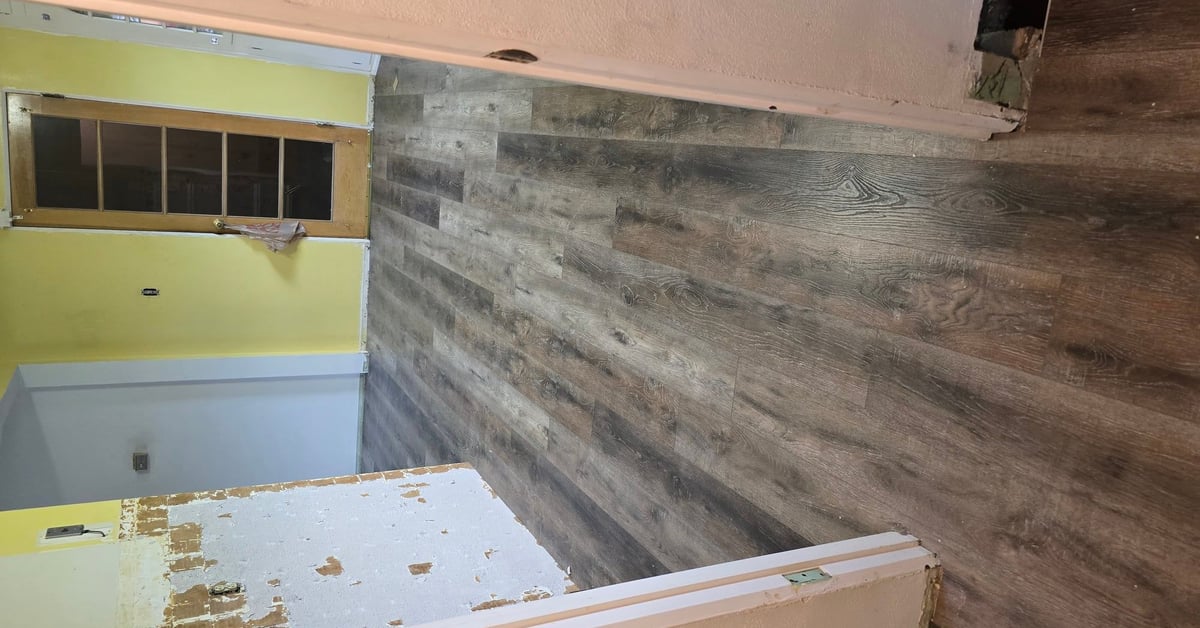
Basement Flooring Restoration Work in Progress
Overhead view into a basement area during renovation, featuring partially installed dark wood-grain laminate or vinyl plank flooring covering most of the floor space. Yellow painted drywall walls on both sides, an open wooden door with glass panels, a white bathtub or shower enclosure in the corner, exposed subfloor in patches, minor debris, and construction edges visible. Suggests water damage restoration with flooring replacement underway.
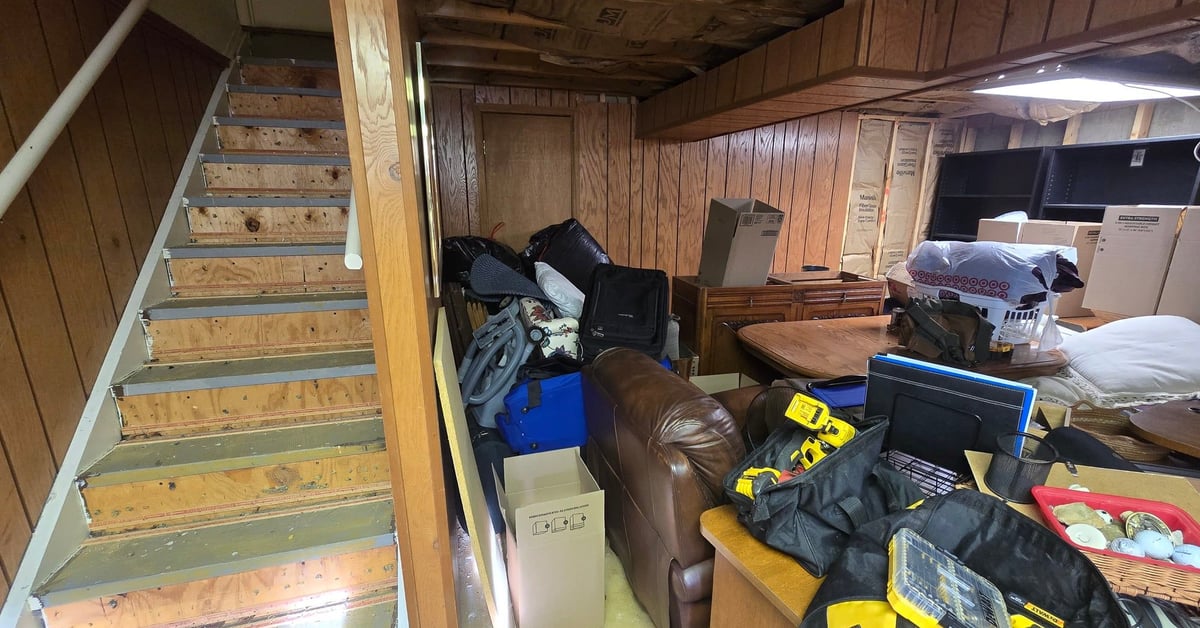
Cluttered Basement Before Restoration Work
A cluttered unfinished basement with wooden paneled walls, exposed wooden beams and pink insulation on the ceiling. A wooden staircase with railing descends from the left side. The floor space is filled with household items including a brown leather armchair, wooden desk cluttered with tools like a yellow drill and cases, multiple cardboard boxes, blue plastic bins, black garbage bags, pillows, baskets, and scattered debris. Fluorescent lighting illuminates the area, suggesting preparation for cleanup or restoration.
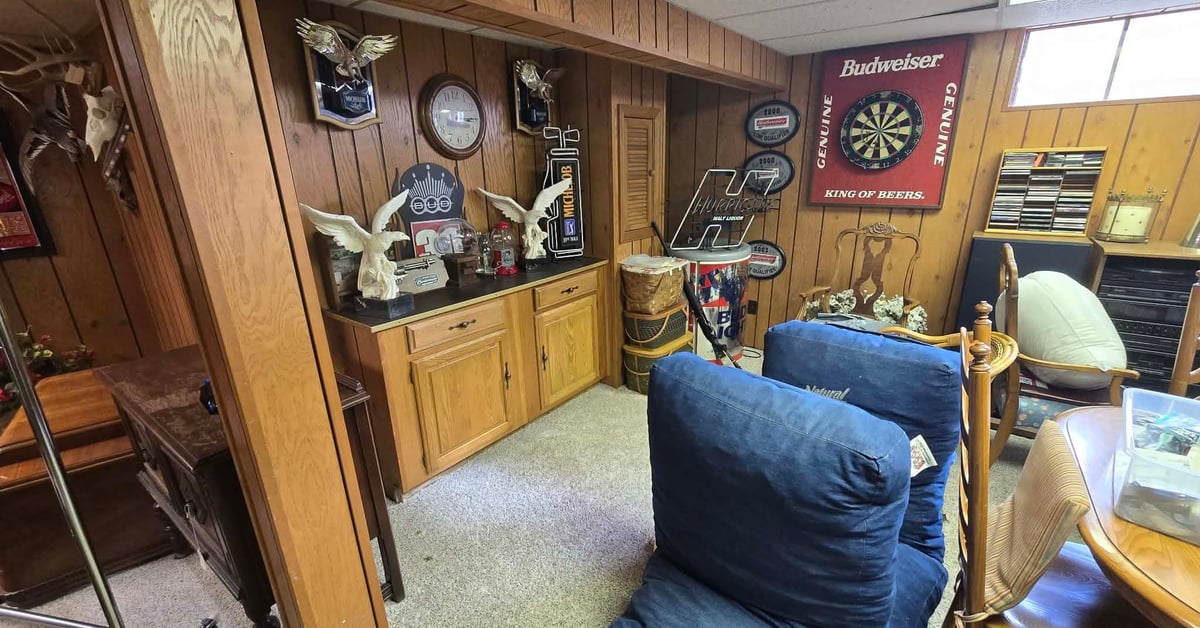
Cozy Wood-Paneled Basement Man Cave Bar
A finished basement recreation room with warm wood paneling on walls and ceiling. Features include mounted deer heads and antlers, Budweiser beer signs, dartboard, shelves displaying figurines, bottles, and collectibles, a bar area with stools, blue bean bag chairs, wooden table and chairs, and various rustic decor elements creating a classic man cave atmosphere.
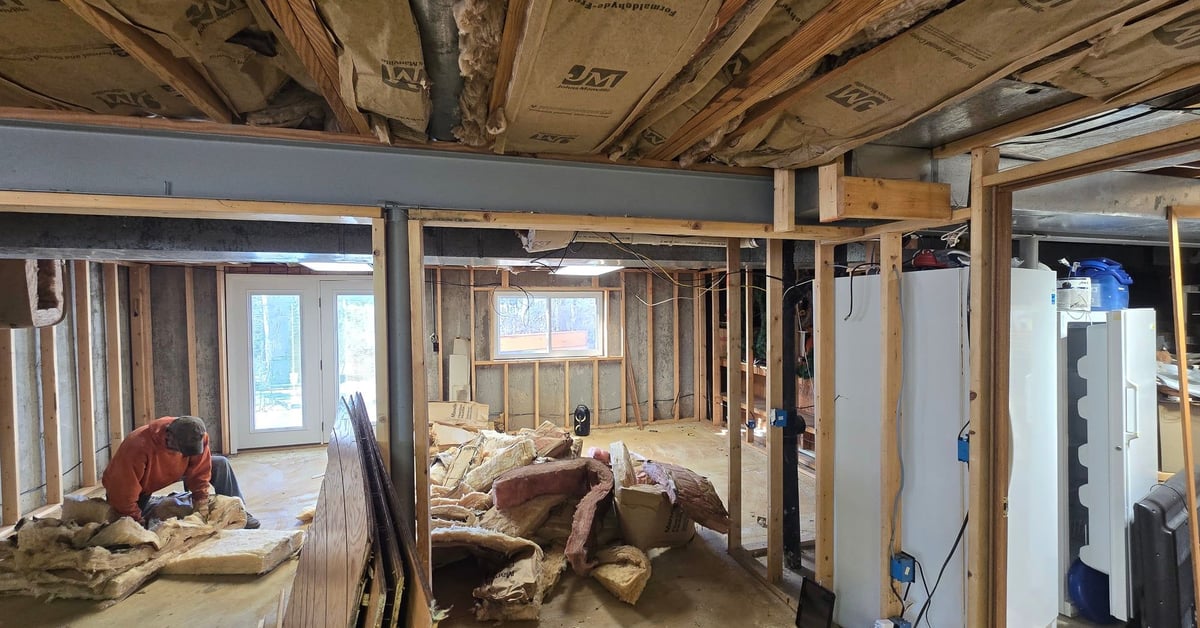
Worker Remodeling Basement with Framing and Insulation
In this basement renovation scene, a worker dressed in an orange uniform and protective gear kneels on the plywood subfloor, working on construction materials. The ceiling features exposed wooden joists wrapped in pink fiberglass insulation batts, some labeled. Walls are framed with wooden studs and metal beams, with partial drywall installation on some sections. Construction debris including wood scraps, insulation remnants, and tools litters the floor. Framed windows and doors allow natural daylight, and white cabinets or shelving units stand along one wall near blue storage bins.
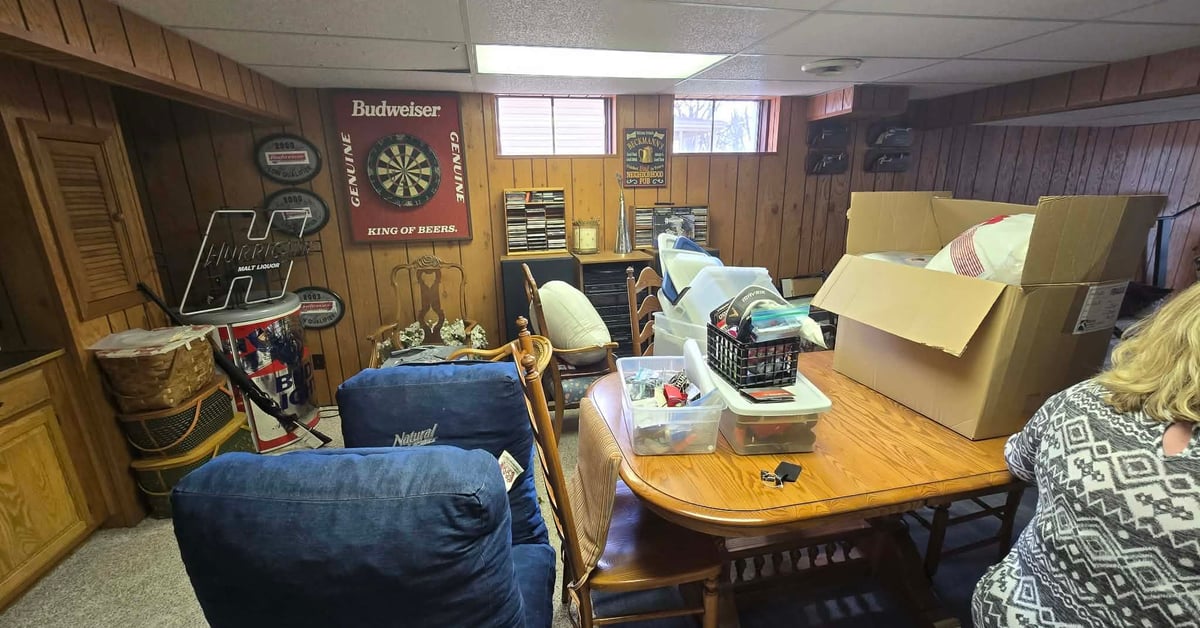
Cluttered Wood-Paneled Basement Rec Room
A basement recreation room with dark wood paneling on walls and ceiling, illuminated by fluorescent lights. Features include a dartboard with Budweiser branding, neon signs, shelves with beer memorabilia, wooden bar stools, blue upholstered armchairs, and an oval wooden table piled high with cardboard boxes, plastic storage bins, and miscellaneous items. A decorative barrel drum sits in one corner, and a woman with long blonde hair in a patterned top stands near the table. The space appears lived-in and cluttered, suggesting preparation for cleanup or restoration.
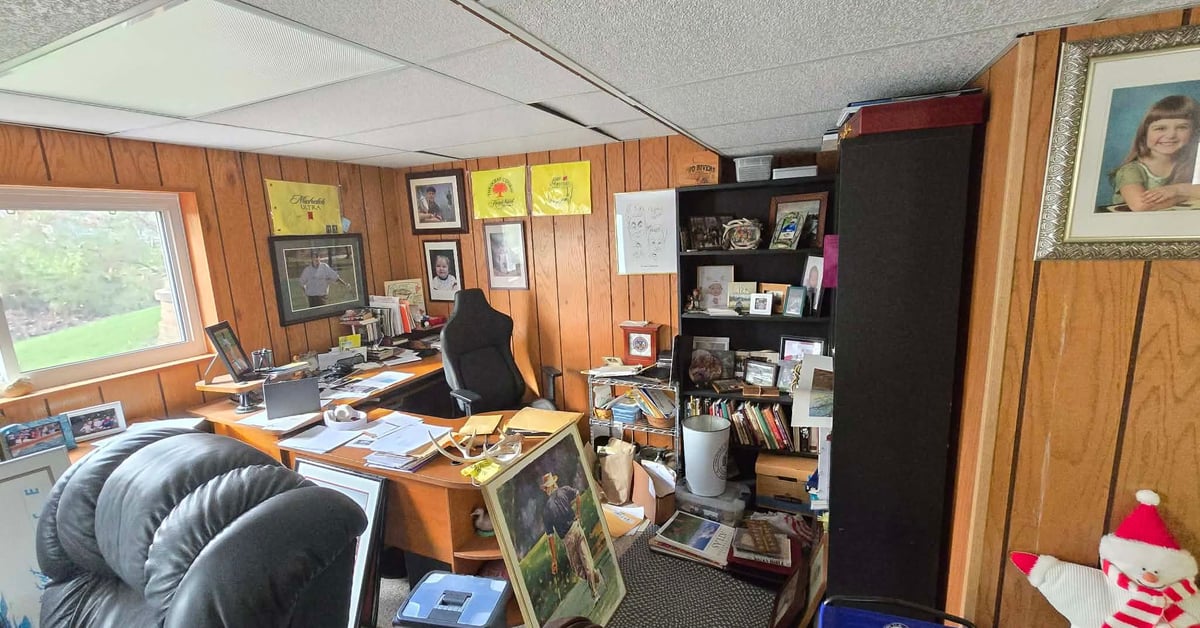
Cluttered Wood-Paneled Basement Home Office
A cluttered basement home office featuring wood-paneled walls, drop ceiling with fluorescent lighting, a large wooden desk with dual computer monitors, keyboard, papers, and office supplies, an ergonomic black gaming chair, additional leather chairs, overloaded bookshelves with books, photo frames, knick-knacks, and storage bins, framed pictures and posters on walls, a window with view of green grass outside, a Santa Claus plush doll, plants in frames, and various personal decorations scattered around the carpeted floor.
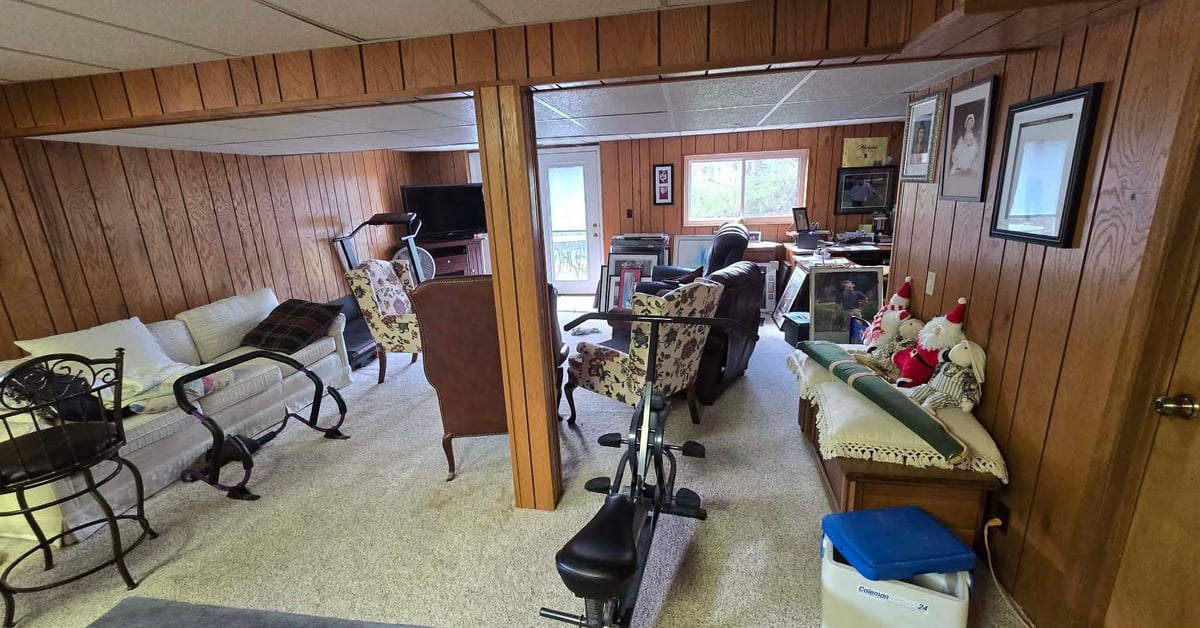
Cluttered Wood-Paneled Basement Living Area
A dimly lit basement room featuring dark wood-paneled walls and ceiling, with a gray carpeted floor. The space includes a large L-shaped couch with white cushions covered in blankets and pillows, several armchairs, a wooden bar stool, a stationary exercise bike, a TV mounted on a stand, framed pictures on the walls, a blue cooler, shelves with books and decorations, stuffed holiday animals on the floor, and an open doorway leading to another area. The room appears lived-in, disorganized, and cluttered with personal items.
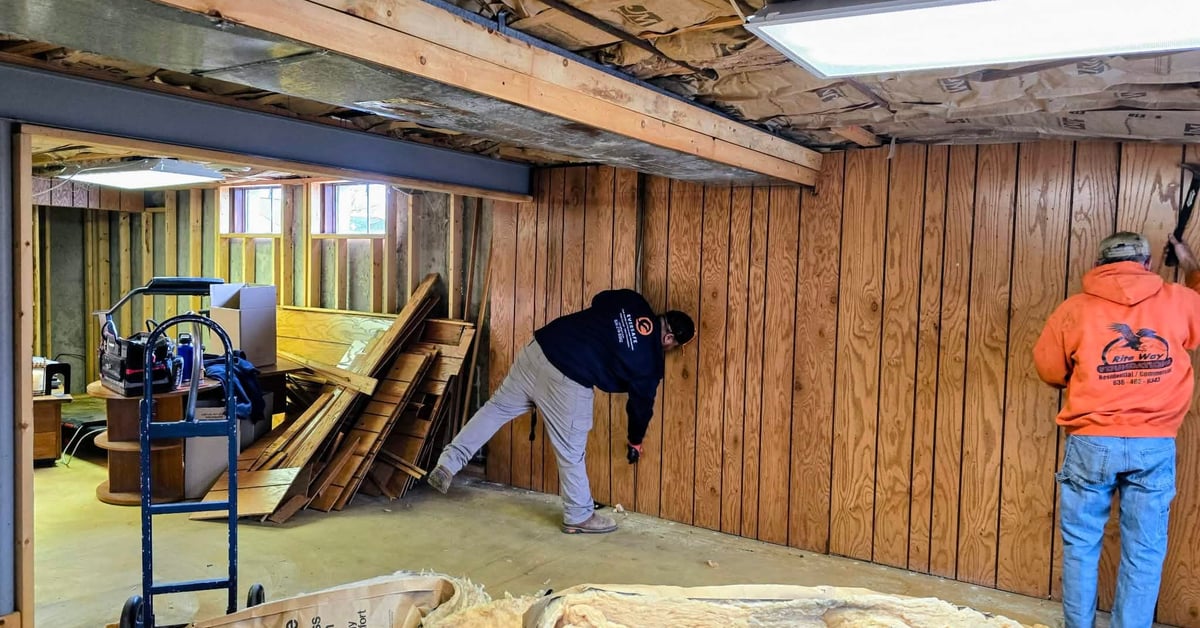
Workers Performing Basement Mold Remediation
In a dimly lit basement with wood-paneled walls partially removed, two workers from Eversafe Restoration LLC are actively engaged in remediation work. One technician, dressed in a blue hoodie, gray pants, and gloves, is crouched low, inspecting or removing sections of wood paneling and exposed pink fiberglass insulation from the wall. The other worker, wearing an orange hoodie and blue jeans, stands nearby observing. Scattered debris including wood scraps, insulation pieces, and plywood sheets lie on the concrete floor. Overhead, exposed wooden beams, yellow electrical wiring, and ductwork are visible under fluorescent lighting. This scene depicts ongoing mold remediation or water damage restoration efforts.
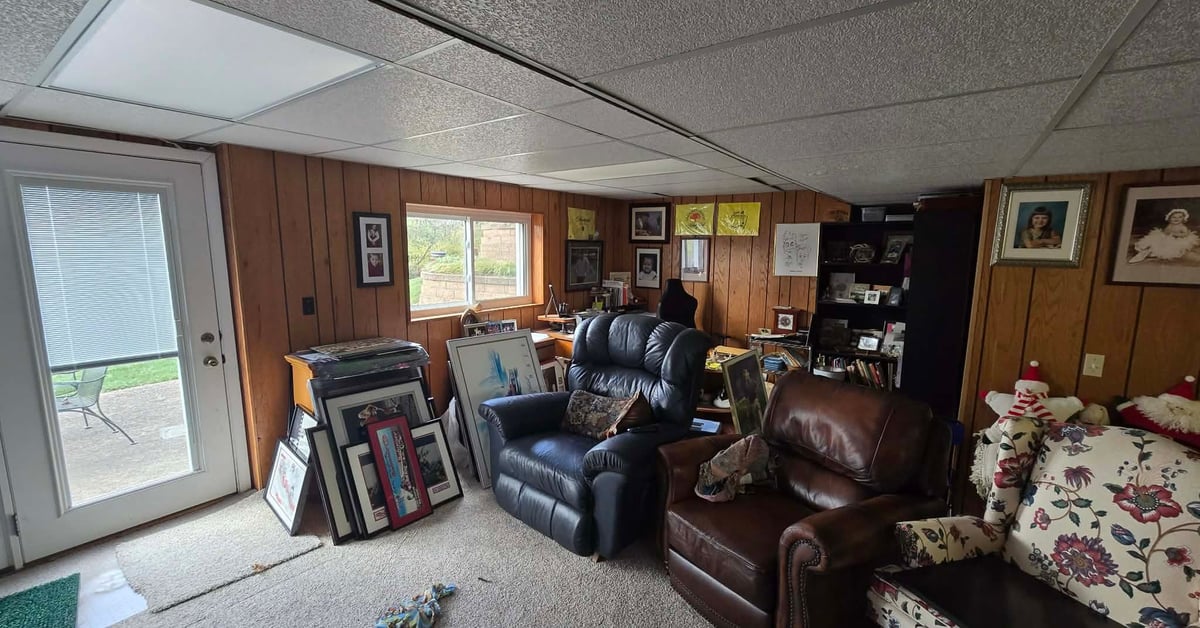
Cozy Basement Family Room with Recliners and Decor
A comfortably furnished basement living room featuring wood-paneled walls, a drop ceiling with fluorescent light panels, and beige carpeted flooring. Two black leather recliner chairs are positioned in the center, one occupied by a small dog. Surrounding furniture includes bookshelves stocked with books and decorative frames, multiple framed pictures and artwork on the walls, a side table with a lamp, scattered toys on the floor, and a glass door with blinds leading to an outdoor area. The room appears clean, organized, and inviting.
What Our Customers Say
St. Charles homeowners trust Eversafe Restoration for professional basement waterproofing and seepage repair.
"Chad fixed my mold. He explained to me exactly how the mold happened and why it would not happen again. He was very kind to me. I explained I was suffering from a medical level of anxiety and he was very understanding. Every day, Chad made sure to communicate clearly and keep me informed throughout the entire process."
Bob Gaines
3 months ago
"Eversafe Restoration was incredible to work with. We had unexpected water damage and Chad responded quickly and professionally. He explained everything clearly and made sure we understood the repair process. The crew was efficient and thorough. Highly recommend!"
Andrea Herron
6 months ago
"They took care in giving me the best service. Very detailed oriented in repairing and finishing moisture damage in my home. They did such an excellent job, I won't think twice about calling Eversafe for anymore restoration needs I have in the future!"
Ryan McGovern
6 months ago
"11/10 would recommend! Great job, great price, and it took them no time at all."
Corey Holmes
3 months ago
"Did a great job."
Matt Guthrie
6 months ago
"Excellent service from start to finish. Professional and reliable."
Destiny Boschert
6 months ago
Frequently Asked Questions About Hydrostatic Pressure
Get detailed answers to common questions about basement water intrusion, French drains, sump pumps, and waterproofing solutions.
What causes hydrostatic pressure in a basement?
Hydrostatic pressure in a basement is caused by groundwater accumulating in the soil surrounding your foundation and exerting force against the basement walls and floor. In the St. Charles and St. Louis metro area, several factors contribute to this problem. First, our region's clay-heavy soil retains water rather than allowing it to drain away quickly. During periods of heavy rain or snowmelt, this soil becomes oversaturated and the water has nowhere to go except against your foundation. Second, a high or fluctuating water table, common in areas near the Missouri River, Dardenne Creek, and other waterways, means groundwater levels naturally rise during wet seasons. Third, poor drainage around your home, including clogged gutters, downspouts that discharge too close to the foundation, or improperly graded landscaping that slopes toward the house rather than away from it, directs additional water into the soil around your basement. Finally, aging or damaged foundation drainage systems, like footer drains that have clogged with sediment or collapsed over decades, no longer carry water away from the foundation as designed. When these factors combine, especially during spring rains or rapid snowmelt, the pressure can become strong enough to force water through tiny cracks, the porous concrete itself, or the cove joint where the basement wall meets the floor.
How do you stop water from seeping through concrete basement floors?
The only reliable way to stop water from seeping through concrete basement floors is to address the underlying hydrostatic pressure rather than trying to seal the surface. This typically requires installing an interior drainage system, commonly called a French drain or perimeter drain, combined with a sump pump. The process involves cutting a channel around the perimeter of your basement floor, typically 12 to 18 inches from the foundation walls. A perforated drain pipe is laid in a bed of washed gravel below the slab level. This drain pipe collects groundwater before it can build up enough pressure to push through the floor and directs it to a sump pit. The sump pit houses a sump pump that automatically activates when water reaches a certain level, pumping it outside and away from your foundation. This system works by giving the water an easier path to follow than pushing through your floor. The water naturally flows into the drain system because it offers less resistance. Additional measures may include installing a vapor barrier on basement walls and, in severe cases, drilling weep holes through the lower portion of basement walls to relieve pressure behind the foundation. Surface sealants like waterproof paint or epoxy coatings are not effective solutions because they cannot withstand the thousands of pounds per square foot of pressure that groundwater can exert. The water will eventually find another path or push the coating off.
Is water coming up through the floor a foundation problem?
Water coming up through your basement floor is not necessarily a foundation structural problem initially, but it can become one if left unaddressed. The water itself is typically a drainage issue caused by hydrostatic pressure, not foundation failure. However, persistent water intrusion creates conditions that can lead to serious structural problems over time. When water repeatedly enters through the cove joint or floor cracks, it can erode the compacted gravel and soil sub-base beneath your concrete slab. This erosion creates voids under the floor that can eventually cause sections to crack, settle, or heave unevenly. The constant presence of moisture also promotes efflorescence, the white mineral deposits you see on concrete surfaces, which indicates that water is actively moving through the material and dissolving compounds as it goes. More critically, water intrusion often indicates that your foundation drainage system has failed. If footer drains are no longer functioning, the same pressure affecting your floor is also pushing against your foundation walls. Over months and years, this pressure can cause horizontal cracks in poured concrete walls or step-cracks and bowing in block foundations. Additionally, persistent moisture attracts termites and other wood-destroying insects, accelerates rust on any metal components (like support columns or beam brackets), and creates conditions for mold growth that can spread to the floor joists and subfloor above. Addressing water intrusion promptly prevents these secondary problems from developing.
Can I just seal my basement floor to stop the water?
No, sealing your basement floor will not stop water intrusion caused by hydrostatic pressure, and attempting this approach often makes the problem worse. Waterproof paint, epoxy coatings, and other surface sealants are designed for moisture management in generally dry basements, not for stopping active water intrusion. Here is why they fail. Hydrostatic pressure from groundwater can exert thousands of pounds of force per square foot against your basement floor. This pressure is far greater than the adhesive strength of any coating. When you seal the floor, you are essentially putting a lid on a pressure cooker. The water will continue building pressure until it finds another path, often pushing the coating off in bubbles or flakes, or forcing water through cracks in the walls, the cove joint, or even up through the floor drains. We regularly receive calls from homeowners in St. Charles County who have spent hundreds of dollars on waterproof paint only to see it peeling off within months or find that water has started appearing in new locations. The pressure must be relieved, not blocked. The only effective approach is to give the water somewhere else to go through a drainage system that collects and removes it before pressure builds. Surface sealants can be useful as a supplementary measure after proper drainage is installed, helping to reduce humidity and prevent minor moisture migration, but they are never a standalone solution for hydrostatic pressure.
What is a French drain system for a basement?
A French drain system for a basement, also called an interior perimeter drain or footer drain, is a below-floor drainage system designed to collect groundwater before it can enter your living space and direct it to a sump pump for removal. The system consists of several components working together. Installation begins with cutting and removing a strip of concrete floor around the perimeter of your basement, typically 12 to 18 inches from the foundation walls. A trench is excavated several inches below the original floor level. Clean, washed gravel is placed in the bottom of this trench to create a bed that allows water to flow freely. A perforated PVC pipe, typically 4 inches in diameter with holes or slots, is laid on top of the gravel bed with the perforations facing downward. More gravel is placed around and over the pipe, and then the trench is either covered with new concrete or fitted with a drainage board and concrete to restore the floor surface. The perforated pipe creates a low-pressure zone that groundwater naturally flows toward rather than pushing up through your floor. The pipe is sloped slightly toward a collection point, which is the sump pit. The sump pit is a basin, usually 18 to 24 inches in diameter and 24 to 30 inches deep, that holds a submersible sump pump. When water in the pit reaches a predetermined level, a float switch activates the pump, which pushes the water through a discharge pipe to the exterior of your home, typically extending several feet away from the foundation. This system works continuously and automatically, removing groundwater before it can cause problems.
How long does a basement seepage fix take?
A complete interior French drain and sump pump installation for a typical St. Charles area basement takes between 2 and 4 days, depending on the size of the basement, site conditions, and the extent of the drainage system required. Here is what to expect. Day one typically involves preparation, including protecting your belongings and flooring in work areas, cutting the concrete perimeter channel with a concrete saw, removing the concrete sections, and beginning excavation of the trench. This is the messiest and noisiest portion of the project. Day two continues with trench excavation, installing the gravel bed and perforated drain pipe, excavating and installing the sump pit, and setting the sump pump with its discharge line. If the basement is larger or requires more extensive drainage, this phase may extend into day three. The final day involves pouring new concrete to restore the floor surface, installing any wall drainage panels, and connecting the sump pump discharge to its exterior termination point. The new concrete needs at least 24 to 48 hours to cure before regular foot traffic, and we recommend keeping heavy items off the newly poured sections for about a week. Most homeowners find the disruption manageable. We typically work in sections, so you retain access to essential areas like laundry and HVAC equipment throughout the project. The noise from concrete cutting is significant but brief, usually completed within the first day. After installation, your basement should remain accessible during normal use while the system works automatically to manage groundwater.
Does insurance cover hydrostatic pressure damage?
Standard homeowners insurance typically does not cover damage caused by hydrostatic pressure or groundwater intrusion. This is one of the most common coverage gaps that surprises homeowners in the St. Charles and St. Louis area after experiencing basement water problems. Most homeowners policies specifically exclude groundwater, defined as water that enters your home from below ground level. This exclusion applies whether the water seeps gradually through the cove joint, comes up through floor cracks during heavy rain, or enters due to a rising water table. The insurance industry considers groundwater intrusion a maintenance issue or gradual deterioration rather than a sudden, accidental loss, which is what most policies are designed to cover. However, there are related coverages that may apply in certain situations. If your sump pump fails and causes water damage, you may be covered if you have a sump pump failure rider or endorsement on your policy. This is an optional add-on that many homeowners do not realize they need until after a loss. We strongly recommend contacting your insurance agent to add this coverage if you have a sump pump. For actual flooding from external sources like river overflow or storm surge, you need separate flood insurance through FEMA's National Flood Insurance Program. Standard homeowners policies exclude this type of flooding entirely. If hydrostatic pressure causes your foundation to crack or shift, resulting in structural damage, some policies may cover the resulting damage even if they would not cover the water intrusion itself. Each situation is different, so we recommend reviewing your specific policy with your agent and understanding what endorsements might be available to protect against these common risks in our region.
How much does a sump pit installation cost in St. Charles?
Sump pit and pump installation costs in the St. Charles area typically range from $1,200 to $3,500 for a complete system, depending on several factors. A basic installation involving a new sump pit with a standard submersible pump in a basement that does not currently have one runs between $1,200 and $1,800. This includes excavating the pit location, installing a quality liner or basin (typically 18 inches diameter by 24 inches deep), setting a 1/3 to 1/2 horsepower submersible pump with a mechanical float switch, and running the discharge line to exit through the foundation wall. More comprehensive installations that include a larger basin, a higher-capacity pump, battery backup systems, and exterior discharge lines that terminate further from the foundation range from $2,000 to $3,500. The type of pump significantly affects cost and reliability. Inexpensive pumps from hardware stores may cost under $200 but often fail within a few years. Professional-grade pumps with cast iron or stainless steel construction cost $300 to $500 but last 10 to 15 years or longer. Battery backup systems, which we strongly recommend in storm-prone Missouri where power outages coincide with heavy rain, add $500 to $1,000 to the project. Electrical work, if required, such as installing a dedicated circuit for the pump, adds to the cost but ensures the system operates reliably. When sump pit installation is part of a complete French drain system, the combined project typically ranges from $5,000 to $12,000 depending on basement size and complexity. We provide free assessments and detailed written estimates so you know exactly what to expect before work begins.
Still have questions?
We're here to help you find the answers.
Serving the Greater St. Louis Area Saint Charles
Located in Saint Charles for rapid response throughout St. Charles County and the St. Louis metro area.
Hours
Monday - Friday: 9am - 6pm
Saturday: 9am - 5pm
Sunday: Closed
Water Coming Up Through Your Basement Floor?
Do not waste money on waterproof paint that will fail. Our free assessment will identify exactly why your basement is wet and provide a permanent solution. Call today or request an estimate online.